How Tier-1 Automotive Suppliers Integrate Camera-Based Vitals
A research-based look at Tier 1 automotive camera vitals integration, including cabin camera architecture, software stacks, regulation, and the move toward contactless driver-state sensing.
How Tier-1 Automotive Suppliers Integrate Camera-Based Vitals
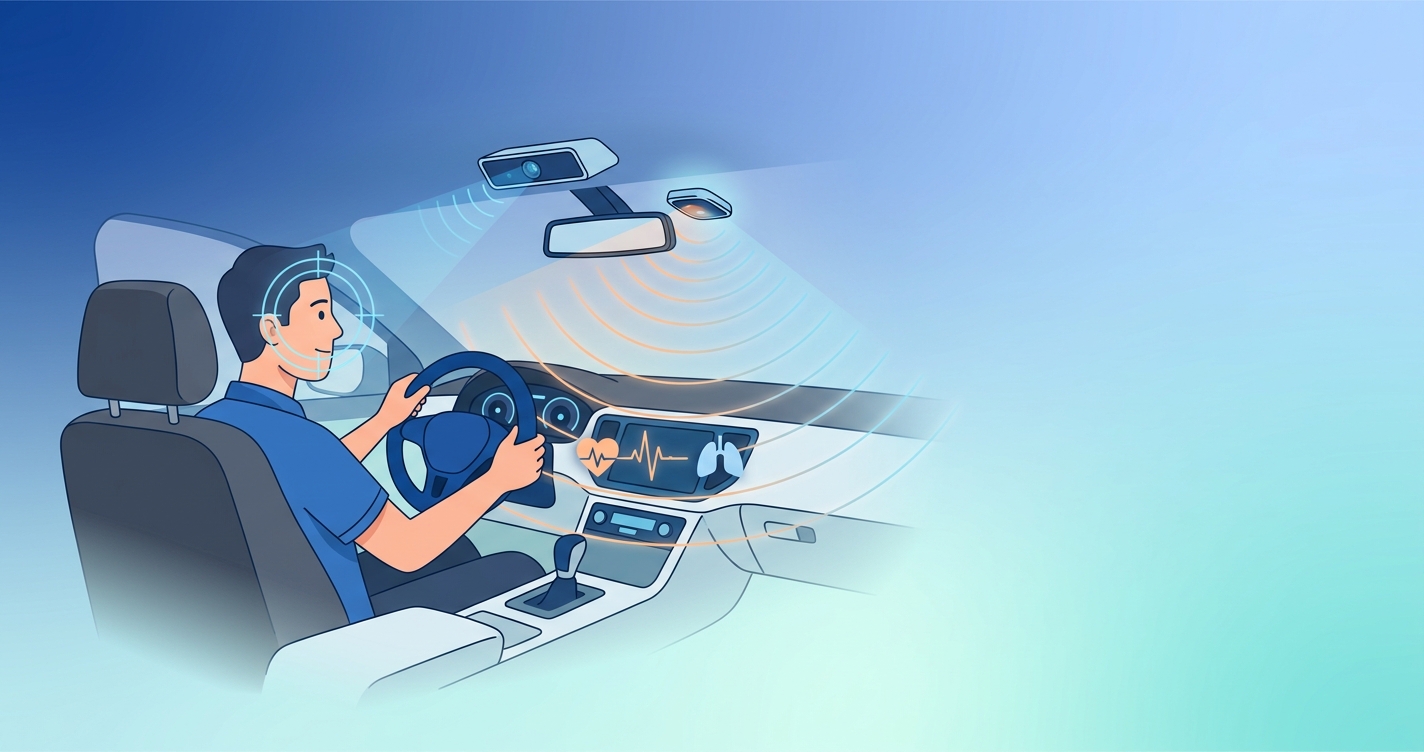
Tier 1 automotive camera vitals integration has moved from a speculative R&D topic to a packaging, compute, and compliance problem that real vehicle programs now have to solve. OEMs are asking suppliers for more than eye tracking and distraction alerts. They want cabin systems that can support drowsiness monitoring, occupant sensing, and eventually contactless signals tied to heart rate, respiration, or broader driver-state estimation. That shift is forcing Tier-1s to think less like component vendors and more like systems integrators: camera placement, near-infrared illumination, software fusion, ECU budgeting, privacy controls, and regulatory timing all have to fit inside one automotive program.
Walter W. Wierwille and L.A. Ellsworth at Virginia Tech helped establish PERCLOS as a validated operational measure of drowsiness in the 1990s. That matters because modern camera-vitals programs still start with the same basic reality: if the system cannot read the driver reliably, the rest of the stack does not matter.
Tier-1 Automotive Camera Vitals Integration: What actually gets integrated
The phrase sounds futuristic, but the integration work is pretty concrete. A Tier-1 supplier usually starts with an existing driver monitoring system camera pipeline, then asks what extra signals can ride on top of it without breaking cost, thermal limits, or homologation schedules.
In most programs, the stack includes:
- an RGB or near-infrared cabin camera, often mounted in the steering column, display, or mirror area
- active illumination so the face stays trackable at night and through changing ambient light
- embedded vision software for face detection, landmark tracking, gaze, blink timing, and head pose
- an ECU or domain controller budgeted for real-time inference
- software hooks into HMI, ADAS, safety logging, and vehicle networking
- optional fusion with radar, seat sensors, or occupant monitoring modules
What changes when vitals enter the picture is the signal-processing burden. Remote photoplethysmography, or rPPG, tries to recover pulse-related information from subtle facial color or reflectance changes. In a lab, that is already a delicate problem. In a moving vehicle, it gets worse: vibration, sunlight flicker, partial occlusion, sunglasses, cabin shadows, and driver motion all fight signal quality.
Comparison of common Tier-1 integration paths
| Integration path | Primary hardware | What it captures well | Main tradeoff | Typical program fit |
|---|---|---|---|---|
| Camera-only DMS | NIR or RGB cabin camera | Gaze, blink, head pose, PERCLOS, distraction | Vitals remain harder under motion and glare | Regulation-driven DMS launches |
| Camera + rPPG software layer | Cabin camera plus signal extraction software | Driver-state plus heart-rate trends in stable conditions | Needs stronger motion and illumination compensation | Premium cabins and innovation programs |
| Camera + radar fusion | Cabin camera plus in-cabin radar | Better robustness for occupancy, breathing, and partial occlusion | Higher BOM and integration complexity | Multi-function interior sensing platforms |
| Mirror-integrated camera module | Camera packaged into interior mirror | Clean field of view, easier packaging | Mirror location may constrain some cabin use cases | Fast-scaling OEM deployments |
| Display-integrated / behind-display sensing | Hidden camera architecture | Better interior design, invisible packaging | Optical constraints and calibration complexity | Higher-end cockpit platforms |
That table gets to the practical question. Tier-1s rarely integrate camera-based vitals as a standalone feature. They integrate it as an extension of a broader interior sensing platform.
Why Tier-1 suppliers are structuring the stack this way
Regulation is one reason. Regulation is not the only reason, but it is the cleanest forcing function.
Regulation (EU) 2019/2144 made driver drowsiness and attention warning, along with distraction-related safety requirements, part of the European type-approval environment for new vehicles. Euro NCAP's 2026 roadmap pushes the market further by assigning more weight to direct driver and occupant monitoring, including real-time eye and head tracking and more capable in-cabin sensing logic.
That combination changes supplier behavior. If a Tier-1 already has to ship an in-cabin camera for compliance and safety-scoring reasons, the next question becomes obvious: what additional value can the same optical stack deliver?
A 2025 Magna release makes the supplier angle explicit. Magna said its integrated interior sensing systems combine cameras, radar, and software to monitor driver attentiveness, seat occupancy, seatbelt use, and even vital-sign-related conditions, and that the systems were adopted or in production for five OEM programs across North America, Europe, and Asia. That is the story in miniature. Tier-1s are no longer treating driver monitoring, occupant sensing, and wellness-related detection as separate boxes if they can avoid it.
Where the research base is pushing supplier roadmaps
The research literature is useful here because it explains why suppliers are interested in vitals even though the deployment environment is messy.
First, there is the established drowsiness foundation. Wierwille and Ellsworth's Virginia Tech work on PERCLOS gave the field a durable baseline for fatigue measurement. Camera systems could already see something safety-relevant before adding any pulse-derived analytics.
Second, the rPPG literature broadened what a camera might do. The 2023 review Remote Photoplethysmography for Driver Monitoring: A Review argued that contactless physiological monitoring could extend driver-state sensing beyond gaze and eyelid features, while also making clear that vehicle motion, lighting variation, and skin-tone robustness remain open engineering challenges.
Third, newer datasets are trying to close the automotive realism gap. Research highlighted in the PhysDrive dataset work describes multimodal in-vehicle physiological measurement with synchronized RGB, near-infrared, and radar data. That matters to suppliers because production programs need automotive-specific training and validation data, not desktop-webcam assumptions.
Put plainly, Tier-1s are chasing camera-based vitals because the sensing stack is already headed into the cabin anyway. The open question is how much physiological inference stays reliable once you leave the lab and start dealing with real drivers, real glare, and real motion.
Industry applications across the supply chain
Passenger-vehicle OEM programs
For passenger vehicles, the first commercial use case is still driver monitoring tied to drowsiness, distraction, and handoff readiness. Vitals features tend to enter as adjacent capability rather than the headline feature. Suppliers pitch a camera platform that can support today's compliance targets and tomorrow's richer driver-state models.
Tier-1 platform consolidation
This may be the most important shift. Tier-1s want one interior sensing architecture that can be tuned across platforms instead of bespoke point solutions for every OEM. That means shared camera modules, reusable perception software, common calibration flows, and clearer upgrade paths for additional sensing features.
Fleet and commercial vehicles
Commercial programs care less about cabin design aesthetics and more about operational usefulness. If a camera stack can support fatigue detection, stress-related signals, and event review in one package, fleet buyers pay attention. Our earlier analysis of fleet driver health monitoring systems covers that operator mindset, and our review of driver stress monitoring for long-haul trucking shows why physiological data is appealing when hours-of-service data still leaves blind spots.
Occupant and child-presence extensions
The boundary between driver monitoring and interior monitoring keeps getting thinner. Magna's recent interior-sensing messaging and Continental's work on in-cabin biometric monitoring both point toward the same market logic: once the supplier owns a robust cabin-sensing stack, it can support multiple safety and personalization functions from the same architecture.
Current Research and Evidence
A few sources shape the field more than most.
- Walter W. Wierwille and L.A. Ellsworth, Virginia Tech: their PERCLOS work remains foundational because it showed that camera-observed eyelid closure could track drowsiness in an operationally useful way.
- Regulation (EU) 2019/2144: this is not a research paper, but it matters as much as one. It changed the commercial timeline by making direct driver-attention technologies harder to postpone.
- Euro NCAP 2026 Roadmap: Euro NCAP is pushing in-cabin safety toward richer driver and occupant monitoring, which increases pressure on suppliers to build systems that do more than basic distraction alerts.
- 2023 rPPG review in Electronics: the review is useful because it treats contactless physiology as promising but not magically solved. That is exactly how automotive engineers tend to think about it.
- PhysDrive multimodal dataset work: automotive-specific datasets are becoming more important because generic video-based physiology models often break when moved into real cabins.
The evidence from supplier announcements lines up with the research direction. Magna has emphasized integrated camera-plus-radar interior sensing. Continental has shown in-cabin biometric monitoring concepts that place sensing invisibly behind the dashboard display. FORVIA and Smart Eye have pushed DMS-camera-based biometric use cases as well. Different suppliers emphasize different form factors, but they are all moving toward multi-function interior sensing rather than isolated driver cameras.
The integration problems Tier-1s still have to solve
This is where the glossy slides usually get less helpful.
Tier-1 automotive camera vitals integration sounds elegant until you look at the edge cases:
- sunlight moves across the face and wrecks optical consistency
- steering-wheel position changes facial visibility
- glasses and hats reduce eye and skin-region quality
- compute budgets are shared with other cockpit functions
- privacy and data-governance expectations differ by region
- false positives can make drivers ignore the system entirely
That is why most suppliers are careful. They talk about attentiveness, occupancy, and physiological sensing potential, but they structure releases around integrated sensing systems rather than making narrow promises about clinical-grade vital signs in every drive condition.
The Future of Tier-1 automotive camera vitals integration
The near future looks more like layered systems than miracle sensors.
Expect Tier-1s to keep moving in four directions:
- more shared hardware so one cabin camera stack supports DMS, OMS, and selected physiology features
- more sensor fusion with radar and other interior signals to stabilize detection under occlusion and motion
- more edge processing because OEMs want lower latency and tighter privacy control
- more software-defined upgrades so an OEM can launch with compliance-focused monitoring and expand features later
That is the real Tier-1 playbook. Get the camera into production for a requirement the OEM already has, then build a path for broader interior sensing on top of it.
Frequently Asked Questions
What does Tier-1 automotive camera vitals integration actually mean?
It usually means adding physiological-signal estimation and broader driver-state analytics to an existing in-cabin camera platform. The integration covers hardware placement, illumination, embedded software, ECU compute, validation, and links to the vehicle safety stack.
Are Tier-1 suppliers deploying camera-based vitals as standalone products?
Usually no. Most programs package vitals-related sensing as part of a broader interior sensing or driver monitoring architecture rather than as a separate module.
Why are Tier-1s interested in rPPG inside the cabin?
Because it offers a contactless way to estimate pulse-related signals from the face using the same cabin camera already needed for driver monitoring. The appeal is efficiency. The challenge is automotive robustness.
What is pushing adoption fastest: research or regulation?
Regulation is pushing deployment faster. Research is shaping feature roadmaps. EU safety rules and Euro NCAP scoring create the commercial deadline, while rPPG and multimodal sensing research define what suppliers may add next.
Will camera-based vitals replace standard driver monitoring metrics like PERCLOS?
No. They are more likely to sit on top of established metrics such as gaze, blink duration, and eyelid closure. Suppliers treat physiology as an added layer, not a full replacement.
Why do suppliers pair cameras with radar for interior sensing?
Because radar can improve robustness for breathing, occupancy, and partially occluded scenarios where optical sensing alone struggles. Fusion also helps suppliers support more cabin functions from one platform.
For teams evaluating cabin-sensing architectures, solutions like Circadify's automotive cabin programs are aimed at the same practical problem: turning contactless sensing research into vehicle-ready modules that fit real hardware, software, and validation constraints.