Driver Stress Monitoring for Long-Haul Trucking: How It Works
Research-level analysis of driver stress monitoring for long-haul trucking, including camera-based sensing, HRV trends, fatigue overlap, and how fleets use physiological data to reduce crash risk.
Driver Stress Monitoring for Long-Haul Trucking: How It Works
Long-haul trucking has always been framed as a fatigue problem, but that is only part of the story. Stress builds earlier and in messier ways: time pressure, night driving, congestion, missed breaks, paperwork, weather, and the cognitive load of handling an 80,000-pound vehicle for hours at a time. That is why driver stress monitoring for long-haul trucking is becoming a distinct category inside fleet safety systems. The goal is not to guess whether a driver feels overwhelmed. It is to measure the physiological signals that usually show up before performance drops, then tie those signals to practical interventions inside the cab and inside the fleet operations stack.
"Fatigue is not a behavioral problem. It is a physiological one." That line keeps surfacing in driver-monitoring research, and it captures why fleets are moving toward direct sensing instead of waiting for lane drift or hard braking.
Driver Stress Monitoring for Long-Haul Trucking: Core Analysis
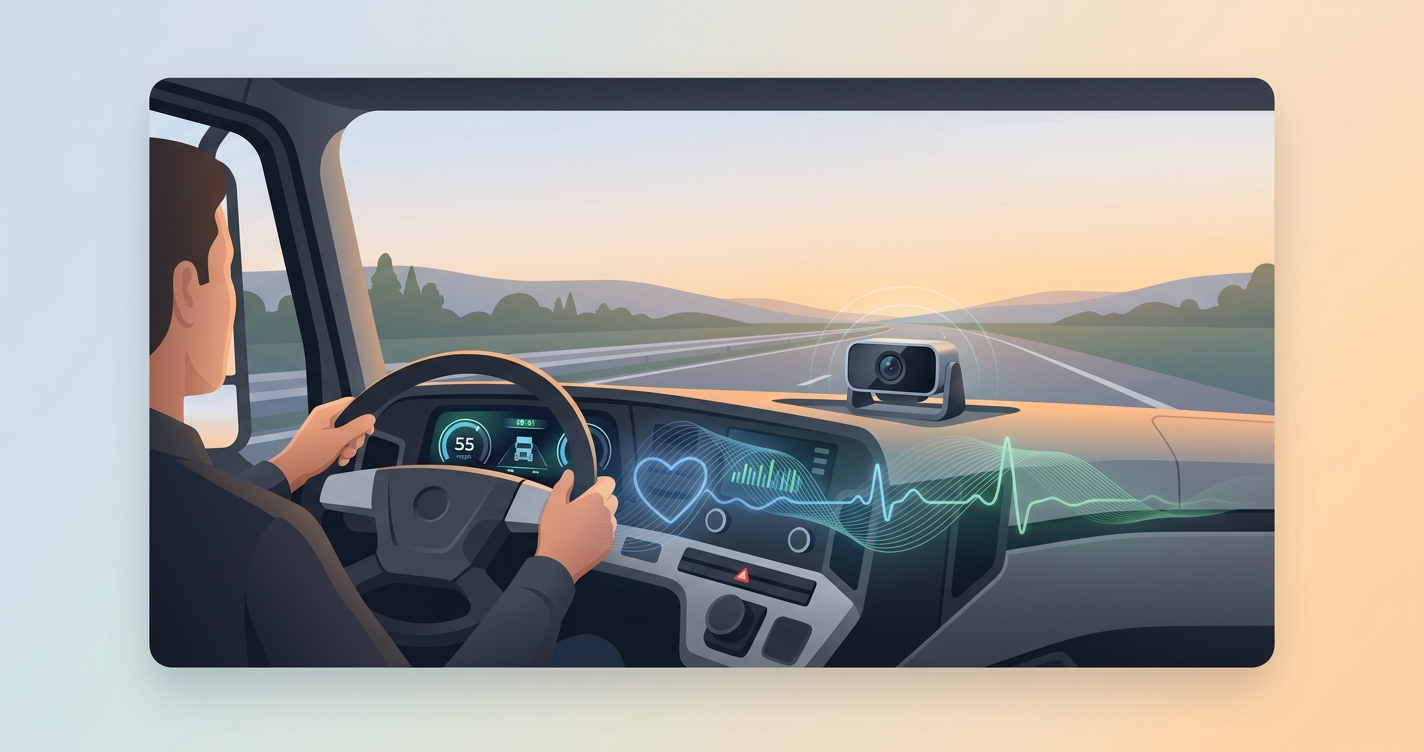
Stress monitoring in commercial vehicles usually combines two layers. The first layer is behavioral sensing: eye closure, blink duration, gaze direction, head pose, and facial tension from an in-cabin camera. The second is physiological inference: heart rate, heart rate variability, respiratory rhythm, and sometimes stress scoring derived from remote photoplethysmography (rPPG), radar, or other contactless signals.
That distinction matters. A driver can still be holding lane position while their autonomic nervous system is already shifting into a strained state. In practice, fleets want earlier warning than a steering correction pattern can provide.
The research base points in the same direction. The FMCSA Large Truck Crash Causation Study linked fatigue to 13% of large-truck crashes. Separately, a 2023 systematic review on occupational stress and heart rate variability in long-haul truck drivers found that higher work stress was consistently associated with lower parasympathetic activity and less favorable HRV patterns. In plain English, chronic strain leaves measurable fingerprints before the situation turns into visible impairment.
Comparison of stress monitoring approaches in commercial fleets
| Approach | What it measures | Strengths | Limits | Best use in trucking |
|---|---|---|---|---|
| Camera-based DMS | Blink duration, PERCLOS, gaze, head pose, facial behavior | Mature, scalable, works with existing DMS hardware | Stress is inferred indirectly unless fused with physiology | Baseline monitoring across large fleets |
| Camera + rPPG | Behavioral signals plus heart rate and HRV trends from facial video | Contactless, uses the same cabin camera stack, useful for early stress detection | Motion and lighting compensation still matter | Long-haul cabs with stable NIR illumination |
| 60 GHz in-cabin radar | Respiration, micro-motion, heart-rate trends | Works in darkness and partial occlusion | Higher integration complexity and cost | Higher-end safety architectures |
| Wearables | HRV, skin conductance, sleep, pulse | Strong physiological signal quality | Driver compliance is poor over time | Short pilots and controlled programs |
| ELD/telematics inference | Hours driven, route timing, braking, speeding | Already deployed at fleet scale | Measures exposure, not actual stress state | Operational context, not primary stress detection |
The strongest production path today is not one sensor replacing everything else. It is fusion. Camera systems remain the operational backbone because they are already central to driver monitoring. Physiological signals add value when fleets want earlier detection, fewer false negatives, and a cleaner way to separate simple distraction from true overload.
Why stress matters before fatigue becomes obvious
Long-haul driving compresses several risk factors into the same shift. Work from the National Institute for Occupational Safety and Health has shown that U.S. long-haul drivers face high rates of sleep problems, obesity, hypertension, and limited access to preventive care. That health backdrop changes how quickly routine driving pressure turns into meaningful impairment.
Researchers studying real-road HRV patterns have repeatedly found that stressful driving situations shift autonomic balance in measurable ways. A 2021 study on ultra-short-term HRV analysis under real-world driving conditions reported that machine-learning models could detect binary driver stress states with 85.3% accuracy using three-minute HRV windows. That is the kind of result fleet engineers pay attention to, because three minutes is short enough to be operationally useful.
Older drowsiness research still matters here. John Wierwille and Larry Ellsworth, working through Virginia Tech's transportation human-factors research, helped establish PERCLOS as a reliable alertness marker in the 1990s. What stress monitoring adds is the earlier part of the chain. Before prolonged eye closure, there is often a physiological shift: rising heart rate, worsening HRV, irregular breathing, narrowed gaze behavior, and less stable visual scanning.
A practical system therefore watches for overlap among several categories:
- sustained blink-duration increases
- reduced HRV or worsening HRV trend
- narrowed gaze distribution during high-demand segments
- respiration changes during congestion or time pressure
- repeated exposure to high-risk contexts such as night driving, dense traffic, or extended time-on-task
None of these signals should operate alone. Fleets get the best value when they are stacked into a confidence score rather than treated as single-event alarms.
Long-haul trucking applications
In-cab real-time warning
The first application is the obvious one: an in-cab warning when the system sees rising stress or a stress-plus-fatigue combination. But the better systems do not jump straight to a loud alert. They escalate. A mild state may trigger a subtle prompt or recommend a break at the next safe stop. A higher-confidence event may trigger audible feedback, seat vibration, or dispatch notification.
Dispatch and safety operations
Stress monitoring also changes what happens outside the cab. If several drivers show elevated physiological strain on the same lane, route segment, or shift window, the fleet has learned something operationally useful. The problem may not be the driver. It may be the schedule.
This is where physiological monitoring becomes more than a gadget. It becomes an operations dataset.
Duty-of-care and incident review
Commercial fleets increasingly need defensible records around safety management. A contactless monitoring stack can show whether the fleet had active safeguards in place, whether a driver received warnings, and whether repeated stress events clustered around specific routes or dispatch patterns. That is useful for internal safety review long before it becomes useful in an insurance or legal context.
Current Research and Evidence
Several research threads are shaping how fleets think about stress monitoring in trucking.
First, the long-haul trucking health literature is hard to ignore. NIOSH-led health surveys have shown that long-haul drivers face elevated cardiometabolic risk, poor sleep quality, and irregular access to care. Those factors do not just affect long-term health. They change next-shift safety.
Second, the HRV and occupational stress literature has become more specific. The 2023 systematic review on long-haul truck drivers concluded that occupational stress is consistently associated with lower HRV, especially markers tied to parasympathetic recovery. That makes HRV one of the most practical physiological features for stress monitoring programs, particularly when the goal is trend detection rather than one-time diagnosis.
Third, the real-world driver-stress modeling work is maturing. The ultra-short-term HRV study mentioned earlier is important because it focuses on windows short enough for deployment logic. If a model needs twenty minutes of stable data, it is hard to use inside a moving truck. Three-minute windows are much more realistic.
Fourth, the camera and rPPG literature keeps improving the contactless piece. Ming-Zher Poh's early work at the MIT Media Lab and later studies by Daniel McDuff and collaborators helped show that facial video can recover pulse signals without requiring a wearable. In trucking, that matters because wearables often fail for ordinary reasons: drivers stop charging them, stop pairing them, or stop wanting them.
Two posts already on this site cover adjacent pieces of the same system. Our analysis of fleet driver health monitoring systems looks at how dispatch teams use these signals operationally, and our review of in-cabin vital signs and road safety explains why contactless physiology is becoming part of the cabin safety stack at all.
The Future of stress monitoring in freight operations
The near future probably belongs to multi-signal stress models, not single-metric dashboards. Fleets want systems that combine route context, time-on-task, camera behavior, physiology, and prior events into one interpretable risk state.
That will likely push the market in three directions.
- More sensor fusion: camera, rPPG, and radar working together instead of competing.
- More personalized baselines: a driver compared against their own typical HRV and visual behavior, not a generic threshold.
- More operations integration: alerts feeding dispatch logic, rest planning, and safety scorecards instead of living in a stand-alone device UI.
There is still real engineering work to do. Motion artifacts, sunglasses, cabin vibration, skin-tone robustness, and alert fatigue all matter. But the broad direction is clear. The industry is moving away from indirect guesswork and toward direct measurement of driver state.
Frequently Asked Questions
What does driver stress monitoring actually detect in a long-haul truck?
Most systems detect a mix of behavioral and physiological changes. That includes blink duration, eyelid closure, gaze stability, head pose, heart-rate trends, heart rate variability, and respiration patterns. The exact signal set depends on whether the truck uses camera-only sensing or a fused setup with radar or another modality.
Is stress monitoring the same thing as fatigue monitoring?
No. Fatigue monitoring usually focuses on later-stage signs such as prolonged eye closure, microsleep risk, or degraded alertness. Stress monitoring looks earlier in the chain, when workload and physiological strain are rising but the driver may still appear functional.
Why not just use electronic logging devices and hours-of-service data?
ELDs tell fleets how long a driver has been on duty. They do not tell fleets how the driver is doing right now. Two drivers with the same logged hours can have very different physiological states depending on sleep quality, health status, route difficulty, and circadian timing.
Are wearables better than contactless systems?
Wearables often provide cleaner raw physiology, but long-haul fleets usually struggle with compliance. Contactless systems are easier to deploy because they work in the background and do not ask drivers to wear, charge, or manage another device.
Can a camera really estimate stress without touching the driver?
A camera cannot read stress like a mind-reading device. What it can do is measure visible and physiological proxies tied to stress, such as blink behavior, gaze changes, pulse-derived trends, and breathing-related motion. Used together, those signals can support a useful operational stress score.
Will fleets use this only for alerts, or for planning too?
Planning too. The more interesting use case is not the single in-cab alert. It is the aggregate view across routes, shifts, and terminals. That is where fleets can change schedules, break policy, and safety operations based on what the physiological data is showing.
A lot of this category is still moving from pilot language into production language. That is usually a good sign. If you are evaluating how contactless stress and vital-sign sensing could fit into a commercial vehicle platform, Circadify's automotive program work is a useful next stop: circadify.com/custom-builds/automotive-cabin.