How Public Transit Systems Monitor Driver Wellness in Real Time
A research-focused look at public transit driver wellness monitoring, from fatigue risk management to real-time in-cabin sensing for stress, drowsiness, and medical-event response.
How Public Transit Systems Monitor Driver Wellness in Real Time
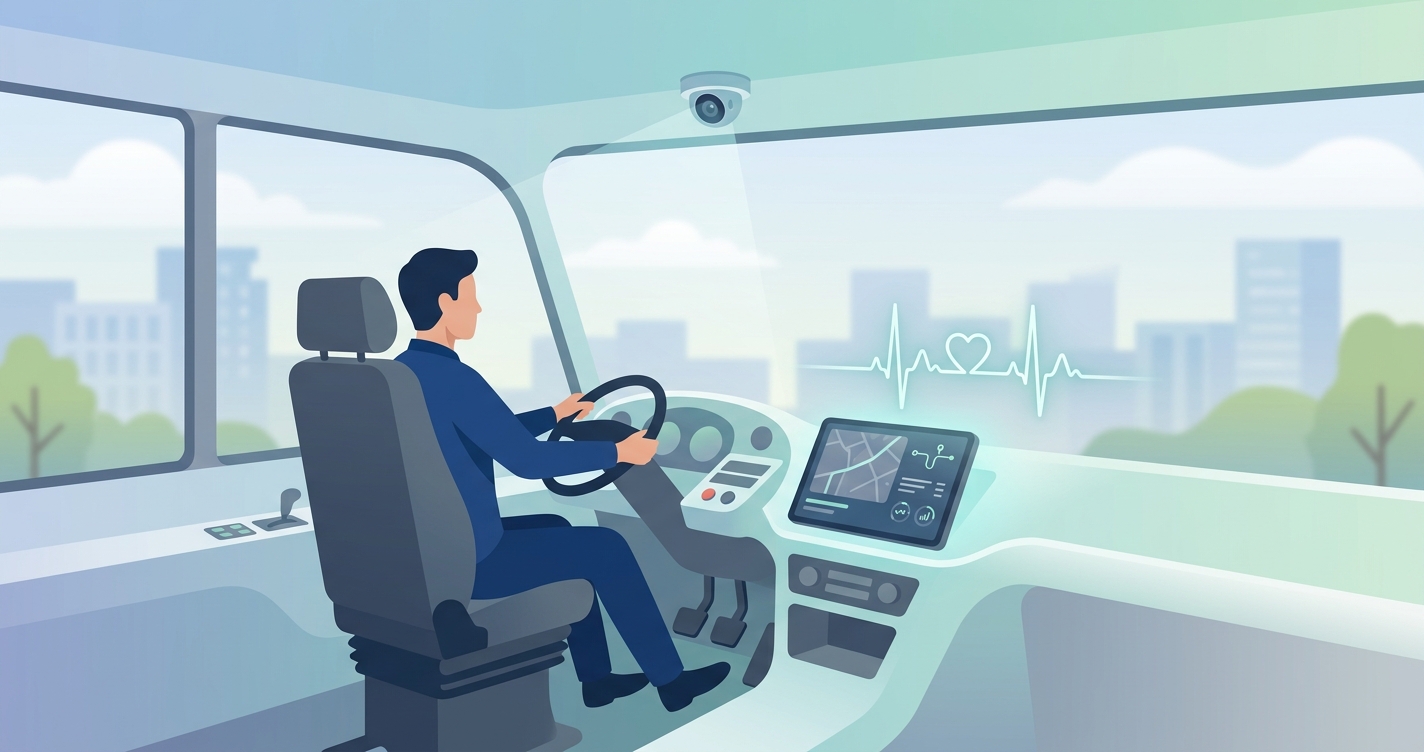
Public agencies have started to treat public transit driver wellness monitoring as an operating question, not just a safety slogan. That shift makes sense. A bus operator can carry dozens of passengers through dense city traffic, work split shifts, manage unpredictable dwell times, and absorb constant cognitive load. When fatigue, stress, or a medical event shows up in that environment, the risk is immediate. So the transit market is moving toward a layered model: scheduling controls, fatigue risk management, supervisor workflows, and increasingly, real-time in-cabin sensing that can spot trouble before it turns into an incident.
"Being awake for 17 hours is similar to having a blood alcohol concentration of 0.05 percent, and 24 hours awake is akin to 0.10 percent." — Federal Transit Administration fatigue resources, drawing on NIOSH and sleep research
Public transit driver wellness monitoring is moving from policy to live operations
For years, most transit wellness efforts were built around hours, breaks, and post-incident review. Those still matter, but agencies now have better reason to add real-time monitoring.
The Federal Transit Administration says overtime, extended shifts, and insufficient sleep are tied to worse health, higher injury rates, and more fatigue-related risk. In its recent fatigue materials, the FTA also noted 133 safety events since 2014 in which worker fatigue was identified as a contributing factor. That is one reason transit agencies are being pushed toward formal fatigue risk management systems rather than relying on self-reporting alone.
The National Transportation Safety Board has been making the same point from the accident side. Its 2019 forum on transit fatigue framed the problem as systemic: scheduling, sleep disorders, reporting culture, and monitoring all shape operator readiness. In other words, wellness monitoring is no longer just about catching a driver who is already nodding off. It is about identifying risk early enough for dispatch or operations teams to do something useful.
What agencies are actually monitoring
| Monitoring layer | What it looks for | Typical data source | Why transit agencies use it |
|---|---|---|---|
| Fatigue risk management | Hours worked, split shifts, overtime, circadian disruption | Scheduling and duty logs | Flags structural fatigue risk before a shift begins |
| Behavioral driver monitoring | Eye closure, gaze direction, head pose, distraction | In-cabin camera | Detects drowsiness and distraction while the route is active |
| Physiological monitoring | Heart rate, respiratory rate, HRV trends, stress proxies | Camera-based rPPG, wearables, seat or wheel sensors | Adds an earlier signal before behavior fully breaks down |
| Dispatch and supervisor response | Alert escalation, route relief, wellness checks | Fleet software and control center workflows | Turns sensor data into operational action |
| Post-event review | Near misses, braking events, incident timelines | Telematics plus monitoring logs | Helps refine thresholds and staffing policies |
The important point is that agencies rarely depend on one signal. Real systems combine administrative and in-cabin inputs because each catches a different part of the problem.
Why physiology matters in transit fleets
The research case for physiology is getting stronger. Ke Lu, Anna Sjors Dahlman, Johan Karlsson, and Stefan Candefjord at Chalmers University of Technology reviewed 18 driver-fatigue studies in 2022 and found that heart-rate-variability-based fatigue systems reported accuracy levels ranging from 44% to 100%, depending on design and validation method. That range is wide, which tells you the field is not plug-and-play. Still, the review reached a useful conclusion: HRV is one of the most promising objective markers for fatigue detection because it reflects changes in autonomic nervous system activity before obvious driving errors appear.
That matters for transit because visible drowsiness is often a late-stage signal. By the time a driver shows prolonged eye closure or lane instability, the system has already missed earlier warning signs.
A second thread comes from bus-specific fatigue research. Li-Tien Hsu and co-authors, working with teams at National Tsing Hua University and Ming Chi University of Technology in Taiwan, reviewed wearable-sensor approaches for bus-driver fatigue in 2023. Their conclusion was straightforward: physiological signals such as ECG, PPG, and related fatigue markers are becoming practical enough for field use, especially when paired with machine learning models. The attraction is not novelty. It is continuity. Physiological monitoring can run throughout the shift instead of waiting for a clear behavioral failure.
How real-time monitoring works inside a transit vehicle
Transit agencies have mostly settled on a layered architecture.
- First, scheduling and duty systems identify operators with elevated fatigue exposure.
- Second, in-cabin cameras watch for distraction, gaze drift, blink behavior, and signs of drowsiness.
- Third, some programs add physiology, either through camera-based remote photoplethysmography, a wearable pilot, or other cabin sensors.
- Fourth, alerts move into dispatch workflows so the system can trigger a relief driver, mandatory break, or supervisor call.
That last step is where many programs succeed or fail. Sensor data without an operations response plan is just expensive video.
Comparison of common transit monitoring approaches
| Approach | Best use in public transit | Strengths | Practical limits |
|---|---|---|---|
| Camera-only DMS | Distracted driving and visible drowsiness | Uses hardware many fleets already deploy | Often reacts after fatigue becomes behaviorally obvious |
| Wearable fatigue monitoring | Pilot programs and high-risk routes | Strong physiological data and continuous HRV capture | Compliance, charging, and union acceptance can be difficult |
| Camera-based rPPG | Contactless heart-rate and stress trend estimation | No wearable burden and fits in-cabin workflows | Motion, lighting, and occlusion still need careful engineering |
| Multi-sensor fusion | Large fleets and premium safety programs | Better resilience across route conditions | Harder integration and validation burden |
| Scheduling-only controls | Baseline compliance and staffing policy | Easy to implement at the enterprise level | Cannot see what is happening mid-route |
Industry applications in public transit
Urban bus networks
Dense city routes create a mix of stop-and-go stress, pedestrian conflict, and timetable pressure. For those systems, real-time wellness monitoring is usually about distraction, rising cognitive load, and early fatigue detection during long service blocks.
Bus rapid transit and long corridor routes
Longer corridor service creates a different risk profile. The operator may face less route complexity minute to minute, but monotony and accumulated fatigue rise. That is where physiology-based monitoring can make more sense, because reduced HRV and related stress signatures may show up before the driver's behavior gets obviously worse.
Paratransit and specialty fleets
These services often involve higher passenger interaction, irregular schedules, and route variability. Wellness monitoring here is less about one universal threshold and more about anomaly detection: is the operator responding like they usually do, or is something off today?
Control centers and safety departments
The biggest operational change may be at the control-center level. Agencies are trying to move from passive review to real-time intervention. A wellness alert can trigger dispatch outreach, route reassignment, or a medical check rather than waiting for a complaint or collision report.
Current research and evidence
The science behind these systems is broader than transit alone, but several findings map well to bus operations.
Ke Lu's Chalmers review is useful because it shows why transit agencies should not think of fatigue as a purely visual problem. HRV reflects stress and fatigue load in a measurable way, even if implementation quality still varies across studies.
Li-Tien Hsu's 2023 review matters because it narrows the question to bus drivers and wearable sensing. That literature suggests the industry is getting closer to operational tools that can work across full shifts, not just in controlled simulator settings.
There is also a human-factors side. Shaina Murphy, Bryce Grame, Ethan Smith, Siva Srinivasan, and Eakta Jain reported in a 2024 study on transit drivers' views of eye-tracking technology that operators saw genuine safety value in monitoring systems, but also worried about surveillance, fairness, and how data could be used against them. That is a big operational lesson. Transit agencies need governance, not just sensors. If drivers think monitoring is punitive, adoption will stall.
The public-sector guidance points the same way. FTA fatigue materials frame the issue as part of agency safety management, not just hardware procurement. The NTSB's transit fatigue work does too. Technology helps, but only when it fits scheduling policy, health reporting, and response procedures.
The future of public transit driver wellness monitoring
The next phase will probably look less like a single fatigue alarm and more like a driver state model.
Systems are starting to combine schedule exposure, route conditions, visual attention cues, and physiology. Over time, that should make alerts more useful. A driver coming off a split shift on a hot afternoon route may need a different threshold than a driver on a short downtown circulator. Transit agencies have plenty of data. The challenge is turning that data into something operators trust and dispatchers can act on.
That is also where contactless sensing has an advantage. Agencies want better wellness visibility, but they do not want to hand every driver another device to charge, wear, or forget. Solutions built around in-cabin cameras and edge processing fit the transit environment more naturally, especially when they are tied to existing safety workflows.
Frequently asked questions
What does public transit driver wellness monitoring usually include?
Most programs combine fatigue policy, scheduling analysis, in-cabin driver monitoring, and some form of alert workflow for dispatch or supervisors. The more advanced versions also include physiological sensing.
Are transit agencies only looking for drowsiness?
No. Drowsiness is the most obvious use case, but agencies also care about distraction, stress overload, and sudden medical issues that can affect safe vehicle operation.
Why add physiological monitoring if cameras already track behavior?
Because physiology can surface risk earlier. A change in HRV or heart-rate pattern may appear before a driver shows prolonged eye closure or other visible signs.
What is the hardest part of deploying these systems?
Usually not the model itself. The hard part is governance: privacy rules, labor acceptance, escalation workflows, and deciding what happens when the system flags a driver mid-shift.
Transit agencies are under pressure to make safety systems more proactive without making operations more brittle. That is why solutions like Circadify's automotive cabin sensing work are relevant to this market: they point toward contactless, in-cabin monitoring that can fit real vehicles and real dispatch environments. For adjacent context, see our earlier posts on how fleet operators use driver health monitoring systems and how drowsiness detection systems read vital signs.