How Drowsiness Detection Systems Read Vital Signs
A research-based look at how drowsiness detection systems read vital signs using cameras, PERCLOS, and physiological signals to improve fleet and automotive safety.
How Drowsiness Detection Systems Read Vital Signs
For fleet safety teams, the hard part is not recognizing that fatigue is dangerous. The hard part is catching it early enough to matter. That is why interest in drowsiness detection systems vital signs has moved well beyond academic labs and into commercial vehicle programs, in-cabin sensing stacks, and automotive safety roadmaps. The field has shifted from watching only steering behavior or lane drift to watching the driver directly: eyelids, gaze, head pose, blink patterns, and, more recently, heart-rate and breathing signals pulled from contactless cameras.
"PERCLOS reflects slow eyelid closures rather than blinks" and emerged as one of the strongest real-time measures of driver alertness in the landmark NHTSA-backed work by W.W. Wierwille and L.A. Ellsworth.
How drowsiness detection systems read vital signs in the cabin
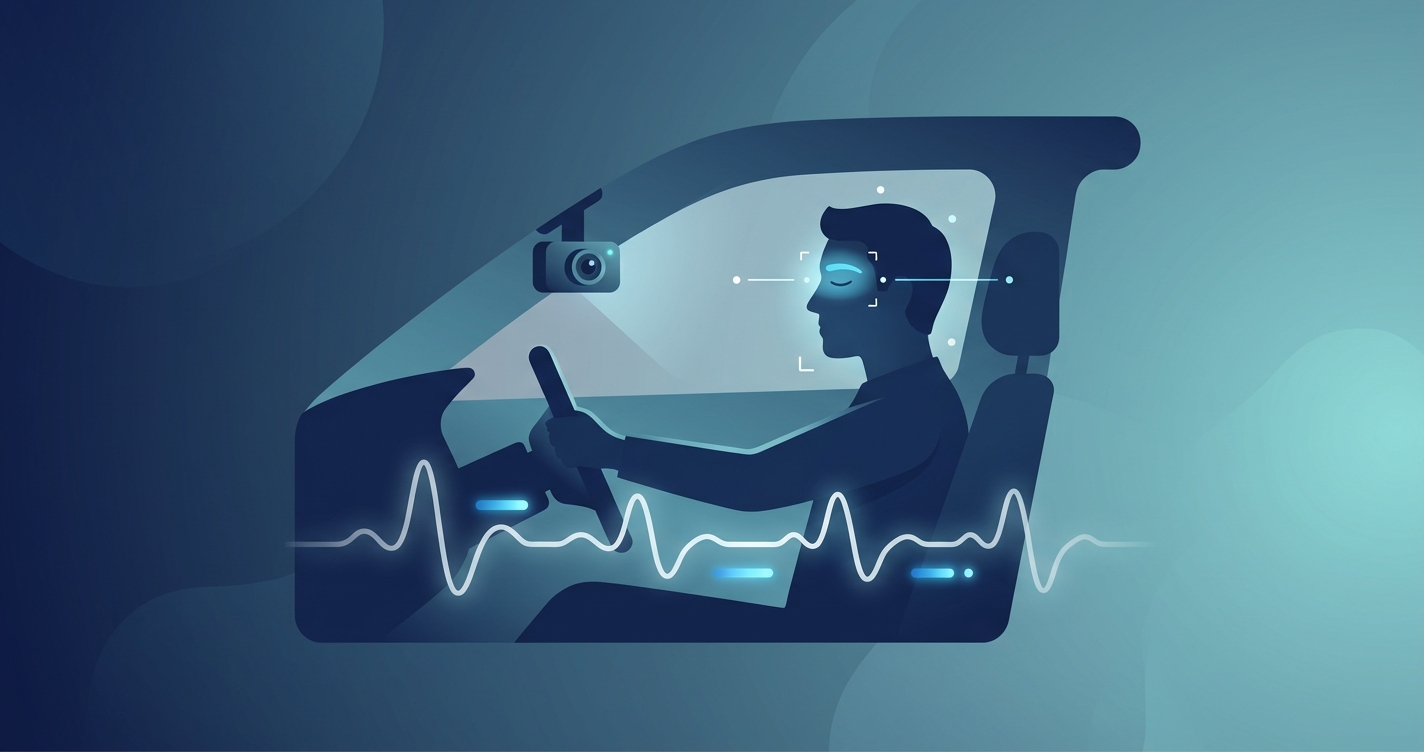
Most production systems still begin with what a camera can see most reliably: the face and eyes. A near-infrared cabin camera tracks eyelid opening, blink duration, gaze direction, and head position frame by frame. From there, software estimates whether the driver is alert, visually distracted, or drifting toward microsleep.
The best-known measure is PERCLOS, short for percentage of eyelid closure over time. Wierwille and Ellsworth's 1994 driver-status study for NHTSA made PERCLOS central to fatigue detection because it tracked alertness better than many competing measures. That work still shows up in modern system design.
What has changed is the second layer. Newer systems try to read physiological signals that sit underneath visible behavior:
- Heart rate trends derived from facial blood-flow changes
- Respiratory rhythm inferred from subtle upper-body or facial motion
- Heart-rate variability patterns associated with rising fatigue or stress
- Combined behavioral and physiological signals, rather than eye metrics alone
That matters in long-haul trucking because fatigue does not appear all at once. Blink timing changes first. Gaze narrows. Head stability degrades. Physiological regulation shifts too. A system that reads several of those changes together has a better chance of flagging trouble before the vehicle starts wandering.
What different sensing approaches actually capture
| Method | What it reads | Strengths | Weak spots | Best fit |
|---|---|---|---|---|
| PERCLOS and blink tracking | Eyelid closure, blink duration | Well validated, easy to explain, works in real time | Can weaken with occlusion or sunglasses | Core drowsiness scoring |
| Gaze and head-pose tracking | Off-road glances, nodding, posture drift | Good for distraction and fatigue together | Needs stable facial visibility | Passenger cars and fleets |
| rPPG camera analysis | Heart rate, pulse-related facial color changes | Contactless vital-sign layer without wearables | Motion and lighting remain hard in vehicles | Advanced in-cabin monitoring |
| Respiration estimation | Breathing rhythm from chest/facial motion | Adds context during fatigue onset | Sensitive to seat position and vibration | Research and premium systems |
| Wearables | Pulse, HRV, skin data | Strong physiological signal | Low adoption, charging and compliance issues | Closed fleet pilots |
| Steering/lane behavior | Vehicle movement patterns | Cheap and familiar | Detects late-stage impairment, not early physiology | Supplementary only |
Why long-haul operators care about vital signs, not just eye closure
The trucking use case is blunt. Drivers spend long periods in monotonous conditions, often at night, often under schedule pressure. The FMCSA and NHTSA Large Truck Crash Causation Study found fatigue in 13% of at-fault large-truck crashes, with inattention close behind. Hours-of-service rules help, but they do not tell you whether a driver is alert at 3:40 a.m. on the seventh hour of a night run.
That gap explains the move toward direct observation. A driver can still be within policy and physiologically fading. Camera-based systems can catch the early signs:
- Longer blink duration
- More time with eyelids partly or mostly closed
- Reduced gaze scanning
- Head dips and unstable posture
- Stress and fatigue signatures in pulse-related signals
A 2022 review by Y. Albadawi, M. Takruri, and M. Awad in Sensors made the same point from a research angle: classic drowsiness systems often relied on intrusive vital-sign sensors, while newer machine-learning systems are trying to pull more information from outward cues and non-contact sensing. In other words, the field is moving toward practical physiological monitoring that drivers do not have to wear.
Where vital signs fit in a modern drowsiness stack
Vital signs rarely replace eye tracking. They make it more useful.
A reasonable way to think about the stack is in layers:
- Behavioral layer: eyelids, blink timing, gaze, yawning, head pose
- Physiological layer: pulse wave, heart-rate trend, breathing pattern, stress markers
- Context layer: time of day, trip duration, road monotony, prior alerts
- Response layer: escalation logic for visual, audio, haptic, or fleet-manager alerts
That layered design is showing up because each signal fails differently. Eye tracking is mature, but sunglasses, poor seating position, and hand occlusion can degrade it. Physiological sensing is promising, but automotive cabins are full of motion artifact, vibration, and changing light. Put the signals together and the system gets less brittle.
Industry applications for drowsiness detection systems that read vital signs
Long-haul trucking fleets
This is the clearest near-term fit. Fleets want earlier fatigue detection, fewer severe events, and data they can route into safety operations. Vital-sign-aware systems can help sort a truly deteriorating driver state from a single bad blink sequence.
Premium passenger vehicles
OEMs are under pressure to make driver monitoring more direct and more dependable as assisted-driving functions spread. Euro NCAP's 2026 protocols raise the bar by putting much more weight on direct driver observation, including eye and head tracking, and by tying top scores to systems that stay active by default.
Mining, transit, and heavy equipment
The same fatigue logic carries over to vehicles with long shifts and high consequence of error. The hardware needs hardening, but the sensing priorities are familiar: detect drowsiness sooner, reduce nuisance alerts, and log usable safety data.
Level 2+ and Level 3 handoff scenarios
As vehicles take on more driving tasks, fatigue detection becomes part of fallback readiness. A system needs to know whether the driver is actually available to retake control, not merely sitting in the seat.
Current research and evidence
Three threads matter most in the literature.
First, the foundational eye-metric work still holds up. Wierwille and Ellsworth's NHTSA-backed research made PERCLOS a reference point because it correlated strongly with loss of alertness in controlled testing. That is old research now, but it is old in the way seatbelts are old: basic, proven, and still built into current systems.
Second, the research community is trying to turn contactless vital signs into something that works in motion. A recent benchmark study on deep-learning rPPG models for automotive applications used the MR-NIRP Car dataset to compare algorithms under real in-vehicle conditions. The takeaway was encouraging but not magical. Neural models can estimate heart and respiration signals in a vehicle, but cabin motion and lighting still make the problem hard.
Third, review papers keep pointing toward multimodal fusion. The 2022 Sensors review on driver drowsiness detection argued that no single signal solves the whole problem. Eye closure alone is useful. Physiological data alone is useful. Combined systems are better aligned with what fatigue actually looks like in the real world: gradual, messy, and different from one driver to the next.
That is probably the most honest description of the field. Nobody has found one perfect fatigue marker. What the best systems do instead is combine imperfect markers and weight them intelligently.
What makes cabin vital-sign sensing difficult
This part gets overlooked in vendor-heavy marketing. Reading pulse or breathing in a moving vehicle is not the same as doing it in a lab.
The biggest engineering problems are straightforward:
- Vehicle vibration contaminates subtle motion signals
- Changing sunlight wrecks consistency for optical sensing
- Skin-tone variation and camera placement affect signal quality
- Glasses, hats, and posture shifts can block the face
- False positives create driver annoyance and program backlash
So the real design question is not whether vital signs can be read in a cabin. They can. The question is how reliably they can be read across real fleets, real weather, and real driver behavior.
The future of drowsiness detection systems vital signs
The next phase looks less like a standalone fatigue camera and more like a driver-state engine.
That engine will likely combine near-infrared facial imaging, rPPG-derived pulse features, respiration estimates, and context from the trip itself. It will also need stronger on-edge processing, because fleet operators and OEMs do not want every cabin video stream leaving the vehicle just to score fatigue.
There is also a practical shift underway. Safety buyers do not just want an alert. They want a system that can answer a few operational questions:
- Was this driver showing early fatigue or severe drowsiness?
- Was the event persistent or just a brief anomaly?
- Did the driver recover after intervention?
- Which routes, shifts, or times of day create the highest fatigue burden?
That is where vital signs become useful. They add another layer of evidence. In a good system, that extra evidence makes alerts earlier, calmer, and easier to trust.
If you have been following related work on this site, our earlier looks at camera-based driver monitoring and driver fatigue detection camera technology show the same pattern: the industry keeps moving away from indirect guesses and toward direct measurement of driver state.
Frequently asked questions
Do drowsiness detection systems really read vital signs, or just eyes?
Most deployed systems still rely primarily on eyes, gaze, and head pose. More advanced systems add contactless physiological measures such as heart-rate or respiration estimates from camera data. The trend is toward combining both.
Is PERCLOS still important if a system can estimate heart rate?
Yes. PERCLOS remains one of the most validated drowsiness measures in the field. Heart-rate or rPPG signals are better understood as an added layer that can improve confidence, not a replacement for eyelid metrics.
Why not just use a wearable for driver fatigue monitoring?
Wearables can capture strong physiological signals, but compliance is a real problem in fleets. Drivers may not want to wear them consistently, charge them, or pair them with vehicle systems. Contactless sensing avoids that friction.
Are vital-sign-based drowsiness systems ready for every fleet today?
Not fully. The research is moving fast, and some automotive-grade implementations are emerging, but motion, lighting, and integration complexity still matter. For many programs, the strongest near-term approach is a fused system that pairs mature eye tracking with carefully validated physiological sensing.
A lot of this market is still sorting out what belongs in the production stack and what belongs in the demo. For teams building the next generation of in-cabin monitoring, that distinction matters. If you are evaluating how contactless driver-state sensing could fit into an automotive platform, Circadify's automotive program work is a useful next stop: circadify.com/custom-builds/automotive-cabin.