Can my car really tell if I'm too tired to drive safely?
A research-based look at whether a car can detect tired driver safely, using cameras, behavioral signals, and the latest driver-monitoring evidence.
Can my car really tell if I'm too tired to drive safely?
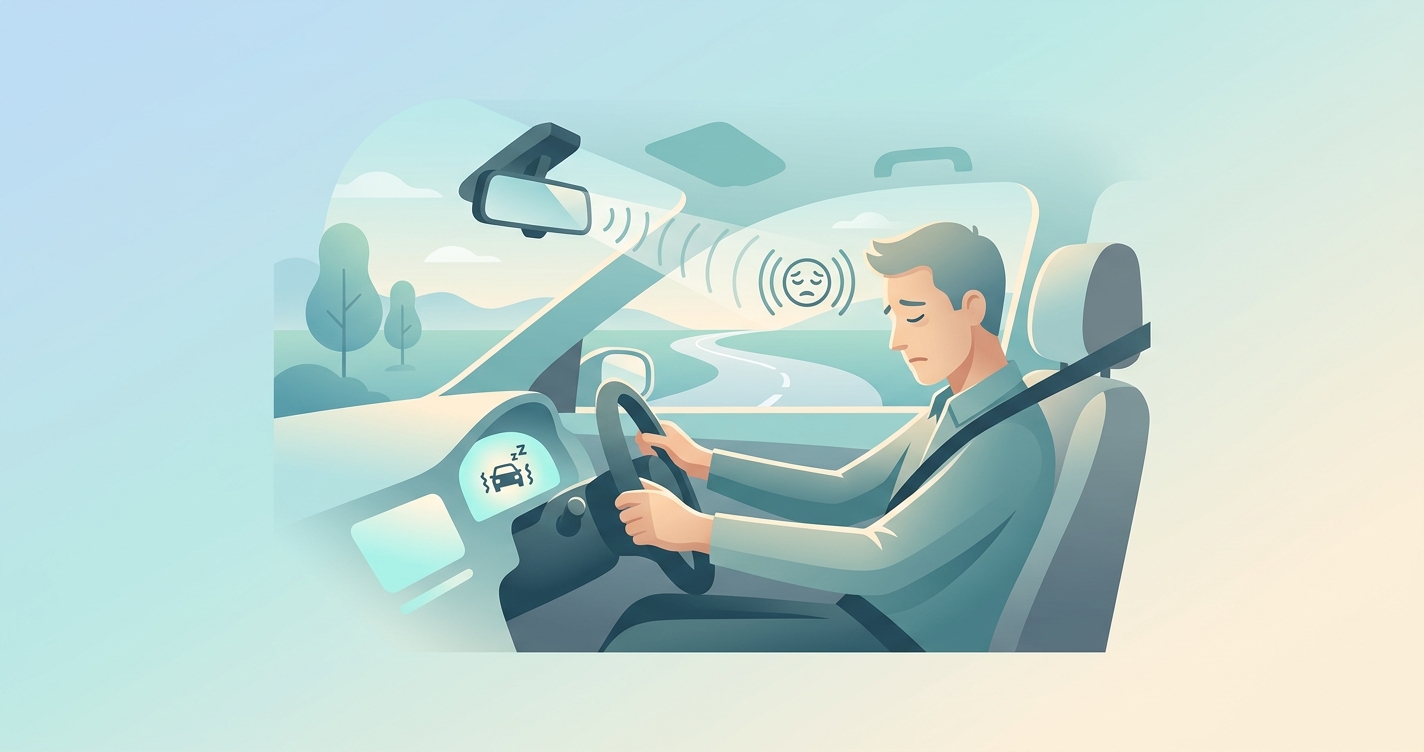
If you're asking whether a car detect tired driver safely system can really tell when fatigue is setting in, the honest answer is yes, to a point. Modern driver-monitoring systems are getting much better at spotting the visible signs that usually show up before a fatigue-related mistake becomes obvious: longer eyelid closures, drifting gaze, slow head movements, and missed attention checks. What they do not do is read your mind or diagnose sleep deprivation with clinical certainty. They estimate risk inside the cabin and decide whether the driver looks less able to keep driving safely.
“Drowsiness was estimated to be present in 9.5% of all crashes studied.” — Brian C. Tefft, AAA Foundation for Traffic Safety, using SHRP 2 naturalistic driving data (2018)
How a car can detect a tired driver safely in real-world driving
Most production systems start with a cabin-facing camera. Often it uses infrared illumination so it can keep tracking the face at night. The software then looks for patterns tied to fatigue: blink duration, PERCLOS-style eyelid closure, gaze direction, head pose, and whether the driver responds when the vehicle expects supervision.
David F. Dinges and Mark M. Grace helped establish one of the field's most durable fatigue markers in their 1998 Federal Highway Administration work on PERCLOS. Their conclusion was simple and still influential: eyelid closure tracked alertness decline better than several competing measures. That matters because many automotive systems still build on that basic logic. If the eyes stay closed a little too long, a little too often, the odds of impaired alertness rise.
A modern driver-monitoring stack usually combines a few layers:
- Face and eye tracking for blink rate, blink duration, and gaze
- Head-pose tracking to see whether the driver is looking away or nodding off
- Vehicle-context signals such as lane drift, steering variability, or erratic correction
- Escalation logic that decides when to warn, when to repeat, and when to hand off to stronger interventions
That last layer matters more than people think. The question is not just whether the system sees fatigue. It is whether it responds early enough to help, without nagging drivers so often that they stop listening.
| Detection approach | What the car looks for | Strengths | Limits |
|---|---|---|---|
| Eye and eyelid tracking | Blink duration, PERCLOS, prolonged closure | Strong research base; works continuously | Can be affected by sunglasses, pose, lighting edge cases |
| Gaze and head pose | Looking away, nodding, reduced scanning | Useful for distraction and fatigue together | Fatigue can look different across drivers |
| Vehicle-behavior signals | Lane deviation, steering correction, speed variability | Helps when face data is weak | Often catches fatigue later, after driving quality changes |
| Multimodal fusion | Camera + vehicle data + other cabin signals | Better context and fewer single-signal errors | Higher integration and validation burden |
Why the answer is “yes, but with boundaries”
The research base is much better than it was a decade ago. Brian C. Tefft's 2018 AAA Foundation analysis used face video from 3,593 drivers in the SHRP 2 Naturalistic Driving Study and found drowsiness in 9.5% of all crashes. That finding landed hard because it suggested fatigue was being missed in traditional crash reporting.
More recent reviews have moved the discussion past simple “sleepy or not sleepy” framing. A 2024 review in Machines by Yujie Li and Yujie Wang grouped current detection methods into image-based, physiological, vehicle-data, and multimodal systems, arguing that the field is steadily shifting toward fused signals rather than one isolated metric. That feels right to me. Fatigue is messy. One driver blinks more. Another goes still. Another keeps their eyes open and quietly makes worse decisions. A camera system works best when it can weigh multiple clues instead of betting everything on one cue.
So yes, a car can often tell when you look too tired to drive safely. But it is making a probability judgment, not a medical diagnosis.
Where current tired-driver systems are strongest
The strongest use case is early warning. A system does not need to prove exactly how tired you are. It only needs enough confidence to say, “something is off; pay attention or stop.”
That is why fatigue monitoring tends to perform best in situations like these:
- Repeated long eyelid closures on highway driving
- Falling gaze engagement during Level 2 assisted-driving supervision
- Overnight or long-haul use cases where fatigue risk is already elevated
- Fleet operations that want earlier intervention before a near miss becomes a crash
Passenger vehicles
In passenger cars, the goal is usually to keep the driver engaged, especially when assistance features are active. A tired driver supervising automation is a worse safety problem than a tired driver in a purely manual car, because the driver may disengage mentally before the vehicle actually needs help.
Commercial fleets
For fleets, the value is broader. A fleet safety team wants fewer severe events, fewer near misses, and better context around what happened in the cab. Fatigue alerts become more useful when they can be reviewed alongside route type, shift timing, braking events, and trip duration.
Emerging in-cabin vital-signs programs
Some automotive teams are asking a bigger question now: can the cabin do more than watch the face? Remote photoplethysmography and related in-cabin sensing approaches are pushing the market toward richer driver-state estimates, especially for stress, wellness, or medical-event context. That does not replace face-based fatigue monitoring. It adds another layer.
Current research and evidence
There are three pieces of evidence I keep coming back to.
First, Dinges and Grace's FHWA work on PERCLOS gave the industry a practical fatigue marker tied to real alertness decline rather than vague intuition. That work still echoes through present-day camera design.
Second, Tefft's AAA Foundation analysis used real-world driving footage instead of neat lab conditions. The 9.5% crash figure is one reason fatigue detection is now treated as a major road-safety issue instead of a niche feature request.
Third, regulatory pressure is moving in the same direction as the research. The European Transport Safety Council's summary of Euro NCAP's 2026 changes says driver-monitoring systems will carry much more weight in safety scoring, with attention to distraction, drowsiness, impairment, and unresponsive-driver scenarios. That is a market signal as much as a safety signal. When top ratings depend on direct evidence of driver state, OEMs have less room to treat cabin monitoring as optional.
What the evidence suggests now
- Camera-based fatigue detection is credible enough to be mainstream vehicle architecture, not just a concept demo
- Eye closure and gaze remain foundational because they are practical for continuous monitoring
- Multimodal systems are gaining ground because fatigue rarely shows up in exactly one way
- Regulation and safety ratings are nudging manufacturers toward more robust in-cabin monitoring stacks
The future of tired-driver detection in cars
The next few years probably will not be about one magic fatigue score. They will be about confidence management.
Cars will get better at answering narrower questions such as:
- Does the driver look engaged right now?
- Is the driver's alertness trend getting worse over the last few minutes?
- Is the road situation getting more demanding at the same time the driver is becoming less responsive?
- Should the system issue a gentle warning, a stronger alert, or prepare a fallback action?
That is a more realistic future than the old idea of a car “knowing” whether someone is tired. Good systems do not need perfect certainty. They need enough signal, soon enough, to interrupt a dangerous drift.
It also means the best systems may be the ones that combine fatigue detection with broader cabin context. Quick Scan Vitals has already covered that shift in posts on in-cabin vital signs and road safety and future in-cabin health beyond fatigue. The industry is moving from simple drowsiness alarms toward a more complete picture of driver state.
Frequently Asked Questions
Can a car really tell when I'm too tired to drive?
A car can often detect signs associated with fatigue, such as long eyelid closures, gaze drift, and reduced responsiveness. It cannot measure tiredness with clinical certainty, but it can estimate when your driving risk appears to be rising.
Do tired-driver systems only use a camera?
Usually the camera is the core sensor, but many systems also use vehicle-behavior data such as steering input, lane position, or response to alerts. More advanced systems may add other cabin signals too.
Are these systems accurate enough to matter?
They matter because they can catch visible fatigue patterns earlier than a human passenger might notice them. The goal is risk reduction and earlier warning, not a perfect medical-grade verdict.
Why are automakers putting more emphasis on driver monitoring now?
Because assisted driving, safety ratings, and fatigue-related crash evidence are all pushing the same way. OEMs need better proof that a driver is still able to supervise the vehicle when conditions change.
If you're evaluating where cabin monitoring is heading next, Circadify is working on custom automotive programs that connect driver-state sensing with broader in-cabin health monitoring. Learn more through our automotive program inquiry page or explore related analysis on driver stress monitoring for long-haul trucking and fleet driver health monitoring systems.