
How Camera-Based SpO2 Estimation Works in Moving Vehicles
A research-based look at camera based spo2 estimation moving vehicle systems, from rPPG signal capture and motion filtering to cabin-lighting and validation challenges.
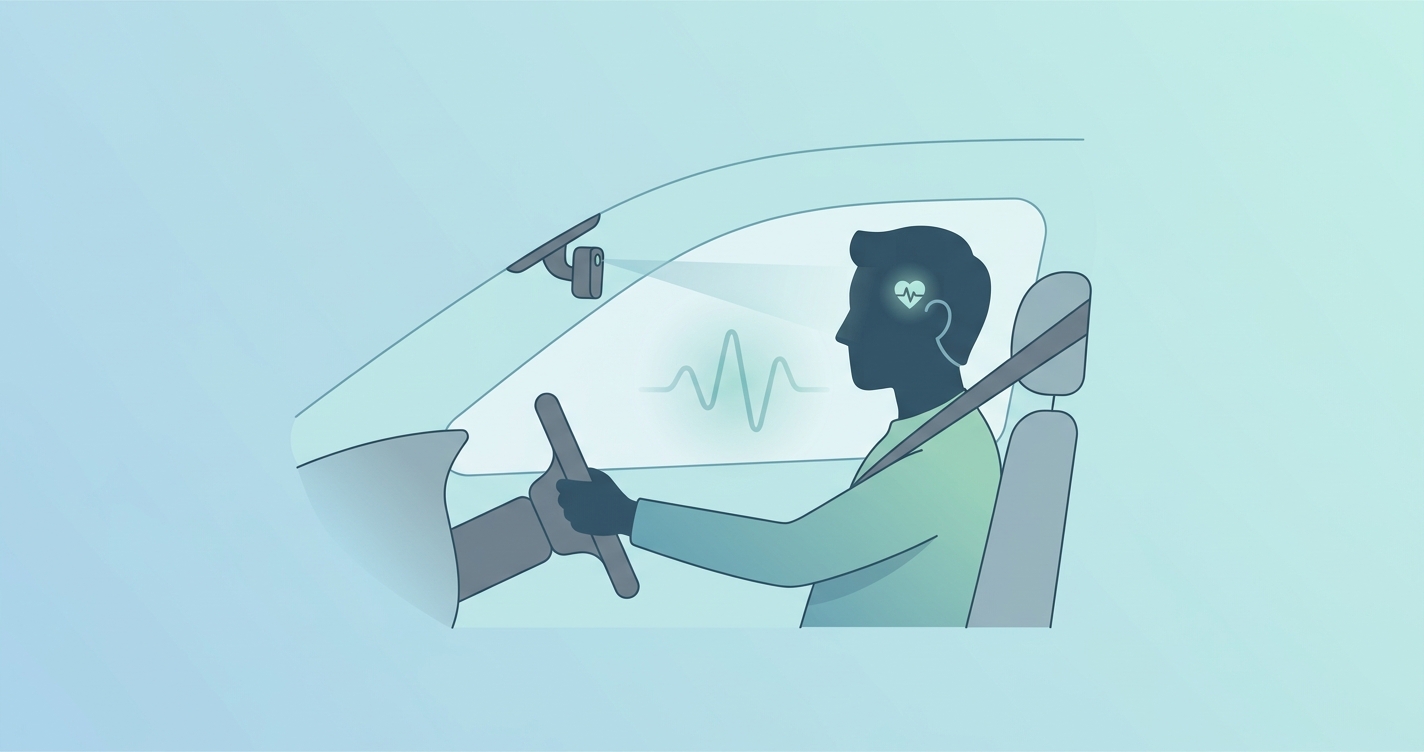
How Camera-Based SpO2 Estimation Works in Moving Vehicles
For automotive teams studying camera based spo2 estimation moving vehicle systems, the interesting question is not whether pulse oximetry exists. It has existed for decades. The hard part is whether oxygen-saturation signals can be estimated without finger clips, while a driver shifts in the seat, sunlight moves across the cabin, and the vehicle itself adds vibration. That is why this topic sits at the edge of driver monitoring, cabin sensing, and signal-quality engineering rather than ordinary wellness tech.
"Motion artifacts significantly impact the accuracy of pulse oximetry readings, particularly in dynamic environments." — summary returned by Circadify's agent-search API from a review on motion artifact reduction in pulse oximetry
Camera based SpO2 estimation moving vehicle systems start with optical physiology
A conventional pulse oximeter shines red and infrared light through tissue and compares how oxygenated and deoxygenated hemoglobin absorb those wavelengths. A camera-based system has to solve a harder problem from farther away. Instead of a contact sensor controlling the light path, it watches tiny color or intensity changes in exposed skin and tries to recover a usable photoplethysmographic waveform.
S. M. R. Islam, M. A. H. Khan, M. A. Rahman, and M. S. Hossain described this broader automotive challenge in their 2023 review, Remote Photoplethysmography for Vital Sign Monitoring in Automotive Applications: A Review. Their central point is simple: vehicle cabins are not clinics. The signal is weak, the lighting changes constantly, and motion noise is built into the environment.
That makes the processing stack more important than the camera alone.
- The camera captures subtle skin reflectance changes tied to blood volume pulses.
- The system isolates a facial or skin region of interest, usually the forehead or cheeks.
- Signal processing suppresses gross motion, vibration, and lighting drift.
- Spectral or learning-based models estimate pulse features from the cleaned waveform.
- SpO2 inference is treated as an estimated physiological state, not a direct clip-style measurement.
Why in-vehicle SpO2 is tougher than in-room rPPG
| Challenge | What happens in a moving vehicle | Why it matters for SpO2 estimation |
|---|---|---|
| Cabin motion | Driver posture, steering, bumps, head turns | Corrupts pulse waveform quality |
| Lighting shifts | Tunnels, shadows, sunlight, dashboard glow | Changes the optical baseline frame to frame |
| Distance from sensor | Camera sits on dash, column, mirror, or pillar | Lowers signal strength compared with contact sensors |
| Skin visibility | Glasses, facial hair, masks, hand position | Reduces clean regions of interest |
| Compute constraints | OEM and fleet systems often need edge inference | Limits how much correction can happen in real time |
The basic physics is easy to explain. The engineering is not.
How the pipeline usually works
The first stage is acquisition. Most systems begin by identifying stable facial regions that are less likely to deform dramatically during speech or steering. Forehead and cheek patches are common because they provide larger exposed areas than the nose or lips. If the cabin uses near-infrared hardware, engineers may also rely on depth or structured-light cues to stabilize tracking.
The second stage is signal extraction. This is where remote photoplethysmography, or rPPG, enters the stack. The software converts small pixel-level changes into a candidate pulse signal. In an office or lab, that alone can be enough for heart-rate estimation. Inside a moving vehicle, it is usually only the start.
The third stage is signal-quality assessment. Research teams increasingly treat this as a gatekeeper. If the waveform is poor, the system should not pretend otherwise. Agent-search surfaced work from Eindhoven University of Technology linking Svitlana Zinger to remote PPG signal-quality assessment for in-vehicle driver monitoring, which reflects how the field is maturing: not every frame should produce a trusted health estimate.
The fourth stage is oxygen-saturation modeling. Unlike heart rate, SpO2 is not directly visible from a single clean rhythm. The model has to infer oxygenation from wavelength-sensitive changes, often under hardware and lighting conditions that were never designed for hospital-grade pulse oximetry. That is why most automotive discussions frame SpO2 as part of a broader cabin-sensing roadmap rather than a fully solved production feature.
Industry applications for moving-vehicle SpO2 estimation
Driver wellness monitoring in commercial fleets
Fleet programs are interested in whether in-cabin sensing can identify fatigue, illness, or acute distress earlier. SpO2 is relevant because oxygen saturation can add context in respiratory strain or broader wellness events, especially when combined with respiratory rate and heart rate. On its own, it is rarely the whole answer.
Safety escalation in high-duty-cycle operations
Mining, long-haul, and specialty vehicle programs often want more than distraction alerts. They want a richer model of driver condition. In those settings, camera-based SpO2 estimation is usually discussed as one signal inside a multi-parameter stack rather than a standalone feature.
Emergency-event detection and future cabin sensing
Yuta Nakashima, Yuta Kudo, and Hiroshi Mizoguchi explored contactless vital-sign monitoring for in-vehicle driver monitoring using a near-infrared time-of-flight camera. That research focused on heart rate and respiratory rate rather than production SpO2 deployment, but it matters because it shows where the architecture is going: cabins that estimate several physiological signals at once and then judge confidence signal by signal.
Current research and evidence
The published literature is more cautious than marketing copy, and that is a good thing.
Islam and colleagues' 2023 automotive review argues that rPPG is promising for in-cabin vital-sign monitoring, but the operating environment remains the defining constraint. Their review points repeatedly to motion, illumination changes, and hardware placement as the reasons automotive sensing cannot simply borrow a telehealth demo and call it vehicle-ready.
A separate 2023 review, Remote Photoplethysmography for Driver Monitoring: A Review, reached a similar conclusion in driver-monitoring contexts. Agent-search identified that paper as a field review focused on how gaze, cabin movement, head pose, and optical instability complicate physiological sensing when the subject is actively driving rather than sitting still.
The motion-artifact literature makes the same point from the pulse-oximetry side. Agent-search returned a summary from a motion-artifact review noting that dynamic movement can make SpO2 readings unreliable unless correction methods are strong enough to separate physiological pulses from movement noise. That sounds obvious, but it is one of the biggest reasons vehicle-grade deployment is hard. A bad estimate is worse than an unavailable estimate.
There is also a practical lesson in the ToF-camera work from Nakashima's group. Non-contact in-cabin sensing becomes more plausible when systems combine better tracking, active illumination, and context-aware filtering. In other words, the field keeps moving toward multimodal sensing rather than betting everything on a single RGB camera under uncontrolled light.
What researchers are really comparing
| Approach | Strengths | Main limitation in vehicles | Likely automotive role |
|---|---|---|---|
| Contact pulse oximeter | Direct optical measurement, mature benchmark | Not practical for passive driver monitoring | Reference data during validation |
| RGB camera rPPG | Lower hardware burden, easier packaging | Sensitive to sunlight, skin-tone variation, head motion | Broad cabin sensing and pilot programs |
| NIR or ToF-assisted sensing | Better low-light support, stronger tracking cues | Higher integration complexity and cost | Premium or custom automotive builds |
| Multimodal driver monitoring | Combines heart rate, respiration, attention, context | Harder validation and fusion design | Most realistic path for production systems |
Why validation matters more than demos
A stationary demo can make camera-based SpO2 estimation look almost solved. A production vehicle test usually tells a rougher story.
Teams have to validate across:
- Daylight, nighttime, and mixed-shadow cabins
- Different seating positions and driver heights
- Eyeglasses, hats, facial hair, and partial occlusion
- Smooth roads versus vibration-heavy routes
- Real edge-compute limits rather than offline lab processing
I think this is the part many conversations skip. People see a clean waveform on a conference slide and assume the rest is packaging. It usually is not. Most of the work sits in confidence scoring, failure handling, and deciding when the system should stay quiet.
The future of camera-based SpO2 estimation in vehicles
The near-term future is probably not a dashboard that replaces a hospital pulse oximeter. It is a cabin-monitoring stack that gets better at reading driver state with layered evidence. SpO2 may become useful when combined with pulse, respiration, stress-related features, and context about whether the driver is stable, distracted, or physically distressed.
That direction fits the broader shift in driver monitoring. Systems are moving away from single-purpose drowsiness alerts and toward richer occupant-state estimation. The technical hurdle is not whether a camera can see a pulse under ideal conditions. It is whether the full system can decide when a physiological estimate is credible enough to inform a safety workflow.
For OEMs, Tier-1 suppliers, and fleets, that is the real design question.
Frequently Asked Questions
Can a camera really estimate SpO2 inside a moving vehicle?
In research settings, yes, but it is still a difficult sensing problem. Motion, lighting shifts, and partial facial occlusion make in-vehicle estimation much harder than contact pulse oximetry.
Why is SpO2 harder than camera-based heart rate?
Heart rate can often be recovered from a cleaner periodic waveform. SpO2 requires more wavelength-sensitive inference and is more vulnerable to low signal quality and optical distortion.
Are RGB cameras enough for in-cabin SpO2 estimation?
Sometimes for research, but many teams look at NIR, ToF, or multimodal stacks to improve stability in low light and under motion-heavy conditions.
What is the biggest engineering challenge?
Signal quality. If the system cannot tell a reliable physiological waveform from motion noise, the final SpO2 estimate will not be trustworthy.
For automotive teams exploring richer cabin-sensing architectures, solutions like Circadify are being developed for custom programs that connect in-cabin vital-sign monitoring with broader driver-state workflows. For that direction, see Circadify's automotive cabin page, along with related Quick Scan Vitals analysis on automotive rPPG and how drowsiness detection systems read vital signs.