Why are trucking companies rolling out in-cab vital-sign monitors?
Trucking companies are implementing in-cab vital sign monitors to address high rates of driver health issues and fatigue-related accidents. Learn how the technology works.
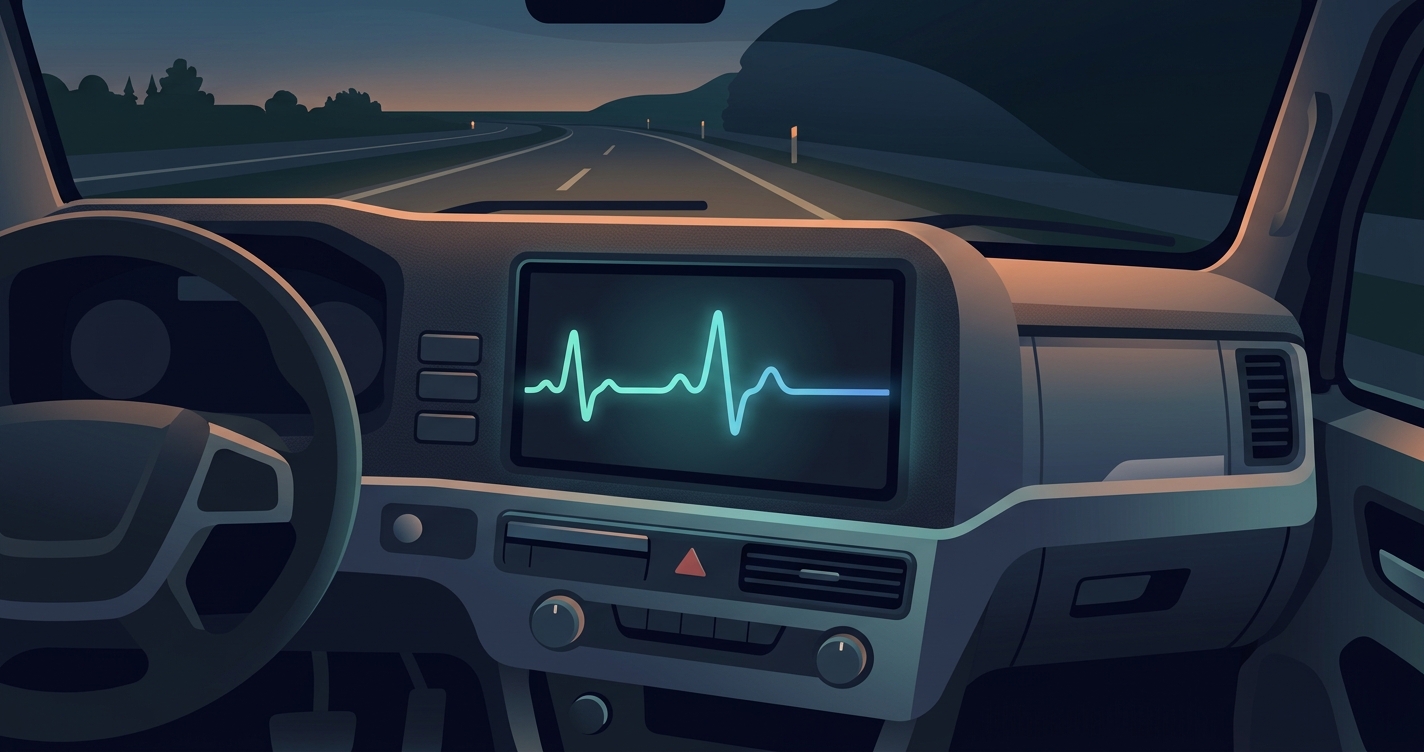
The sight of a commercial truck on the highway is a symbol of modern logistics, but it masks a growing crisis among its drivers. The demanding nature of long-haul trucking has been linked to significant health problems and an increased risk of accidents. In response, a growing number of trucking companies are turning to technology, installing systems to monitor driver health and alertness directly from the cab. This move is not about surveillance for its own sake; it is a data-driven strategy to protect drivers, reduce accidents, and create a safer environment for everyone on the road. The adoption of the trucking in cab vital sign monitor represents a proactive approach to a long-standing industry problem.
"More than half (51%) of long-haul truck drivers were current cigarette smokers, over twice the rate of other adult workers... and the prevalence of diabetes was double (14% vs. 7%) that of the general population."
- National Institute for Occupational Safety and Health (NIOSH)
A Response to a Health and Safety Crisis
The push for in-cab monitoring is a direct response to alarming statistics about the health and well-being of commercial truck drivers. Research by the Centers for Disease Control and Prevention (CDC) and NIOSH paints a stark picture. A landmark 2014 study found that long-haul truck drivers experience substantially higher rates of chronic diseases compared to the general working population. For instance, 69% of drivers were found to be obese, compared to just one-third of other adult workers.
These health issues are compounded by the stressful and sedentary nature of the job. Long hours on the road, irregular sleep schedules, and limited access to healthy food contribute to a high prevalence of conditions like hypertension and sleep apnea. The consequences extend beyond the driver's personal health. Driver fatigue is a leading cause of truck-related accidents. The Federal Motor Carrier Safety Administration (FMCSA) has estimated that 13% of commercial motor vehicle crashes involve a fatigued driver. A trucking in cab vital sign monitor offers a way to catch the early warning signs of drowsiness or a medical event before it leads to a catastrophic failure.
These systems work by using sensors to track key physiological indicators. Early systems relied on contact-based sensors in wearables or the steering wheel, but the industry is increasingly moving toward contactless, camera-based solutions that use advanced software to analyze facial and ocular cues.
In-cab vital sign monitoring: technology comparison
There are several approaches to monitoring driver vital signs inside a vehicle. Each comes with different implications for installation, driver experience, and the types of data that can be collected.
| Technology Type | How It Works | Advantages | Disadvantages |
|---|---|---|---|
| Wearable Devices | Drivers wear a wristband or chest strap that tracks heart rate, activity levels, and sleep. | Continuous data collection, even outside the cab; mature technology. | Requires driver to remember and wear the device; potential for lost or damaged devices; hygiene concerns in shared vehicles. |
| Contact Sensors | Sensors are embedded into the steering wheel or seat to measure heart rate and respiratory rate through touch. | Seamless for the driver; no extra device to wear. | Data collection is intermittent (only when touching sensor); can be expensive to integrate into vehicle hardware. |
| Camera-Based Monitoring | An optical sensor (camera) uses remote photoplethysmography (rPPG) to measure heart rate, respiratory rate, and blood pressure variability by detecting subtle changes in light reflected from the driver's skin. It also tracks eye movement and head position for fatigue. | Contactless and frictionless; cannot be forgotten or lost; provides a richer data set including fatigue and distraction cues. | Requires sophisticated software to ensure accuracy in variable lighting and with different skin tones; potential for privacy concerns if not implemented transparently. |
Industry Applications
For fleet managers, the data from a trucking in cab vital sign monitor provides actionable insights to improve safety programs. The applications fall into two main categories: real-time alerts and long-term health and wellness programs.
- Real-Time Fatigue and Distraction Alerts: The most immediate use is preventing accidents. If a system detects that a driver's heart rate variability indicates drowsiness or their gaze wanders from the road for too long, it can trigger an in-cab alert, such as a chime or a seat vibration. This prompts the driver to refocus or pull over and rest.
- Sudden Medical Event Detection: In the case of a sudden medical emergency, such as a heart attack or a seizure, the system can detect the associated physiological changes and potentially even alert emergency services.
- Driver Wellness Programs: Over the long term, aggregated and anonymized data can help companies identify fleet-wide health trends. This enables them to offer targeted wellness programs, such as resources for improving sleep quality or managing stress.
- Post-Incident Analysis: In the event of an accident, data from the monitoring system can help investigators understand the role that fatigue or a medical event may have played, providing valuable information for future prevention efforts.
Improving driver retention
While safety is the primary driver, these systems can also play a role in improving the work lives of drivers. By demonstrating a commitment to their well-being, companies can boost morale and improve retention in an industry plagued by high turnover rates.
Regulatory and insurance incentives
Insurers are beginning to offer discounts for fleets that adopt advanced safety technologies, including driver monitoring. Furthermore, while not yet mandated in most regions for commercial trucks, regulatory bodies globally are increasingly focused on mitigating driver fatigue, suggesting that such systems may become standard in the future.
Current research and evidence
The technology behind in-cab vital sign monitoring is built on decades of clinical and academic research. The use of photoplethysmography (PPG) to measure cardiovascular signals is a standard medical practice. The innovation lies in remote PPG (rPPG), which allows for measurement without physical contact.
A body of research validates the core principles. For example, a 2017 study by Wouter B. Vlemmix and colleagues at the Eindhoven University of Technology demonstrated the feasibility of camera-based heart rate monitoring in a car. Numerous studies since have worked to improve the accuracy and reliability of these systems in challenging real-world conditions.
The health data from NIOSH provides the "why" for this technology. The 2014 survey of 1,670 long-haul drivers across the U.S. found that:
- 27% reported sleeping 6 hours or less per day.
- 87% reported having at least one risk factor (hypertension, smoking, obesity), which could lead to chronic disease.
These findings highlight the need for a solution that can bridge the gap between the driver's state and the fleet manager's ability to intervene.
The future of in-cab monitoring
The evolution of the trucking in cab vital sign monitor is moving toward deeper integration with other vehicle systems. In the future, a fatigue detection event might Alert the driver. Communicate with the truck's advanced driver-assistance system (ADAS) to increase following distance from the vehicle ahead. In a scenario where a driver becomes unresponsive due to a medical event, the vehicle may activate its own emergency braking and steering systems to bring the truck to a safe stop.
As the technology becomes more widespread, it will generate vast amounts of data that can be used to develop more sophisticated predictive models. Researchers will be able to identify the subtle physiological precursors to fatigue and illness, allowing for interventions that are predictive rather than reactive.
Frequently asked questions
Q: Can a trucking company legally monitor my vital signs while I'm driving? A: Generally, yes, provided the company has a clear policy in place and the monitoring is for a legitimate business purpose, such as safety. Laws vary by jurisdiction, but commercial driving has a lower expectation of privacy than a personal vehicle. Transparency is key, and companies typically inform drivers about what is being monitored and why.
Q: What happens if the system sends a fatigue alert? A: The specific protocol varies by company. In most cases, the initial alert is delivered only to the driver to prompt them to rest. If the drowsiness is severe or persistent, a notification might be sent to the fleet manager or dispatcher, who may then contact the driver to check on their well-being and instruct them to take a break.
Q: Is the camera always recording me? Does my company have access to the video? A: Most systems do not continuously record or store video. The camera is a sensor that feeds data into an algorithm. The system analyzes the video feed in real time to derive physiological data and detect events. Video snippets are typically only saved and uploaded in the case of a specific event, like a crash or a hard-braking incident, for later review.
Q: What vital signs can a camera-based system actually detect? A: Current camera-based systems can accurately measure heart rate, heart rate variability (a marker for stress and fatigue), and breathing rate. They also track physical signs of fatigue, like eye-closure duration (PERCLOS), blink frequency, and head position.
As the technology for driver monitoring advances, Circadify is actively developing camera-based software solutions to address the health and safety challenges in the automotive sector. For fleet management companies, Tier-1 suppliers, and OEMs interested in building custom applications for in-cabin sensing, learn more about our development programs at circadify.com/custom-builds/automotive-cabin.