What is Automotive rPPG? A Simple Guide for 2026
A simple guide to automotive rPPG technology for 2026. Learn how camera-based remote photoplethysmography measures driver vital signs in moving vehicles.
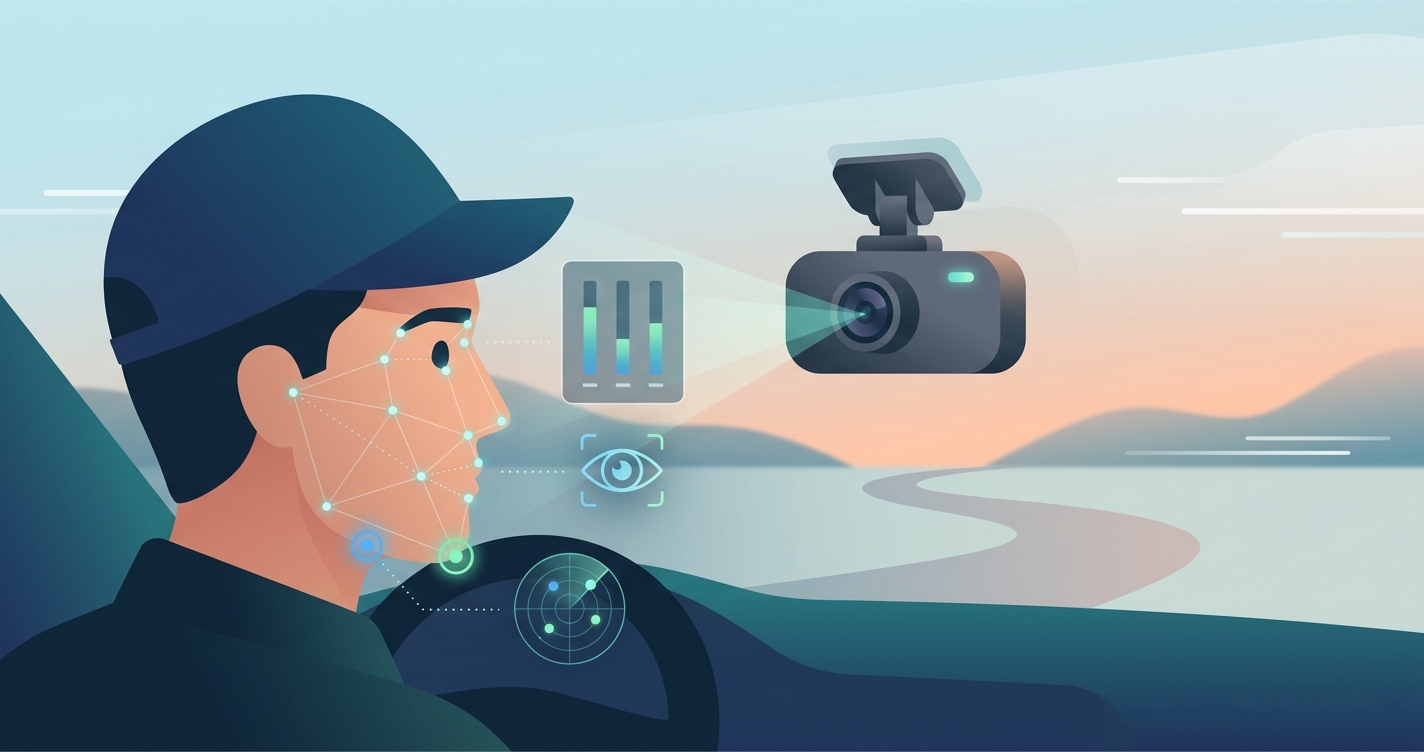
The dashboard camera was originally installed in commercial and passenger vehicles to monitor one simple metric: whether the driver's eyes were open. Today, that exact same hardware is being trained to read a pulse. For product managers and engineering teams evaluating the next generation of cabin safety, understanding automotive rPPG is no longer optional. The technology shifts a vehicle from passively observing head position to actively measuring physiological signals. By calculating vital signs through standard video feeds, systems can detect the earliest physiological markers of fatigue, stress, and unresponsiveness before the steering wheel ever drifts.
"With regulatory mandates pushing adoption, camera-based systems are estimated to capture a 48 percent share of the 5.7 billion dollar driver monitoring systems market by 2026, driven by advances in contactless physiological sensing."
- Global Market Insights, In-Cabin Monitoring Industry Report, 2025
What is Automotive rPPG?
Automotive rPPG stands for remote photoplethysmography applied within a vehicle cabin. It is a contactless technology that uses a standard or near-infrared (NIR) camera to measure a driver's heart rate, respiration rate, and other vital signs without any physical sensors touching the skin.
At a biological level, every time the human heart beats, it pumps blood through the vascular system. This surge of blood changes the volume of microvascular tissue in the skin, which in turn slightly alters how much light the skin absorbs and reflects. Human hemoglobin absorbs specific wavelengths of light. While this micro-flush of color is entirely invisible to the naked human eye, the image sensor of a digital camera can detect these minute fluctuations in pixel intensity.
By isolating specific regions of the driver's face - typically the forehead, cheeks, and chin - an rPPG algorithm processes the raw video frame by frame. It extracts a continuous waveform that mirrors the mechanical pumping of the heart. From this raw signal, the system derives metrics like resting heart rate, heart rate variability (HRV), and breathing patterns.
| Feature | Standard DMS (Eye Tracking) | Automotive rPPG |
|---|---|---|
| Primary Metric | Eyelid closure, gaze vector | Heart rate, respiration, HRV |
| Fatigue Indicator | Blinking patterns, head droop | Autonomic nervous system shifts |
| Hardware Required | IR/NIR Camera | IR/NIR Camera |
| Processing Focus | Spatial tracking | Spatiotemporal signal extraction |
| Use Case | Late-stage drowsiness | Early physiological fatigue onset |
Key advantages of this approach include:
- Continuous measurement without requiring the driver to wear a smartwatch or chest strap.
- Utilizes existing inward-facing camera hardware already mandated by new safety regulations.
- Tracks baseline shifts in autonomic nervous system activity over long drives.
- Operates entirely on the edge, keeping sensitive health data isolated within the vehicle.
How contactless sensing works in a moving vehicle
Extracting a clean physiological signal in a clinical setting is a solved problem. Doing the same thing in a moving vehicle is an immense technical challenge. A car cabin is an environment defined by optical and physical chaos: harsh sunlight, sudden shadows from overpasses, flashing headlights, and constant driver motion.
To solve this, modern automotive rPPG relies on a robust sequence of computational steps designed to isolate the tiny physiological signal from massive amounts of environmental noise.
- Facial Detection and Tracking: The system must first identify the driver's face and map specific regions of interest. As the driver turns their head to check mirrors or talk to a passenger, the algorithm must dynamically track these regions without losing the signal.
- Signal Extraction: The software measures the variation in pixel intensity over time within those mapped regions.
- Motion Compensation: Algorithms identify and subtract variations caused by physical movement. If the car hits a pothole, the resulting sudden shift in the video feed must be mathematically filtered out so it is not misinterpreted as a physiological event.
- Vital Sign Calculation: The filtered data is processed into standardized physiological metrics, updating continuously as the drive progresses.
The role of near-infrared illumination
One of the most critical adaptations for automotive environments is the shift from visible light (RGB) cameras to near-infrared (NIR) sensors. Visible light conditions inside a car change drastically and rapidly. A system relying solely on standard color video would fail at night or when driving into direct sunlight.
Because NIR light operates outside the visible spectrum, a vehicle can actively illuminate the driver's face using IR LEDs without distracting them. This provides a constant, stable lighting environment for the camera sensor, ensuring the rPPG algorithm receives a consistent video feed regardless of external weather or time of day.
Industry Applications for OEMs and Tier-1 Suppliers
Early fatigue and drowsiness detection
Standard driver monitoring systems wait for physical exhaustion, such as prolonged eye closure (PERCLOS) or a drooping head. By the time these physical symptoms appear, the driver is already heavily impaired. Automotive rPPG measures the autonomic nervous system. Measurable shifts in heart rate variability and a drop in respiration rate often precede the physical signs of sleepiness by several minutes. This gives advanced driver assistance systems (ADAS) more time to issue a warning, adjust cabin temperature, or recommend a break.
Cognitive load and stress monitoring
Driving in dense urban traffic or severe weather elevates stress, which directly impacts reaction times and decision-making. An rPPG system can track increases in resting heart rate and shallow, rapid breathing, categorizing the driver's cognitive load. If the system detects high stress levels, the vehicle's architecture can adapt by suppressing non-essential infotainment notifications, muting incoming calls, or increasing the sensitivity of automated emergency braking features.
L3 automation handoff readiness
As vehicles incorporate Level 3 autonomous features, the transition of control between the machine and the human becomes a critical safety vulnerability. If the vehicle encounters a scenario it cannot handle, it must hand control back to the driver. However, it is dangerous to hand control to a driver who is physiologically unresponsive or asleep. Contactless vital sign monitoring ensures the vehicle knows exactly how alert the driver is before initiating a handoff sequence.
Commercial fleet safety
For heavy-duty truck and fleet operators, ensuring the health of drivers is a core operational priority. Contactless monitoring provides a continuous, frictionless way to log driver readiness. Fleet managers do not need to rely on drivers remembering to charge and wear specific smartwatches. The data can trigger mandatory rest breaks or flag anomalous physiological baselines that might indicate an incoming illness or acute distress.
Current research and evidence
The transition of rPPG from controlled laboratory settings to real-world automotive cabins has been heavily documented in recent engineering literature. Early models struggled with motion artifacts, but focused research has largely solved these foundational hurdles.
In 2018, researchers Ewa Nowara, Tim K. Marks, and their team at Mitsubishi Electric Research Laboratories published their work on "SparsePPG," a method specifically designed to extract vital signs using near-infrared cameras in vehicles. Their research demonstrated that robust signal extraction is possible even when dealing with the drastic illumination changes and constant vibrations of a car cabin, relying on spatial and temporal filtering techniques.
More recently, the computer vision community has built specialized datasets to train these deep learning algorithms for the road. In 2025, researchers Jiho Choi and Sang Jun Lee presented "MMDrive" at the IEEE Conference on Computer Vision and Pattern Recognition (CVPR) workshops. This multi-modal dataset synchronizes near-infrared driver video with ground-truth electrocardiogram signals. Datasets like this are essential for Tier-1 suppliers, providing the training material necessary to build resilient, road-ready rPPG models capable of handling diverse demographics and driving conditions.
The future of automotive rPPG
As vehicles transition toward software-defined architectures, the car's responsibility to understand the driver's physical state increases. The next generation of automotive rPPG will likely fuse optical data with other cabin sensors, such as micro-impulse radar and capacitive seat sensors, creating a highly redundant, multi-modal health profile of the occupant.
Engineering teams are currently optimizing these algorithms to run efficiently on low-power automotive-grade systems-on-a-chip (SoCs). This optimization is critical for mass production. By 2026, the expectation is that contactless vital sign estimation will move from being a premium luxury feature to standard safety equipment, fundamentally changing how a vehicle interacts with its human operator.
Frequently asked questions
What does rPPG stand for? It stands for remote photoplethysmography. It is a method of measuring blood volume changes in the microvascular bed of tissue using a standard camera, rather than a physical sensor clipped to the finger or wrist.
Does automotive rPPG work at night? Yes. Most automotive systems utilize near-infrared (NIR) cameras and active IR illumination. This allows the camera sensor to see the driver clearly in complete darkness and extract physiological signals without relying on visible street lights or dashboard glow.
Can this technology replace standard driver monitoring systems? No, it is designed to enhance them. Modern systems run rPPG algorithms on the same video feed used for tracking eyelid closure and gaze direction. Combining spatial eye-tracking with physiological vital signs creates a much more comprehensive profile of driver fatigue.
Is driver health data sent to the cloud? Generally, no. For privacy and latency reasons, modern automotive rPPG algorithms are designed to run entirely on the edge. The video feed is processed locally in real-time within the vehicle's computer, and only the resulting metadata - such as a fatigue alert flag - is utilized by the vehicle systems.
For automotive engineering teams building the next generation of cabin safety, integrating contactless vital signs requires robust software that can handle the unpredictability of the road. Circadify is actively developing solutions in this space, providing tools designed to extract reliable physiological data in challenging environments. To learn more about integrating these capabilities into your hardware roadmap, explore our resources on automotive cabin custom builds.