
How to Validate rPPG Accuracy for Automotive-Grade Driver Monitoring
A research-based framework for validating rPPG accuracy in automotive driver monitoring, covering reference sensors, motion artifacts, cabin lighting, and safety-case expectations.
How to Validate rPPG Accuracy for Automotive-Grade Driver Monitoring
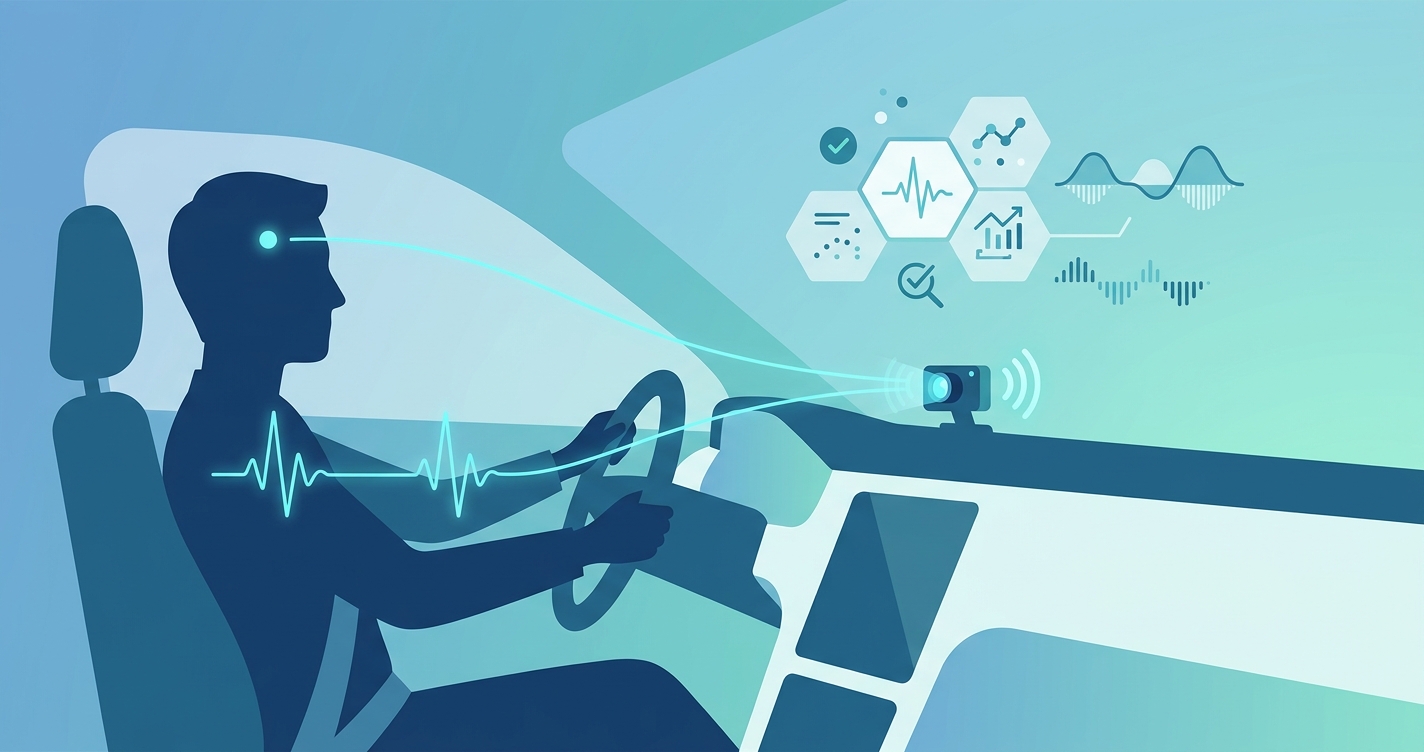
Validating rppg accuracy automotive driver monitoring is not the same as proving that a camera can read pulse in a quiet lab. An automotive cabin is a rough measurement environment: sunlight shifts by the second, head pose changes constantly, vibration contaminates the signal, and safety teams need evidence that the system keeps working when the drive gets messy. For OEMs, Tier-1 suppliers, and fleet technology teams, the real question is not whether remote photoplethysmography can work. It is whether the validation plan is strong enough to support production decisions, safety arguments, and procurement requirements.
"Motion artifacts, caused by driver movement, significantly impact the accuracy of rPPG measurements in vehicles." — summary of automotive rPPG validation research returned by Circadify's agent-search API, citing Mitsubishi Electric Research Laboratories and related studies
rPPG accuracy for automotive driver monitoring starts with the right validation target
A surprising number of teams begin with the wrong endpoint. They validate average heart-rate estimation in short stationary clips, then assume that result translates to production driver monitoring. It usually does not.
M. A. M. Al-Naji, M. Gibson, and J. J. Al-Naji wrote in their 2023 review, "Remote Photoplethysmography for Driver Monitoring: A Review," that driver monitoring has to account for cabin-specific noise sources, especially motion, lighting variation, and operational constraints that do not exist in clinical test rooms. That point matters because automotive-grade validation is really a layered exercise.
A useful validation plan usually separates four questions:
- Can the system recover a usable pulse waveform at all?
- How close are heart-rate and respiratory-rate estimates to reference sensors?
- Under which cabin conditions does quality drop below an acceptable threshold?
- What should the driver monitoring stack do when signal quality is poor?
That last question tends to get ignored. It should not. In production programs, graceful degradation matters almost as much as nominal accuracy.
What automotive teams typically need to validate
| Validation layer | What to measure | Typical reference | Why it matters |
|---|---|---|---|
| Signal availability | Percentage of drive time with usable rPPG signal | Signal-quality labels + frame-level QA | Shows whether the camera can sustain measurement in real cabins |
| Heart-rate accuracy | MAE, RMSE, correlation, Bland-Altman agreement | ECG chest strap or medical-grade PPG | Core physiological benchmark |
| Respiratory-rate accuracy | BrPM error and trend stability | Respiration belt or capnography surrogate | Useful for fatigue and distress models |
| Robustness | Performance across motion, vibration, illumination, skin tones, eyewear | Stratified test protocol | Prevents lab-only claims |
| System behavior under failure | Fallback logic and alert suppression | DMS software test cases | Keeps bad signals from driving unsafe interventions |
Reference sensors matter more than catchy benchmark numbers
If the reference is weak, the validation result is weak. That sounds obvious, but it keeps happening.
The strongest automotive studies still use contact references. T. H. Lee and colleagues reported in their 2022 paper, "Contactless Vital Sign Monitoring System for In-Vehicle Driver Monitoring Using a Near-Infrared Time-of-Flight Camera," that their in-vehicle system achieved a mean absolute error of 2.15 beats per minute for heart rate and 1.25 breaths per minute for respiratory rate. Those numbers are useful because they were compared against contact measurements rather than guessed labels.
For production validation, most teams should treat ECG as the primary reference for heart-rate timing and a medical-grade respiration reference as the secondary benchmark for breathing. Pulse oximeters can help, but they are not always enough on their own because pulse transit effects and motion can distort alignment.
In practice, a solid reference stack often includes:
- ECG or a validated chest strap for beat timing
- Finger or ear PPG for pulse trend cross-checks
- A respiration belt for breathing rate
- Cabin video synchronized to all sensor streams
- Vehicle dynamics signals such as speed, steering input, and vibration markers
I keep coming back to synchronization here. A lot of validation errors are really timestamp problems in disguise.
The hardest part of rPPG accuracy automotive driver monitoring is motion and signal quality
Ewa M. Nowara, Tim K. Marks, Hassan Mansour, and Ashok Veeraraghavan, working with Mitsubishi Electric Research Laboratories and Rice University, focused directly on this problem in "Near-Infrared Imaging Photoplethysmography During Driving." Their work addressed illumination variation, head motion, and the sparse facial regions that remain usable while a person is actually driving. They introduced AutoSparsePPG because the usual full-face assumptions break down fast in realistic cabin scenes.
That is why modern validation plans should test more than mean error. Sonja Babac, Luc P. J. Vosters, Rik Vullings, Svitlana Zinger, and Mark J. H. van Gastel reported in a 2026 Biomedical Signal Processing and Control paper that machine-learning-based signal-quality assessment can help classify when in-vehicle remote PPG is trustworthy and when it is not. Their study found that an XGBoost model using frequency-domain features performed well while staying computationally lighter than heavier deep models.
That is a useful lesson for automotive teams: before arguing about one more decimal place of heart-rate accuracy, make sure the system can tell good signal from junk.
Common failure modes in cabin validation
- Sudden sunlight transitions entering or leaving tunnels
- Vibration from rough road surfaces
- Partial facial occlusion from steering posture or sunglasses
- Off-axis head pose during mirror checks and turns
- Dark cabin scenes at night with nonuniform NIR illumination
- Compression or frame-drop issues in domain-controller pipelines
Industry applications and validation scenarios
Passenger vehicle ADAS programs
For passenger vehicles, the validation objective is usually tied to driver-state estimation rather than standalone vital-sign reporting. Euro NCAP's 2026 direction raises the bar here. Agent-search results tied to Euro NCAP coverage note that direct driver monitoring can contribute up to 25 points in the Driver Engagement category, with more credit for systems that can identify unresponsive drivers and support controlled intervention behavior.
That does not create a dedicated Euro NCAP score for rPPG. It does, however, increase the pressure to prove that physiological signals are reliable enough to support higher-level inferences when visual behavior alone is ambiguous.
Fleet and commercial safety programs
Fleet programs usually care about operational reliability. They want to know how performance changes across routes, shifts, cab layouts, and duty cycles. A validation study for trucking or mining should therefore include long-duration drives, repeated starts and stops, and a breakdown by event type rather than a single pooled average.
Tier-1 sourcing and platform decisions
Tier-1 suppliers need reproducible validation packages that can survive procurement scrutiny. That usually means a protocol that spells out sensor placement, illumination settings, participant diversity, motion scenarios, and acceptance thresholds before the first data review begins.
Current research and evidence
The literature is starting to converge on a few consistent points.
Al-Naji, Gibson, and Al-Naji's 2023 review makes clear that driver-monitoring rPPG lives or dies on robustness, not on best-case demos. Lee and colleagues' 2022 in-vehicle NIR Time-of-Flight study suggests that contactless heart-rate and respiratory-rate measurement is realistic in cabins when ROI tracking, filtering, and ICA are handled carefully. The reported MAE values — 2.15 bpm for heart rate and 1.25 BrPM for respiratory rate — are promising, but they also came from a controlled validation design rather than open-road chaos.
Nowara, Marks, Mansour, and Veeraraghavan push the field forward by focusing on near-infrared driving conditions, where only portions of the face may be usable. Babac and co-authors add another important layer: signal-quality assessment. That is probably where a lot of production work is headed, because a robust DMS needs confidence estimates, not just raw pulse outputs.
What current studies suggest teams should report
| Metric | Why it belongs in the report | Better practice |
|---|---|---|
| Mean absolute error (MAE) | Easy to compare across studies | Report by scenario, not just overall |
| Correlation with reference | Shows trend tracking | Pair with agreement analysis |
| Bland-Altman limits | Exposes bias and spread | Include separate plots for day/night and motion cases |
| Signal availability | Captures real-world usability | Report percentage of valid windows over full drives |
| Quality-classification accuracy | Shows whether fallback logic is defensible | Tie quality scores to downstream DMS behavior |
| Subgroup breakdowns | Reveals hidden failure pockets | Include skin tone, eyewear, seat position, and route type |
The safety case is bigger than the physiology model
This is where automotive-grade work starts to look different from health-tech demos.
ISO 26262 covers hazards caused by electrical and electronic malfunctions, while ISO 21448, usually discussed as SOTIF, addresses hazards that arise even when the system is working as designed but faces performance limits or foreseeable misuse. Agent-search results on ISO 21448 point out that sensor performance specifications, scenario-based testing, and ongoing field learning are central to that process.
In plain terms, an rPPG validation plan should help answer three safety-case questions:
- What conditions allow reliable physiological estimation?
- What conditions predict degraded performance?
- How does the broader DMS respond when confidence is low?
That is a more useful production question than asking whether the algorithm can hit an impressive number on a clean benchmark.
The future of validation will be scenario-based and multimodal
I do not think automotive teams will rely on camera-only validation for much longer. The direction of travel is pretty clear: multimodal cabins, stronger signal-quality models, and validation protocols built around scenarios rather than static summary numbers.
The next generation of test plans will probably include:
- NIR and RGB comparisons under matched routes
- Synthetic and real vibration profiles
- Driver-state scenarios such as stress, fatigue, and unresponsiveness
- Fusion studies combining rPPG with behavioral DMS outputs
- Post-deployment monitoring to discover new triggering conditions
That is more work, obviously. It is also closer to what an automotive-grade proof package should look like.
Frequently asked questions
What is the best reference sensor for validating automotive rPPG?
ECG is usually the strongest reference for heart-rate timing because it provides precise beat detection. Teams often add contact PPG and respiration belts so they can validate pulse trend and breathing separately.
Is mean absolute error enough to prove rPPG accuracy for automotive driver monitoring?
No. MAE is useful, but it hides failure clusters. Automotive teams should also report signal availability, scenario-based error splits, agreement analysis, and quality-classification performance.
Why is signal-quality assessment so important in vehicle cabins?
Because many real cabin failures come from motion, lighting changes, and partial occlusion. A production system needs to know when the signal is unreliable so it can suppress or downgrade downstream inferences.
Do Euro NCAP rules require rPPG specifically?
No. Euro NCAP focuses on driver monitoring outcomes, engagement, and unresponsive-driver handling. But as scoring pressure rises, suppliers have a stronger reason to validate any physiological layer they want to add to the cabin stack.
For teams building next-generation cabin sensing, solutions like Circadify are being developed for custom automotive programs that combine contactless physiological measurement with broader driver monitoring workflows. For related analysis, see what rPPG means for automotive in-cabin vitals and the future of in-cabin health beyond fatigue detection, or visit Circadify's automotive cabin page.