Can a camera in my taxi know if I'm feeling unwell right now?
How in-cabin cameras read DMS vital signs to passively flag driver illness, fatigue, and stress for fleets and rideshare platforms.
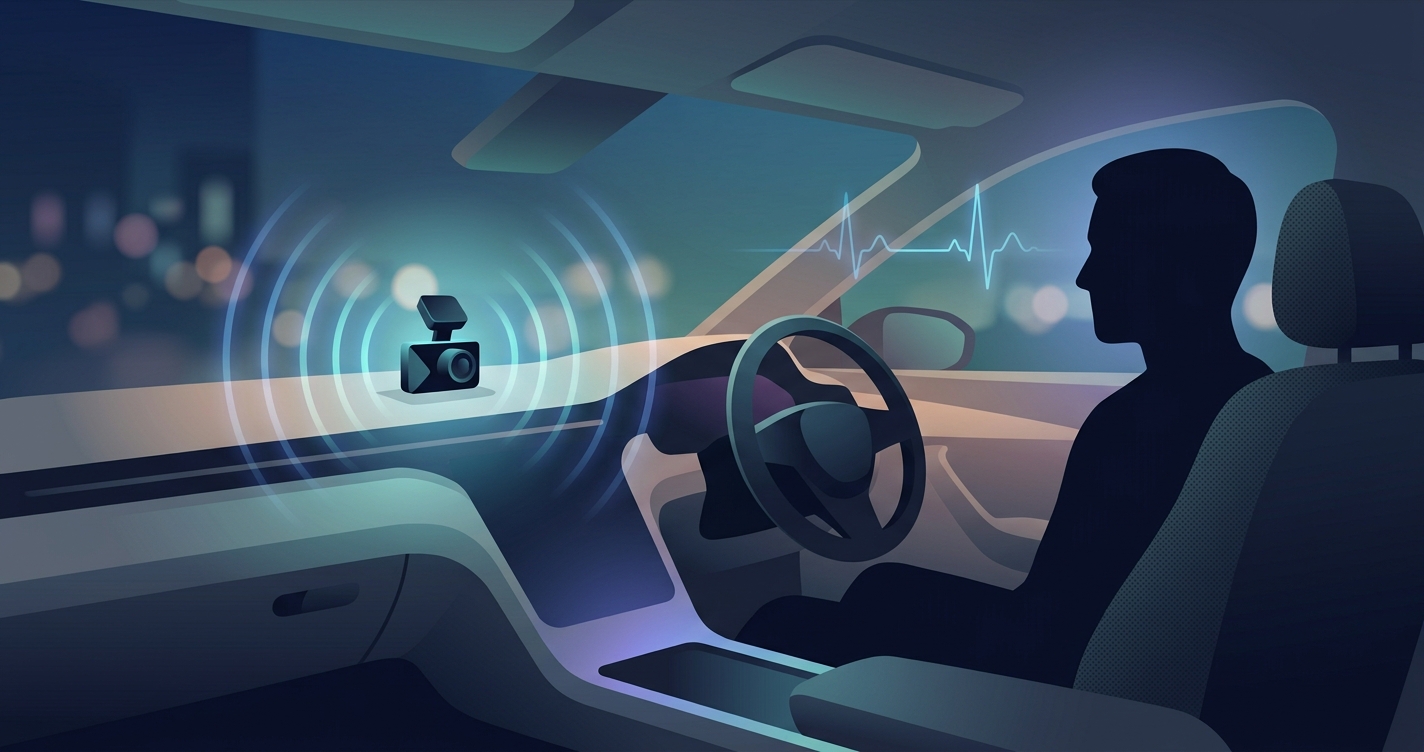
A driver pulling a twelve-hour shift rarely registers the first signs of being unwell. A rising resting heart rate, shallower breathing, or a creeping fever builds quietly while attention stays fixed on the road. For fleet operators and rideshare platforms, that gap between when a body changes and when a driver notices is where avoidable incidents happen. The question of whether a camera already pointed at the driver can read those changes is no longer hypothetical. Modern driver monitoring systems are learning to extract DMS vital signs from ordinary video, turning a safety camera into a passive wellness sensor that never asks the driver to wear or touch anything.
Camera-based physiological measurement can recover heart rate, breathing rate, and pulse-related signals from skin-color changes invisible to the human eye, with reviewed accuracy approaching contact sensors under controlled conditions, according to Daniel McDuff's 2023 survey in ACM Computing Surveys.
How DMS vital signs are read from a cabin camera
The core method is remote photoplethysmography, usually shortened to rPPG. With every heartbeat, blood volume in the face changes slightly, and that alters how much light the skin reflects. A camera captures these tiny color shifts across the forehead and cheeks, then signal-processing and machine-learning models convert them into a pulse waveform. From that waveform a system can estimate heart rate, heart rate variability, and respiration, and in research settings, indicators linked to blood oxygen and stress. This is the foundation of DMS vital signs: physiological measurement pulled from pixels rather than electrodes.
"Feeling unwell" is not a single signal. It is a pattern of small deviations from a person's own baseline. A driver coming down with an infection often shows an elevated resting heart rate and altered breathing well before subjective symptoms peak. Acute stress narrows heart rate variability. Early fatigue shifts both respiration and pulse rhythm. A camera that has learned a driver's normal range across previous shifts can flag when several of these markers drift together, which is a far stronger illness signal than any one number on its own.
The important distinction for fleet buyers is between behavioral and physiological monitoring. Most deployed systems started with behavioral cues such as eye closure, blink rate, head pose, and yawning. Vital sign sensing adds an internal layer that does not depend on visible drowsiness, which matters because a driver can be physiologically compromised while still appearing alert.
| Monitoring approach | What it measures | Strengths | Limits for wellness detection |
|---|---|---|---|
| Behavioral DMS (eyes, head, blink) | Drowsiness and distraction cues | Mature, low compute, well understood | Misses internal illness with no visible signs |
| Camera rPPG (DMS vital signs) | Heart rate, respiration, HRV, stress indicators | Passive, contactless, uses existing camera | Sensitive to motion, lighting, skin-tone variation |
| Radar in-cabin sensing | Chest motion, heart and breathing rate | Works in darkness, less light-dependent | Added hardware cost, coarser per-driver baseline |
| Wearable devices | Continuous pulse, oxygen, motion | High signal quality on body | Requires compliance, charging, per-driver issue |
A practical wellness system rarely relies on one row of that table. Production architectures increasingly fuse rPPG with behavioral cues and, in some cases, near-infrared imaging so the system keeps working at night and through changing light.
Key signals a camera can reasonably contribute to a wellness assessment:
- Resting and trend heart rate compared to the driver's own baseline
- Respiration rate and breathing pattern changes over a shift
- Heart rate variability as a proxy for acute stress and recovery
- Combined drift across several markers that suggests illness onset
- Behavioral overlays such as prolonged eye closure that confirm impairment
Industry applications for fleets and rideshare platforms
Fleet driver health monitoring
For commercial fleets, the value is operational rather than diagnostic. A system that notices a driver's vitals trending away from their baseline can prompt a check-in, a scheduled break, or a dispatch decision before a minor illness becomes a roadside event. Aggregated and de-identified, these signals also help safety managers understand fatigue and stress patterns across routes, shift lengths, and times of day. This is the same category as broader fleet driver health monitoring programs, but vital signs add an early-warning dimension that behavioral data alone cannot supply.
Rideshare and taxi platforms
Rideshare and taxi operators run a distributed workforce in highly variable cabins and lighting. Here the appeal of DMS vital signs is that nothing is issued, charged, or worn. A camera the driver already accepts for safety can quietly contribute wellness signals, supporting voluntary break prompts and duty-of-care policies. The same constraints that make rideshare attractive also make it hard: sunlight through windows, sunglasses, and constant head movement all stress the rPPG signal.
OEM and Tier-1 integration
For automotive OEMs and Tier-1 suppliers, vital sign features extend an existing safety camera rather than adding a sensor. Because regulatory momentum already pushes camera-based driver monitoring into new vehicles, layering physiological estimation onto that hardware is an efficient way to differentiate. The engineering challenge sits in edge processing, validation across diverse populations, and clear separation between wellness alerts and medical claims.
Current research and evidence
The research base behind DMS vital signs has matured quickly. Daniel McDuff's 2023 review in ACM Computing Surveys documents how camera measurement can recover heart rate and breathing rate, and outlines the path toward more complex indicators. Pireh Pirzada and colleagues published a 2023 current review of rPPG that catalogs both the techniques and the practical limits, including motion artifacts and lighting sensitivity.
Automotive-specific work has moved from lab to cabin. Zhiyu Wang, Xuezhi Yang, Hongzhou Lu, and Wenjin Wang presented a 2023 benchmark comparing physiological model-based and deep-learning rPPG in driving conditions, directly addressing the noise problem unique to vehicles. The PhysDrive dataset, released through arXiv, provides multimodal RGB and near-infrared recordings built specifically for in-vehicle physiological measurement, giving researchers a shared basis for testing across cameras and conditions. Work from Eindhoven University of Technology on machine-learning signal-quality assessment tackles a related problem: knowing when an rPPG reading is trustworthy enough to act on, which matters more for safety alerts than raw accuracy alone.
The consistent theme across this literature is honest about constraints. Head movement, cabin vibration, fast-changing illumination, and skin-tone representation in training data all affect reliability. Progress is real, but credible systems treat camera-derived vitals as trend indicators and triggers for attention, not as clinical measurements.
The future of DMS vital signs
The trajectory points toward fusion and personalization. Single-signal estimates give way to multi-modal systems that combine rPPG, behavioral analysis, and near-infrared or radar inputs so a wellness judgment survives bad lighting and motion. Per-driver baselines, built over many shifts, will make "unwell" a meaningful relative state rather than a fixed threshold. As more vehicles ship with capable in-cabin cameras and edge compute, the marginal cost of adding wellness sensing keeps falling, which favors broad fleet deployment.
The harder frontier is governance. Passive health sensing raises real questions about consent, data ownership, and where alerts go. Fleets that adopt this technology will need transparent policies on what is measured, how long it is stored, and who sees it. The technology that can tell whether a driver feels unwell will only earn trust if the program around it is built with the driver in mind.
Frequently asked questions
Can a normal taxi camera really detect illness, or does it need special hardware? Standard RGB cameras already capture enough color information for rPPG-based heart rate and respiration estimates under reasonable lighting. Near-infrared or radar add robustness in darkness and heavy motion, but the foundation can run on the kind of camera many cabins already have.
Is this a medical diagnosis? No. DMS vital signs produce trend indicators and early-warning flags, not clinical measurements. The appropriate use is prompting breaks, check-ins, or dispatch decisions, not diagnosing conditions. Credible systems avoid medical claims and treat readings as one input among several.
What stops the readings from being wrong in a moving vehicle? Motion, vibration, and changing light are the main threats to accuracy. Research groups address this with motion-tolerant algorithms, signal-quality scoring that discards unreliable segments, and multi-modal fusion so the system leans on behavioral cues when the physiological signal degrades.
How is driver privacy handled? That depends on program design rather than the camera itself. Responsible deployments use on-edge processing, de-identification, clear retention limits, and driver consent so wellness sensing supports duty of care without becoming surveillance.
Circadify is building toward this space, developing camera-based cabin sensing that brings DMS vital signs into practical fleet and OEM programs. Teams evaluating in-cabin wellness detection can start an automotive program inquiry at circadify.com/custom-builds/automotive-cabin.