Signs of Driver Drowsiness AI Can Catch Before You Crash
How driver drowsiness detection AI reads eyelids, gaze, and head motion to flag fatigue minutes before a microsleep, and why it matters for OEMs and fleets.
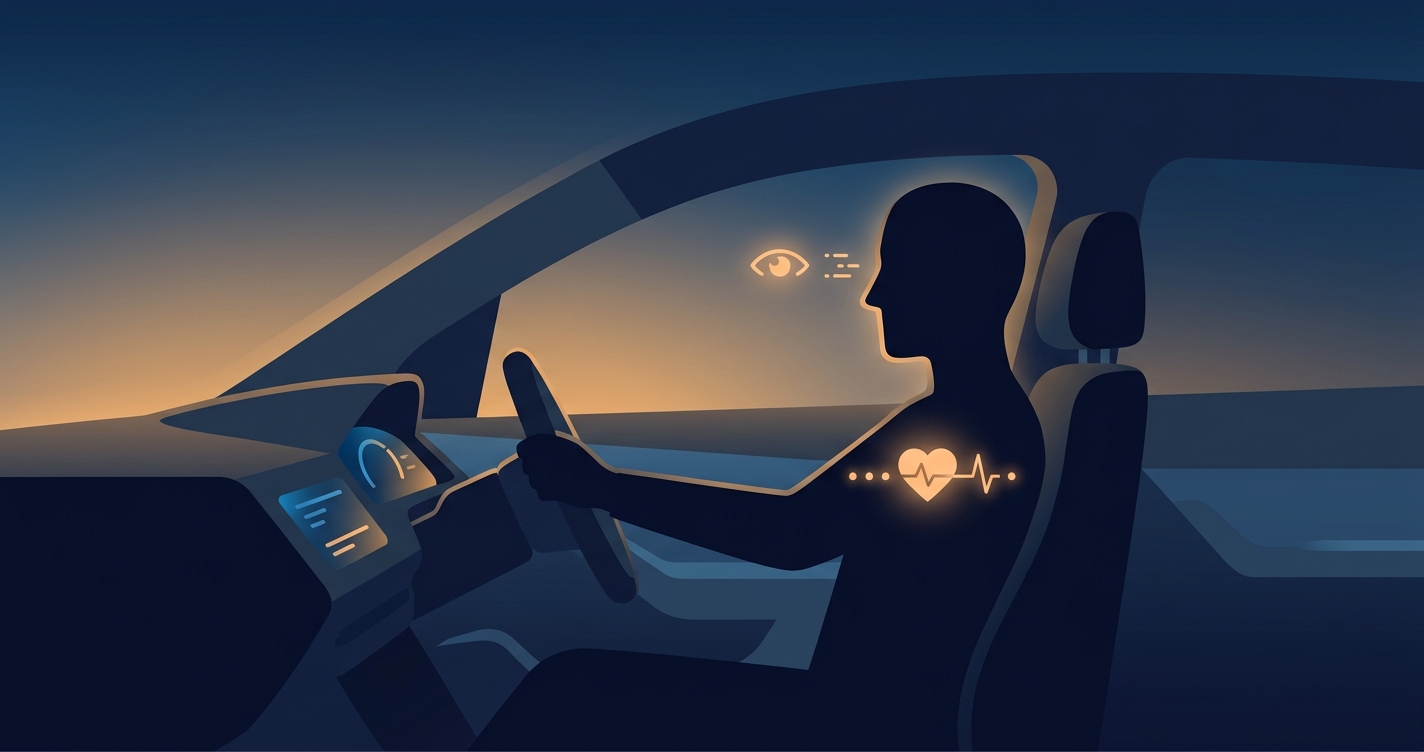
A driver almost never feels the exact moment fatigue takes over. The body begins shedding alertness long before the conscious mind registers it, and by the time a head drops or eyes snap back open, the vehicle may have already drifted across a lane line. This gap between physiological decline and self-awareness is precisely the window that driver drowsiness detection AI is built to occupy. Modern in-cabin cameras now track a sequence of subtle, measurable cues that appear minutes ahead of a microsleep, giving OEMs, Tier-1 suppliers, and fleet operators a chance to intervene while there is still time to act.
"The Governors Highway Safety Association estimates roughly 6,326 drowsy-driving deaths in 2023, nearly ten times the 633 officially recorded by NHTSA, because fatigue leaves no physical trace at the crash scene.", Governors Highway Safety Association, 2024
What driver drowsiness detection AI actually watches
The core insight behind driver drowsiness detection AI is that fatigue is a gradual process with distinct visual stages, not a single on-off event. A camera-based driver monitoring system samples the face and upper body many times per second, then feeds those frames through deep learning models trained to recognize the earliest markers of declining alertness.
The most validated of these markers is PERCLOS, the percentage of time the eyes are closed by 80 percent or more across a rolling window. Research reviewed in the Journal of Vision suggests a PERCLOS threshold near 10 percent can flag one-second microsleep episodes during real driving. But eyelids are only the start. The strongest systems fuse several signals at once, because any single cue can be defeated by sunglasses, head turns, or a driver who simply has narrow eyes at baseline.
Drowsy driving warning signs that an inward-facing camera can quantify include:
- Slower, longer blinks and rising PERCLOS values over a few minutes
- Reduced blink amplitude, where the eye no longer fully reopens
- Drooping eyelids and a falling eye aspect ratio
- Head nodding, slow head tilt, and recovery jerks
- Yawning frequency and wide-mouth duration
- Gaze fixation, glassy staring, and reduced scanning of mirrors
- Loosening grip posture and slumping shoulders captured in the wider frame
Layered on top of vision, camera-based remote photoplethysmography (rPPG) can estimate heart rate and respiration from tiny color changes in facial skin. Heart rate variability and breathing rate often shift before outward behavior changes, so these vital-sign cues extend the warning window even further.
Behavioral cues vs physiological cues
Different signals carry different strengths. Behavioral cues are visible and easy to explain to a driver, while physiological cues tend to move earlier but require more careful processing. The table below compares the main categories a drowsiness detection stack draws on.
| Cue category | Example signals | Typical lead time before microsleep | Sensing method | Main limitation |
|---|---|---|---|---|
| Eyelid dynamics | PERCLOS, blink duration, eye aspect ratio | Seconds to a few minutes | IR camera + CNN | Occlusion from glasses, glare |
| Head and posture | Nodding, tilt, recovery jerks, slumping | Seconds to minutes | RGB/IR camera + pose model | Confused with normal checking motions |
| Facial expression | Yawning, jaw drop, glassy gaze | One to several minutes | Camera + landmark tracking | Yawns are not always fatigue |
| Cardiac and respiratory | Heart rate, HRV, breathing rate | Several minutes (often earliest) | rPPG from facial video | Motion and lighting sensitivity |
| Driving behavior | Lane drift, steering variance | Variable, often late | Vehicle CAN + ADAS fusion | Appears after impairment begins |
The pattern that emerges is consistent across the literature: vital-sign and eyelid signals tend to precede the lane-keeping errors that traditional vehicle-based systems rely on. That is why a camera looking at the driver can warn earlier than a system that only watches the road.
Industry Applications
Passenger vehicle oems
For OEMs, the driver is now part of the safety loop that regulators expect to be monitored. Drowsiness detection that runs on an existing driver monitoring camera lets a program reuse one sensor for fatigue, distraction, and increasingly vital-sign estimation. The earlier the warning, the more graceful the response can be, ranging from a seat or audio alert at first signs to a coordinated handover prompt in partially automated modes.
Commercial and long-haul fleets
Fleets carry the heaviest fatigue exposure because of night shifts, irregular schedules, and long monotonous routes. AI fatigue alerts give safety managers an objective record of when a driver was sliding toward a microsleep, which supports coaching and route planning rather than blame after the fact. Pairing real-time in-cab warnings with aggregated trend data turns isolated incidents into a measurable risk profile across the whole operation.
Tier-1 Suppliers
For Tier-1 suppliers, the opportunity is to deliver microsleep detection software that meets automotive constraints: on-edge processing, low latency, robustness to lighting, and graceful behavior when a face is partly hidden. The differentiator is rarely raw accuracy on a clean dataset. It is reliability across real drivers, cabins, and conditions.
Current research and evidence
The evidence base for driver drowsiness detection AI has matured quickly. A 2024 review of deep-learning drowsiness systems published in EPJ Web of Conferences reported a median model accuracy above 0.95, with some real-world deployments reaching a median near 0.977. Hybrid approaches that combine visual cues such as PERCLOS and eye aspect ratio with physiological inputs like ECG have been reported above 96.5 percent in controlled studies.
PERCLOS itself remains the most validated single index. Work summarized on ResearchGate confirms that PERCLOS rises predictably with sleep deprivation and during nighttime driving, which is exactly when drowsy crashes cluster. Researchers also caution that PERCLOS alone can miss moderate drowsiness and inattention, reinforcing the case for multi-signal fusion.
The scale of the problem keeps this research urgent. NHTSA recorded 633 drowsy-driving fatalities in 2023, about 1.5 percent of all traffic deaths, while the National Sleep Foundation's 2023 survey estimated sleepiness contributes to as many as 6,400 fatal crashes annually. The order-of-magnitude gap between official and estimated figures, highlighted by the Governors Highway Safety Association, exists because fatigue leaves no measurable residue the way alcohol does. A camera that timestamps the physiological slide toward sleep is one of the few tools that can close that measurement gap.
Key takeaways from the current evidence:
- Multi-signal fusion outperforms any single cue in real conditions
- Vital-sign and eyelid changes generally precede lane-departure errors
- Robustness across drivers and lighting matters more than peak benchmark accuracy
- Drowsy-driving deaths are likely undercounted by a factor of roughly ten
The future of drowsiness detection
The next phase moves from detecting drowsiness to anticipating it. As rPPG-derived heart rate variability, respiration, and even stress estimates become reliable inside a moving cabin, models can shift from reactive alerts toward forecasting fatigue risk before the first visible nod. Expect tighter fusion with ADAS, so that a drowsiness flag adjusts following distance or lane-keeping assertiveness rather than only sounding a chime.
Personalization is the other frontier. Baseline blink rate, posture, and resting heart rate vary widely between individuals, so systems that adapt to each driver will cut false alarms that otherwise train drivers to ignore warnings. Regulatory momentum, including Euro NCAP protocols and emerging regional mandates, will push these capabilities from premium options toward standard equipment across passenger and commercial segments.
Frequently asked questions
How early can driver drowsiness detection AI warn a driver?
It depends on which signals the system uses. Eyelid metrics such as PERCLOS can flag risk seconds to a few minutes before a microsleep, while physiological cues like heart rate variability and breathing rate often shift several minutes earlier. Fusing both extends the practical warning window.
Does the camera work if the driver wears sunglasses?
Eyelid tracking can be degraded by glasses or glare, which is why robust systems combine head-pose, posture, facial expression, and camera-based vital signs. When one channel is occluded, others continue to provide signal, keeping the alert reliable.
Is this the same as the lane-departure warning my vehicle already has?
No. Lane-departure systems infer impairment from how the vehicle moves, which usually happens after fatigue has already affected control. Inward-facing drowsiness detection reads the driver directly, so it can flag the warning signs before the car begins to drift.
How accurate are these systems today?
Recent deep-learning reviews report median accuracy above 0.95, with hybrid visual-plus-physiological models exceeding 96 percent in controlled studies. Real-world performance hinges on robustness across drivers, cabins, and lighting rather than a single benchmark figure.
Circadify is actively working in this space, developing camera-based driver fatigue, drowsiness, and stress detection designed for the realities of the cabin. OEMs and fleets evaluating how earlier drowsiness warnings could fit an in-cabin monitoring program can start an automotive program inquiry at circadify.com/custom-builds/automotive-cabin.