How Ride-Hail Platforms Use Real-Time Driver Wellness Scoring
A research-focused look at ride hail platform driver wellness scoring, including fatigue signals, in-cabin sensing, dispatch logic, and the evidence shaping safer mobility operations.
How Ride-Hail Platforms Use Real-Time Driver Wellness Scoring
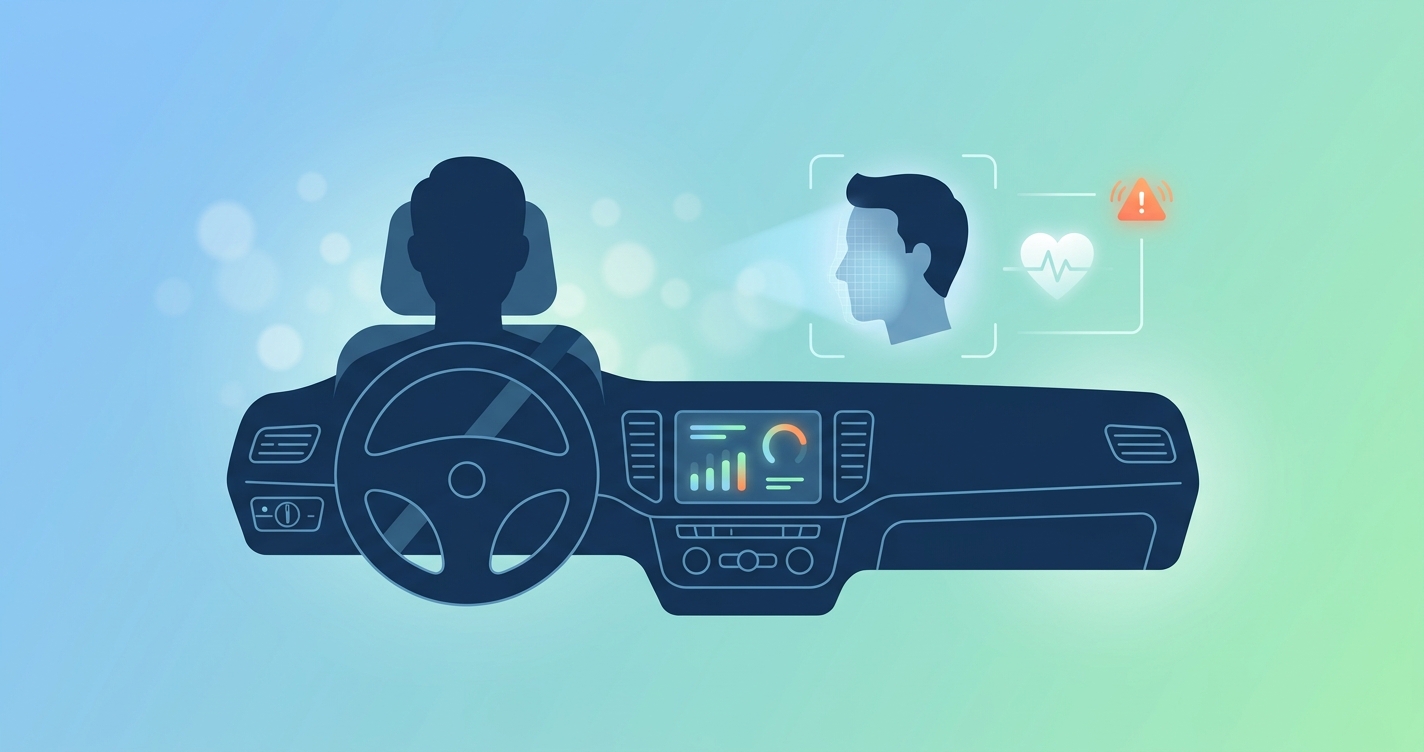
The phrase ride hail platform driver wellness scoring sounds like a product label, but the underlying issue is much more operational. Ride-hail networks need to know when a driver is drifting into fatigue, stress, distraction, or reduced responsiveness before a bad shift turns into a crash, a rider complaint, or a medical event. That is why the conversation is moving beyond basic telematics. More platforms now think in terms of continuous driver-state signals, where schedule patterns, trip density, camera-based monitoring, and in-cabin vital-sign estimation can feed a real-time view of driver readiness.
"Driver fatigue in taxi, ride-hailing, and ridesharing services is linked to long working hours, irregular schedules, and economic pressure." — Saeed Jaydarifard, Krishna Behara, Douglas Baker, and Alexander Paz, systematic review (2024)
Ride hail platform driver wellness scoring starts with exposure, not diagnosis
Most serious ride-hail safety programs are not trying to turn the vehicle into a clinic. They are trying to reduce exposure to known safety risks.
That distinction matters. A workable wellness score is usually a decision layer, not a single biometric reading. It combines several classes of signals:
| Signal class | What platforms can observe | What it may indicate | Best operational use |
|---|---|---|---|
| Shift and duty-cycle data | Consecutive hours, night driving, trip density, idle gaps | Fatigue buildup, sleep debt, reduced vigilance | Dispatch throttling, break prompts |
| Driving behavior | Harsh braking, lane drift proxies, inconsistent speed control | Cognitive overload, distraction, degraded alertness | Risk escalation and coaching |
| In-cabin computer vision | Eye closure, gaze diversion, head pose, blink rate | Drowsiness, distraction, microsleep risk | Real-time warnings |
| Contactless vital signs | Heart rate, respiratory patterns, stress-related variability trends | Physiologic strain or acute distress | Confidence scoring, escalation logic |
| Platform context | Rider complaints, route complexity, surge pressure, airport queue time | Stress concentration and task load | Scheduling and intervention policies |
The strongest wellness scoring models do not treat one signal as truth. They fuse weak signals into a practical risk estimate. That is closer to how fleet safety teams actually operate.
Research backs the need for that broader view. Jaydarifard and colleagues found that taxi, ride-hail, and ridesharing drivers face a recurring mix of long hours, income pressure, circadian disruption, and fragmented rest. A platform that scores wellness only from trip history will miss the driver who looks fine on paper but is visibly deteriorating in the cabin. A system that only looks at a face camera will miss the scheduling context that made the driver unsafe in the first place.
- Wellness scoring works best as a layered risk model.
- Scheduling data explains exposure.
- In-cabin sensing explains current state.
- Escalation policy determines whether the score actually changes outcomes.
Why ride-hail workflows make real-time scoring harder than fleet scoring
Traditional fleets have dispatch control, fixed rosters, and more direct labor oversight. Ride-hail networks do not. Drivers sign on and off dynamically, stack shifts around other work, and often push through fatigue because earnings are tied to availability.
That platform structure changes the design requirements.
Ride-hail platforms need lighter, faster interventions
A long-haul fleet can mandate a stop. A ride-hail platform often cannot. Its options are softer but still useful:
- limit new trip offers after elevated fatigue risk
- insert break nudges between airport or late-night runs
- raise thresholds for accepting high-complexity trips
- trigger in-app check-ins after stress or drowsiness events
- escalate to emergency workflows if driver responsiveness drops sharply
The score has to be interpretable
If a platform safety team cannot explain why a driver was paused, the system will create friction fast. Simple inputs such as late-night duty accumulation, repeated high-PERCLOS events, and persistent gaze-off-road patterns are easier to defend than opaque black-box scoring.
Privacy architecture matters
That is one reason edge processing keeps coming up in automotive monitoring research. The 2022 paper by Ashutosh Mishra, Jaekwang Cha, and Shiho Kim on privacy-preserved in-cabin monitoring argued that edge devices can anonymize identity before any video frames are transmitted. For ride-hail operators, that approach is practical: sensitive cabin data can stay local while the platform receives event-level metadata rather than raw continuous video.
Industry applications for ride-hail operators and mobility teams
Marketplace trust and safety teams
Trust and safety teams care about event prevention. A wellness score can help them flag drivers who are still technically active but are trending toward unsafe operation. The value is not just crash prevention. It also improves rider confidence, reduces severe incidents, and gives platforms a more structured basis for intervention.
Insurance and risk operations
Insurers and internal risk teams want cleaner exposure models. A static driver score based only on history says little about a difficult Saturday-night shift after ten hours on the road. Real-time wellness scoring adds temporal context. It can distinguish baseline driver risk from shift-specific deterioration.
Mobility product teams
Product teams can use wellness scoring to tune dispatch logic. A platform may choose to avoid stacking airport pickups on a driver showing repeated fatigue markers, or reduce assignment of high-complexity urban trips during periods of elevated stress probability.
Current research and evidence
Several research threads are shaping how real-time wellness scoring is likely to evolve.
First, the occupational evidence is clear that platform drivers sit in a high-risk environment for fatigue and health strain. The 2024 systematic review by Saeed Jaydarifard, Krishna Behara, Douglas Baker, and Alexander Paz tied fatigue in taxi, ride-hail, and ridesharing work to long duty cycles and unstable schedules. That is the scheduling side of the problem.
Second, the broader labor-health evidence points in the same direction. In their 2025 scoping review on platform-mediated gig work and health, Shehan De Saram, Sonali Galagedara, Anne Perera, Ama Priyankara, and Vageesha Rajapakse found consistent links between gig-work structure and stress, sleep disruption, and poor mental-health outcomes. That matters because a wellness score should not assume fatigue is the only signal worth tracking.
Third, the sensing layer is improving. Ewa M. Nowara, Tim K. Marks, Hassan Mansour, and Ashok Veeraraghavan showed in SparsePPG (2018) that camera-based vital-sign estimation in near-infrared cabin settings can recover physiologic information useful for driver monitoring. More recently, Tayssir Bouraffa, Dimitrios Koutsakis, and Salvija Zelvyte published a 2025 automotive rPPG benchmark study showing that motion and illumination remain serious challenges, but also confirming that in-cabin vital-sign sensing is maturing into a real engineering path rather than a lab novelty.
That combination is important. Ride-hail platforms do not need perfect medical-grade inference to gain value. They need enough signal quality to improve confidence around interventions such as break prompts, trip throttling, or emergency escalation.
What the current evidence suggests for scoring design
| Evidence source | Authors / institution context | Practical lesson for ride-hail scoring |
|---|---|---|
| Driver fatigue systematic review (2024) | Jaydarifard, Behara, Baker, Paz | Shift design and economic pressure are core fatigue drivers |
| Platform-mediated gig work and health review (2025) | De Saram, Galagedara, Perera, Priyankara, Rajapakse | Stress and health burden should be modeled alongside fatigue |
| SparsePPG (CVPR Workshops, 2018) | Nowara, Marks, Mansour, Veeraraghavan | NIR cabin cameras can support contactless vital-sign estimation |
| Automotive rPPG benchmark (WACV Workshops, 2025) | Bouraffa, Koutsakis, Zelvyte | Real vehicles create motion and lighting problems, so confidence scoring matters |
| Privacy-preserved in-cabin monitoring (2022) | Mishra, Cha, Kim | Edge anonymization is a practical path for privacy-sensitive deployment |
The future of ride-hail wellness scoring
I do not think the end state is a single universal score shown on a dashboard. The more realistic outcome is a stack of narrow models that feed one operational readiness layer.
One model will estimate fatigue exposure from hours, break gaps, and time of day. Another will look at real-time in-cabin indicators such as gaze, blink behavior, and head pose. Another may add contactless cardio-respiratory signals when the hardware supports it. The platform will then use those inputs to make small decisions: offer a break, pause new trips, escalate an alert, or trigger an emergency workflow.
That also lines up with where safety policy is headed. Euro NCAP's 2026 direction gives more weight to systems that can detect an unresponsive or impaired driver and support controlled intervention. Ride-hail programs are not identical to OEM safety programs, but the signal is the same: passive logging is no longer enough.
The practical future probably looks like this:
- edge processing handles the privacy-sensitive first layer in the cabin
- platform systems ingest compact risk events rather than raw biometric streams
- dispatch engines use readiness scores to shape trip allocation
- trust and safety teams use the same data for incident prevention, not just post-event review
Frequently Asked Questions
What is a driver wellness score in ride-hailing?
A driver wellness score is an operational estimate of driver readiness built from signals such as shift duration, fatigue indicators, distraction events, and sometimes in-cabin physiologic measurements. It is usually meant to guide intervention, not diagnose a medical condition.
Is wellness scoring the same as driver monitoring?
No. Driver monitoring is the sensing layer. Wellness scoring is the decision layer that combines those signals with work-pattern and platform context.
Why would ride-hail platforms use contactless vital signs at all?
Because camera-based heart-rate or respiration trends can add confidence when a platform needs to tell the difference between normal workload and a driver who may be under acute strain or becoming unresponsive.
Does every ride-hail program need full biometric monitoring?
Not necessarily. Many programs can gain value from shift analytics and attention monitoring alone. Contactless vital-sign sensing becomes more useful when the platform wants stronger escalation logic for fatigue, stress, or emergency-response workflows.
For mobility teams evaluating safer in-cabin monitoring, solutions like Circadify's automotive cabin program are aimed at that next layer of contactless sensing. For related analysis, see How Last-Mile Delivery Companies Detect Driver Fatigue and Driver Health Analytics: From Raw Data to Actionable Alerts.