How to Reduce Fleet Crashes With Driver Health Monitoring
A practical guide to fleet driver health monitoring: how in-cabin vital sign tracking cuts crash rates, reduces downtime, and lowers at-fault claims.
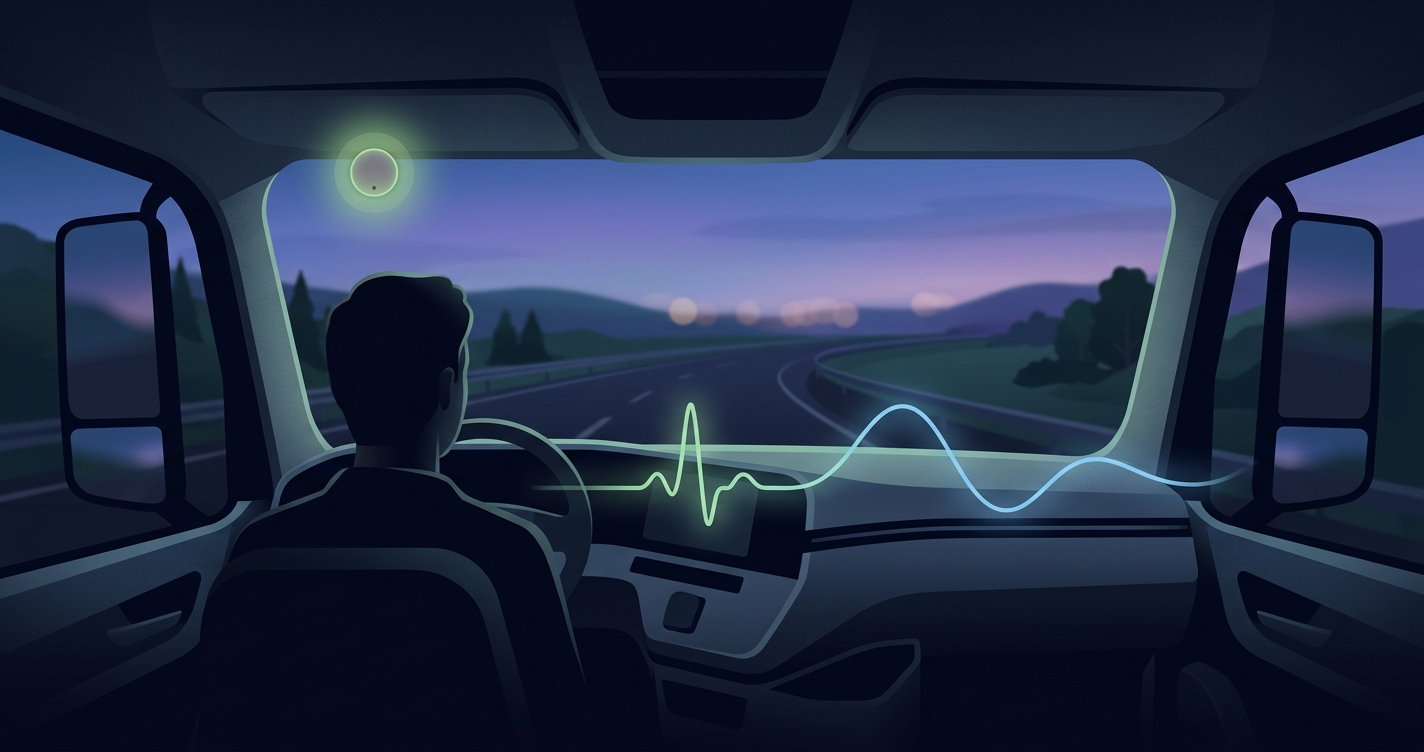
Most fleet crash-reduction programs start at the wrong end of the problem. They react to the event that already happened: the hard-braking alert, the dashcam clip, the insurance claim. By the time those signals fire, the physiological conditions that caused the incident have usually been building for minutes or hours. Fleet driver health monitoring reverses that order. Instead of grading drivers after a near-miss, in-cabin systems read the body signals that precede impairment, giving safety managers a window to intervene before a tired or stressed driver becomes a statistic. For fleet management companies measured on accident frequency, downtime, and insurance loss ratios, that shift from reactive to predictive is where the real savings sit.
The Federal Motor Carrier Safety Administration estimates that driver fatigue contributes to roughly 13 percent of all commercial motor vehicle crashes, while the Governors Highway Safety Association puts suspected drowsy-driving deaths for 2023 above 6,300 nationwide, nearly ten times higher than the official count.
What fleet driver health monitoring actually measures
Fleet driver health monitoring uses an inward-facing camera and sensor stack to track the physiological and behavioral markers that signal declining fitness to drive. Older driver wellness tracking fleet tools relied almost entirely on steering input and lane position, which only flag a problem once the vehicle is already drifting. Modern in-cabin health monitoring adds a layer underneath that: eyelid closure rate (PERCLOS), blink dynamics, head pose, yawning frequency, and camera-based vital signs such as heart rate and respiration estimated through remote photoplethysmography (rPPG).
The distinction matters for fleet safety monitoring because behavioral signs and physiological signs degrade on different timelines. A driver's heart rate variability and breathing pattern can shift well before their eyelids start to droop, and long before the truck wanders out of its lane. Catching the earliest reliable signal is the difference between a coaching nudge and a crash report.
The data feeds three layers of response:
- In-cabin alerts that wake or refocus the driver in real time
- Fleet-level dashboards that surface fatigue and stress patterns across routes, shifts, and individual drivers
- Longitudinal wellness trends that help managers fix the root causes, such as scheduling and rest gaps
How in-cabin monitoring compares to older fleet safety tools
Fleet operators rarely start from zero. Most already run telematics, GPS, and possibly an outward-facing dashcam. The question is what camera-based driver health monitoring adds on top of that existing stack.
| Capability | GPS and Telematics | Outward Dashcam | Behavioral DMS Camera | Health-Aware In-Cabin Monitoring |
|---|---|---|---|---|
| Detects speeding and harsh braking | Yes | Partial | No | No |
| Captures road-facing crash footage | No | Yes | No | No |
| Flags distraction and phone use | No | No | Yes | Yes |
| Detects drowsiness via eyelids and head pose | No | No | Yes | Yes |
| Reads vital signs (heart rate, respiration) | No | No | No | Yes |
| Warns before impairment is visible | No | No | Partial | Yes |
| Supports proactive driver coaching | Partial | Partial | Yes | Yes |
The pattern is clear. Telematics and dashcams document what a vehicle did. Behavioral driver monitoring catches what a driver is doing. Health-aware monitoring estimates the driver's internal state, which is the variable that actually predicts the next incident.
Why this cuts crashes and downtime
The accident math behind drowsy and impaired driving is stark. The Insurance Institute for Highway Safety reported 4,354 deaths in large-truck crashes in 2023, with about 65 percent of those killed being occupants of cars and other passenger vehicles rather than truck drivers themselves. Survey data cited by FMCSA-aligned researchers indicates roughly 65 percent of truck drivers admit to driving drowsy at least occasionally, and nearly half report having fallen asleep at the wheel.
Intervention studies suggest the upside is measurable, not theoretical:
- Fleets adopting integrated management technology have reported accident reductions of up to 43 percent, according to 2024 fleet technology trend reporting.
- A 2024 study of 1,200 fleet operators found a 17 percent decrease in preventable accidents among fleets using telematics-driven driver coaching.
- AI-assisted in-cab monitoring paired with coaching has been linked to 30 to 40 percent reductions in at-fault claims.
- Behavior-based safety programs with proactive coaching have cut incidents by as much as 20 percent.
The downtime case is just as direct. A single fatigue-related collision pulls a vehicle out of service, triggers investigation and repair cycles, and raises premium exposure across the whole fleet. Preventing one serious incident often outweighs the cost of equipping multiple cabins.
Industry Applications
Long-Haul Trucking
Long-haul is where fatigue risk concentrates. Hours-of-service rules cap driving time, but compliance does not guarantee alertness, especially on overnight runs against the circadian low between roughly 2 a.m. and 6 a.m. Health-aware monitoring catches the gap between a legally compliant schedule and an actually rested driver. Stress signals also matter here, since chronic tension and poor sleep compound fatigue over multi-day routes.
Last-mile and delivery fleets
Last-mile drivers face a different risk profile: dense urban traffic, frequent stops, tight delivery windows, and high distraction load. For these fleets, fleet safety monitoring leans more heavily on distraction detection and acute stress signals than on deep-sleep fatigue. The early physiological signs of illness, which raise resting heart rate before a driver feels symptoms, are also relevant for fleets running thin coverage where one sick driver disrupts a full route.
Mixed and transitioning fleets
Operators running electric vehicles alongside diesel face subtler fatigue patterns. The quiet, low-vibration cabin of an EV can mask the sensory cues drivers traditionally relied on to gauge their own tiredness. In-cabin health monitoring restores an objective measure that does not depend on the driver's self-assessment, which research consistently shows is unreliable once fatigue sets in.
Current research and evidence
The research consensus has moved from whether monitoring helps to how much. Independent traffic-safety analysis has estimated that broad deployment of driver monitoring systems could reduce road deaths by a meaningful fraction, with one widely cited projection suggesting roughly a third of relevant fatalities could be addressed. The 2024 work-truck and fleet technology studies referenced above show double-digit reductions in preventable incidents wherever monitoring is paired with structured coaching rather than passive recording.
Two findings recur across the literature. First, alerts alone produce smaller gains than alerts plus coaching, because the durable behavior change comes from the feedback loop, not the buzzer. Second, physiological monitoring catches a class of risk that behavioral-only systems miss, since heart rate and respiration shifts can precede the visible eyelid and head-pose changes that traditional drowsiness detection depends on. The newest driver wellness tracking fleet approaches reflect this by fusing physiological and behavioral data rather than treating them as separate channels.
It is worth being precise about limits. Camera-based vital sign estimation in a moving cabin contends with vibration, changing light, and occlusion, so current systems are best understood as continuous risk indicators rather than medical instruments. The value for fleets comes from trend detection and timely intervention, not diagnosis.
The future of fleet driver health monitoring
Three trajectories are shaping the next several years. Regulation is the strongest pull: driver monitoring requirements have moved from voluntary safety ratings into mandates across major markets, which means OEMs and Tier-1 suppliers are building DMS hardware into cabins by default. Fleets that adopt now align with where the regulatory baseline is heading rather than retrofitting under pressure later.
The second trajectory is sensor fusion. Standalone fatigue cameras are giving way to platforms that combine behavioral cues, camera-based vitals, and vehicle telematics into a single risk score, with edge processing keeping sensitive health data inside the cabin rather than streaming it to the cloud. The third is integration with ADAS, where the vehicle's response can scale to the driver's measured state, from a gentle alert to assisted intervention when impairment is severe.
For fleet management companies, the strategic question is no longer whether to monitor driver health, but how to deploy it in a way drivers trust and managers can act on. Privacy-conscious, edge-first designs that frame monitoring as protection rather than surveillance see far higher adoption and far better safety outcomes.
Frequently asked questions
How is fleet driver health monitoring different from a standard dashcam?
A dashcam records footage for review after an event, usually facing the road. Fleet driver health monitoring uses an inward-facing camera and sensors to read the driver's state in real time, including drowsiness, distraction, and camera-based vital signs like heart rate and respiration. The goal is to warn before an incident, not just document it afterward.
Does in-cabin health monitoring actually reduce crash rates?
Evidence points to meaningful reductions when monitoring is paired with coaching. Reported figures include up to 43 percent fewer accidents with integrated fleet technology, a 17 percent drop in preventable accidents among fleets using data-driven coaching, and 30 to 40 percent fewer at-fault claims with AI-assisted in-cab systems.
Will drivers accept being monitored?
Acceptance depends on design and framing. Systems that process data at the edge, keep health information private, and use it for protection and coaching rather than punishment see substantially higher driver buy-in. Transparency about what is measured and why is the single biggest factor in adoption.
Can camera-based vital signs be trusted in a moving truck?
Camera-based vital sign estimation works in moving cabins but contends with vibration, lighting changes, and occlusion. Current systems are best treated as continuous risk indicators that flag trends and trigger timely intervention, not as medical-grade diagnostic devices.
Circadify is building camera-based, edge-first in-cabin monitoring designed for exactly this problem: detecting driver fatigue, drowsiness, and stress early enough to prevent crashes and protect uptime across a fleet. Fleet management companies evaluating a deployment can request a fleet pilot through Circadify's automotive program at circadify.com/custom-builds/automotive-cabin.