NIR vs RGB Cameras for Driver Vital Signs: Sensor Selection Guide
A practical nir vs rgb camera driver vital signs analysis for OEM and fleet teams comparing lighting robustness, signal quality, privacy, and integration tradeoffs.
NIR vs RGB Cameras for Driver Vital Signs: Sensor Selection Guide
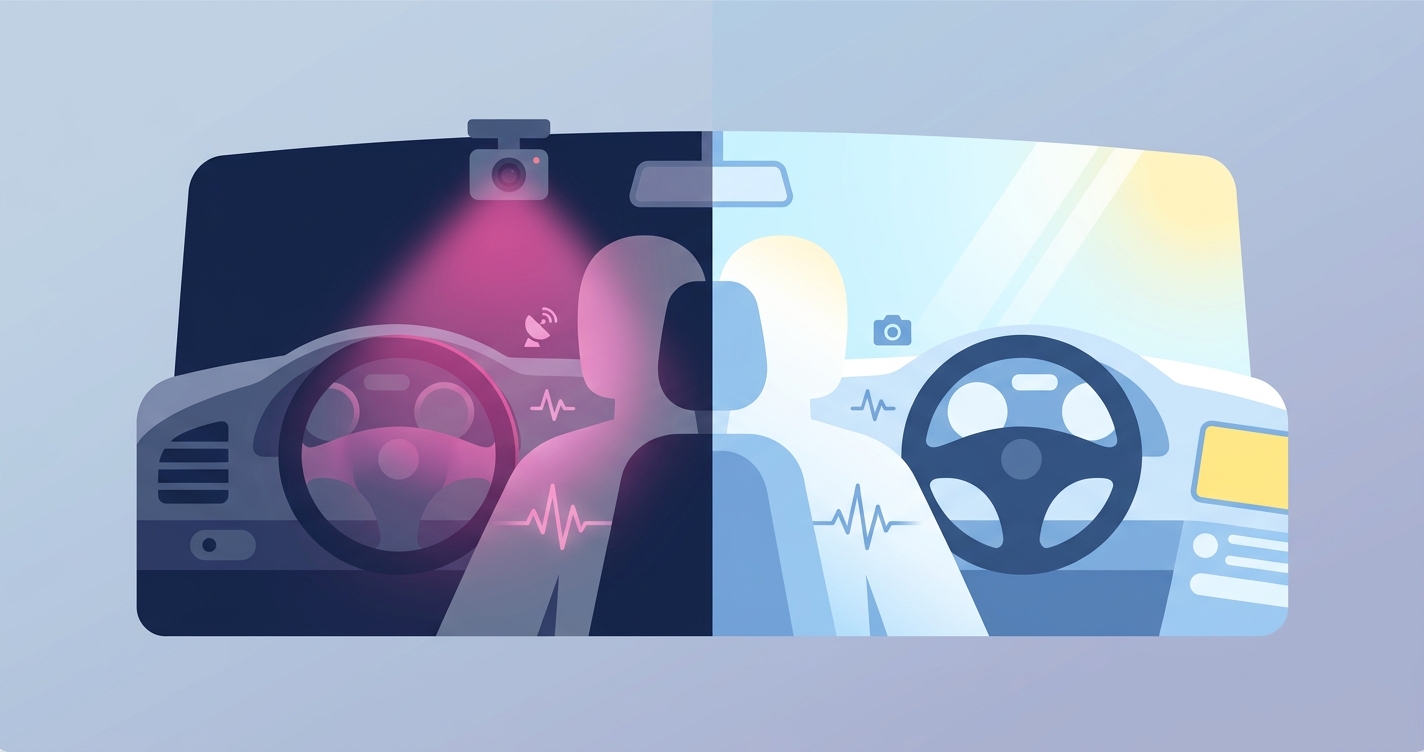
The nir vs rgb camera driver vital signs debate keeps coming up because automotive teams are no longer evaluating cabin cameras only for gaze and drowsiness. They are also asking whether the same sensor stack can support heart rate, respiration, stress proxies, and unresponsive-driver detection without adding another device in the cabin. That makes sensor selection less of a component question and more of a platform choice. RGB cameras usually give stronger color-based physiological signals in favorable light. NIR cameras usually hold up better when the cabin does what real cabins do: go dark, flare with sun, pick up shadows, and shift conditions every few seconds.
“The experimental results showed that the proposed method outperformed state-of-the-art methods for both RGB and NIR images, with RMSE improving by up to 42.6% at night.” — Li-Wen Chiu, Yang-Ren Chou, Yi-Chiao Wu, and Bing-Fei Wu, IEEE Transactions on Instrumentation and Measurement (2023)
NIR vs RGB camera driver vital signs: what teams are actually choosing between
At a high level, RGB and NIR cameras are not interchangeable, even when they sit in nearly the same place on the dashboard or steering column.
RGB cameras capture visible-light color variation. That matters for remote photoplethysmography because blood volume changes can be estimated from subtle shifts in reflected light, especially in the green channel. In stable lighting, that is a real advantage. The signal is often stronger, the tooling is broader, and many early rPPG pipelines were built around visible-light datasets.
NIR cameras work differently. They rely on near-infrared wavelengths and often pair with active illumination, which gives the system more control over the cabin scene. That control matters in vehicles. J. A. O'Sullivan, S. M. C. Lee, and J. M. O'Sullivan showed as early as 2015 that near-infrared imaging photoplethysmography could measure heart rate during driving, even with the motion and environmental instability that make in-cabin sensing hard.
That is why the sensor choice usually comes down to one practical question: do you want the strongest signal in ideal conditions, or the most stable signal across ugly ones?
Side-by-side sensor comparison
| Dimension | RGB camera | NIR camera |
|---|---|---|
| Best lighting condition | Daylight or controlled visible light | Low light, night driving, controlled active illumination |
| rPPG signal strength | Usually stronger in ideal visible-light conditions | Usually weaker than RGB, but more stable in poor light |
| Sensitivity to sun glare and shadows | High | Lower |
| Night driving performance | Limited without added lighting | Stronger fit |
| Typical DMS alignment | Good for broader cabin imaging | Strong for eye tracking and fatigue sensing |
| Active illumination support | Not typical | Common |
| Privacy perception | More visually identifiable imagery | Often viewed as slightly less intrusive, though still biometric |
| Sensor stack complexity | Lower if visible-light camera already exists | Higher if dedicated NIR illuminators are needed |
| Best fit | Consumer-grade cabins with favorable lighting | Safety-critical monitoring with variable real-world conditions |
That table is the short version. The real design decision gets more interesting once the deployment context is clear.
- RGB is attractive when teams want signal richness from a simpler vision stack.
- NIR is attractive when teams care more about consistency across lighting transitions.
- Hybrid RGB-NIR designs make sense when the vehicle program can justify extra sensor cost for broader operating coverage.
Why NIR keeps winning the automotive argument
NIR has a built-in automotive advantage: it lets the system take back some control from the environment.
That matters because cabins are hostile sensing environments. Drivers rotate their heads, pass through tunnels, wear glasses, encounter hard sunlight, then shift into dim evening light a few minutes later. A lab-clean rPPG pipeline can fall apart fast under those conditions. Ewa Magdalena Nowara, Tim K. Marks, Hassan Mansour, and Ashok Veeraraghavan tackled exactly that issue in SparsePPG, where they used narrow-band 940 nm active illumination and a denoising pipeline aimed at motion-heavy driver monitoring scenarios. Their point was not that NIR is magically noise-free. It was that NIR gives engineers a better starting point when illumination is otherwise chaotic.
NIR also fits naturally with established driver monitoring work. Driver-facing DMS stacks already use infrared imaging for eye tracking, eyelid closure, and PERCLOS-style fatigue analysis because pupils and eyelid boundaries are easier to isolate under infrared illumination. If the same sensor family can support both classic attention monitoring and at least part of a vital-signs pipeline, the architectural case gets stronger.
For OEM and Tier-1 teams, that often leads to a simple conclusion: NIR may not always produce the prettiest physiological signal, but it is often the safer production bet.
Where RGB still has a real edge
It would be a mistake to treat RGB as the weaker option across the board. In good lighting, RGB still has compelling strengths.
Visible-light imaging generally offers richer skin-tone variation for color-based pulse extraction. That is one reason so much of the early rPPG literature leaned on RGB data. In the 2023 driving-scenario study by Chiu, Chou, Wu, and Wu, the researchers reported strong performance from both RGB and NIR models, while also showing that RGB benefited meaningfully from improved deep-learning reconstruction and heart-rate estimation pipelines.
RGB cameras can also simplify product planning when the cabin already includes a visible-light sensor for other functions such as occupant monitoring, video calling, or in-cabin UX. In those cases, teams sometimes ask whether one camera can do enough of everything. If the target use case is daytime operation, non-safety-critical wellness sensing, or feature expansion in premium vehicles, RGB can look appealing.
Still, the tradeoff is hard to ignore:
- RGB often delivers stronger physiology signals when light is stable.
- RGB usually struggles more with glare, shadows, and abrupt transitions.
- RGB-only designs can become brittle if night use or all-weather coverage is part of the safety case.
That is why RGB rarely wins the argument by itself in serious driver-state programs. It usually wins as part of a broader stack.
Industry applications by buyer type
Passenger vehicle OEMs
For OEMs, the deciding factor is usually coverage, not elegance. If the system has to work on city streets, highways, tunnels, parking garages, and night driving without asking anything from the driver, NIR is usually the more defensible base sensor. RGB can still add value for richer cabin perception or premium feature layers.
Tier-1 suppliers
Tier-1s care about reuse across programs. A sensor stack that depends on ideal visible-light conditions is harder to standardize. NIR-heavy designs often align better with existing driver monitoring hardware, especially when the goal is one cabin camera platform that can support gaze, drowsiness, and future physiological features.
Commercial fleets
Fleets usually care less about maximum signal quality and more about uptime. For long-haul trucking, transit, and industrial vehicles, a system that keeps working after sunset matters more than one that benchmarks well at noon. That pushes many fleet programs toward NIR-first or hybrid sensor plans.
Advanced research and premium platforms
This is where RGB-NIR fusion becomes more attractive. Tayssir Bouraffa, Ziyuan Wang, and Daniel Strüber proposed a feature-disentangling RGB-NIR fusion network to improve remote driver physiological measurement in dynamic vehicle settings. That work reflects where the field is heading: not toward a permanent winner, but toward sensor fusion that borrows RGB signal richness and NIR robustness at the same time.
Current research and evidence
The research base has moved past a simplistic “pick one forever” framing.
O'Sullivan, Lee, and O'Sullivan's 2015 paper established that near-infrared imaging photoplethysmography during actual driving was feasible. That was important because it moved the conversation from theory into a real automotive environment.
Nowara, Marks, Mansour, and Veeraraghavan followed with SparsePPG, showing why NIR plus active illumination had practical value for driver monitoring. Their work focused on motion, illumination change, and low signal-to-noise ratio, which are exactly the variables cabin programs wrestle with.
Then the 2023 IEEE study from Li-Wen Chiu and colleagues pushed the comparison further. The team tested RGB and NIR models under night driving, rainy days, head motion, and long-term journeys. According to the paper summary surfaced through Circadify's agent-search workflow, their approach improved RMSE by 28.6% for RGB and 21.91% for NIR under head-motion conditions, with nighttime improvement reaching 42.6%. That is a useful finding because it says two things at once: both modalities can improve a lot with better modeling, and night performance remains a special pressure point.
More recent work from Bouraffa, Wang, and Strüber suggests fusion may become the serious answer for premium architectures. If one modality weakens under a given condition, the other can stabilize the estimate.
What current evidence suggests
| Research direction | What it implies for sensor choice |
|---|---|
| Early driving studies with NIR | NIR is viable for real in-cabin pulse estimation |
| RGB and NIR deep-learning comparisons | Both can work, but robustness depends heavily on conditions and modeling |
| SparsePPG and active illumination work | Controlled NIR lighting is valuable in moving vehicles |
| RGB-NIR fusion research | Hybrid systems may outperform single-modality stacks in premium programs |
| Production DMS requirements | NIR remains easier to justify for all-light driver-state coverage |
The larger pattern is pretty clear. If the program is safety-linked, lighting robustness dominates the spec sheet. If the program is exploratory or comfort-oriented, RGB can look more attractive.
The future of sensor selection in driver vital signs
I do not think the long-term answer is “NIR everywhere” or “RGB everywhere.” It is more specific than that.
For mainstream driver monitoring, NIR still looks like the stronger primary sensor because it matches how automotive systems are validated: worst-case conditions first. For broader physiological measurement, RGB still matters because the color information is useful and the sensor cost can be lower when visible-light hardware already exists. For the most ambitious programs, the future is likely RGB-NIR fusion with better onboard quality scoring so the system knows when to trust one stream more than the other.
That shift matters for roadmap planning in 2026 and 2027. Teams are not only choosing a camera. They are choosing how much environmental uncertainty they want to absorb in software later.
A rough rule holds up surprisingly well:
- Choose NIR-first when reliability across lighting conditions is non-negotiable.
- Choose RGB-first when the use case is less safety-critical and the cabin already supports strong visible-light capture.
- Choose RGB-NIR fusion when the platform can afford extra complexity and wants wider operating coverage.
Frequently Asked Questions
Is NIR or RGB better for driver vital signs?
For most automotive safety use cases, NIR is usually the better base sensor because it performs more consistently in low light and under changing illumination. RGB can produce stronger rPPG signals in stable visible light.
Why do driver monitoring systems often use infrared cameras?
Infrared cameras make eye tracking and fatigue sensing more reliable in dark or variable lighting. That same lighting control can also help contactless physiological measurement.
Can RGB cameras measure heart rate in vehicles?
Yes. RGB cameras can support remote photoplethysmography, especially in favorable lighting. The challenge is that vehicles rarely stay in favorable lighting for long.
Are hybrid RGB-NIR systems worth it?
They can be, especially for premium or research-driven vehicle programs. Fusion models can combine RGB signal richness with NIR robustness, though they add hardware and software complexity.
What is the safest production choice for OEMs today?
For programs tied to driver-state reliability across day and night conditions, NIR is usually the more conservative and production-ready starting point.
For teams evaluating sensor stacks for in-cabin health and driver-state monitoring, solutions like Circadify's automotive cabin program are aimed at real vehicle architectures rather than lab-only demos. For related analysis, see our coverage of camera-based driver monitoring systems and automotive rPPG and in-cabin vitals.