How Mining and Heavy Equipment Operators Use Driver Monitoring
Research-based analysis of how mining heavy equipment driver monitoring helps haul fleets reduce fatigue risk, improve operator safety, and build more measurable fatigue management programs.
How Mining and Heavy Equipment Operators Use Driver Monitoring
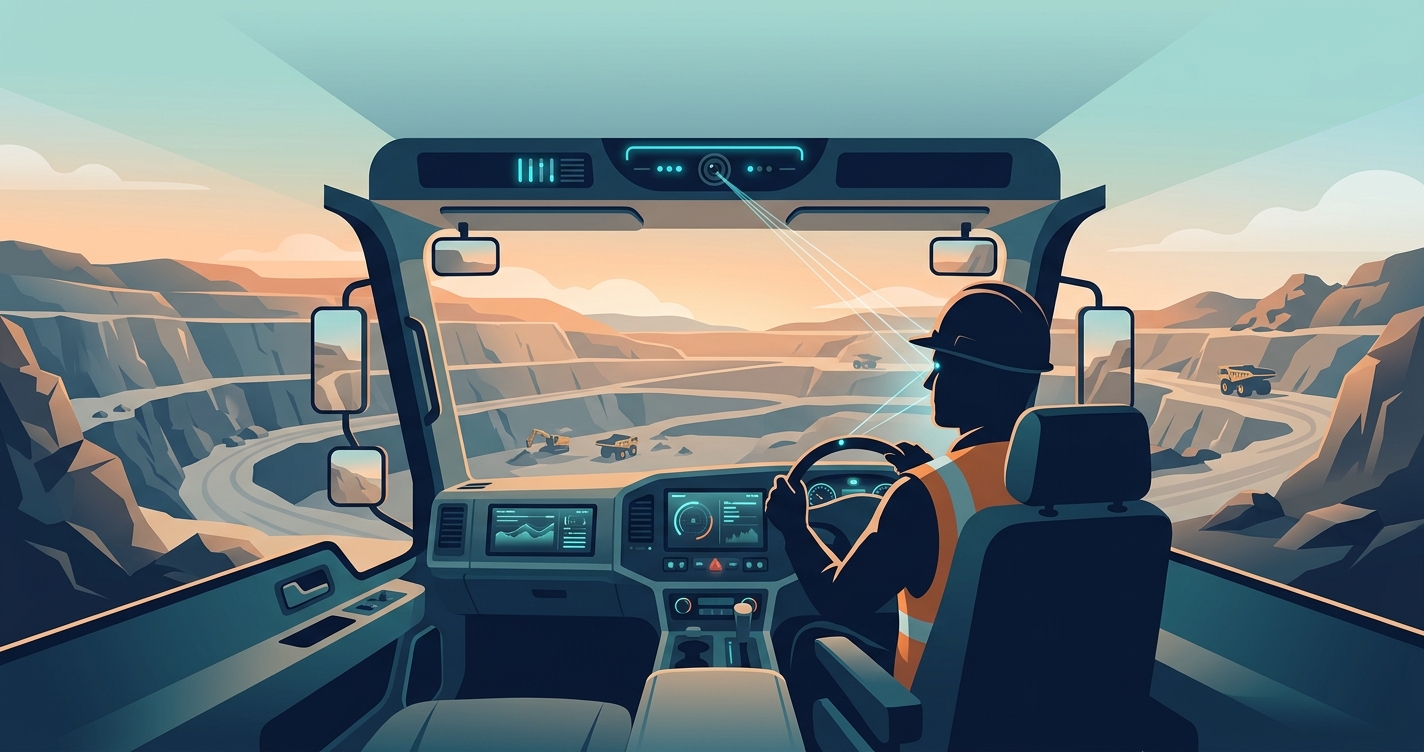
Mining is one of the few industries where driver monitoring was not first treated as a convenience feature. It was treated as a survival tool. That distinction matters. In open-pit mines, operators handle haul trucks, loaders, and auxiliary equipment that outweigh highway vehicles by an order of magnitude, move through dusty low-contrast environments, and often run through the circadian dead zone under punishing shift schedules. In that setting, mining heavy equipment driver monitoring is less about checking whether an operator looked away for two seconds and more about catching the physiological slide toward fatigue before a haul truck becomes an unguided projectile. The most mature programs now combine in-cab cameras, eyelid metrics, fatigue scoring, dispatch workflows, and formal fatigue risk management systems rather than relying on rules about hours worked alone.
"Fatigue is a major contributor to accidents and incidents in the mining industry." — P.C. Schutte, CSIR Centre for Mining Innovation, South Africa
Mining heavy equipment driver monitoring and why mines adopted it early
Mining operators adopted driver monitoring earlier than many passenger-vehicle programs because the operational math was brutal. A single fatigue event in a haul truck, dozer, or water cart can shut down production, damage equipment, injure workers, and trigger regulatory review.
Research from Tim Horberry, Jill Harris, and David Cliff at the University of Queensland has described mining fatigue as a systems problem, not just an individual behavior problem. Their work on fatigue management in mining argued that roster design, commute time, heat, vibration, monotonous routes, and poor sleep opportunities all stack together. That is why mines moved toward layered controls: scheduling, fatigue education, fit-for-duty practices, and in-cab monitoring.
Caterpillar Global Mining has been widely cited in industry reporting for an estimate that fatigue may contribute to roughly 65% of haul-truck incidents. Even if individual sites debate the exact percentage, the number keeps showing up because it matches what mine managers already know from experience: the highest-cost events often begin with a tired operator missing an obvious cue.
Comparison of mining driver monitoring approaches
| Approach | What it measures | Strength in mine operations | Main limitation |
|---|---|---|---|
| Camera-based eyelid and face monitoring | PERCLOS, blink duration, gaze, head pose | Strong for real-time drowsiness detection in haul trucks and cabs | Needs tuning for dust, vibration, eyewear, and low light |
| Wearable fatigue tracking | Sleep quantity, heart rate, activity, alertness proxies | Useful for pre-shift risk scoring and sleep coaching | Compliance drops if operators stop wearing devices |
| Hours-of-service or shift-rule controls | Time on task, break timing, roster compliance | Good baseline policy control | Does not measure actual alertness |
| Telematics and vehicle behavior | Lane drift, harsh inputs, route deviation, speed anomalies | Useful after fatigue begins affecting machine control | Often detects risk late |
| Full fatigue risk management system (FRMS) | Combines monitoring, scheduling, escalation, and reporting | Best fit for enterprise mine safety programs | Requires operational discipline, not just hardware |
A lot of mines learned the same lesson: alerting technology works better when it feeds an operating model. A beeping camera alone is not a fatigue program.
What the systems actually watch inside the cab
The core metric in many mining deployments is PERCLOS, short for percentage of eyelid closure over time. Richard Grace at Carnegie Mellon Research Institute helped popularize PERCLOS as a practical drowsiness signal, and later transportation work at the Virginia Tech Transportation Institute reinforced its value in real-world monitoring. In mining, that metric has appeal because it is passive and continuous. The operator does not need to touch anything.
Modern systems generally look at several signals at once:
- eyelid closure duration and blink frequency
- head nodding and forward tilt
- gaze deviation and long off-path glances
- facial signs associated with microsleeps or fatigue
- contextual data such as shift timing, duration on task, and prior alerts
Mining environments force the hardware and software to work harder than they would in a passenger car.
- Dust lowers image clarity.
- Whole-body vibration shakes the camera and the driver.
- Low-light and night operations require infrared support.
- Hard hats, eyewear, and reflective surfaces complicate face tracking.
- Repetitive routes make fatigue harder to spot from steering behavior alone.
That is why mines often favor ruggedized in-cab systems with infrared illumination and edge processing. The camera has to keep producing usable eyelid and face data when the operator is traveling over rough haul roads at 3 a.m., not just during a clean daytime demo.
Why mining fatigue looks different from highway fatigue
Mine operators share some fatigue risks with truck drivers, but the environment changes the profile.
First, the work is repetitive. Haul routes can become cognitively dull, especially on night shift. Second, the equipment is physically punishing. Whole-body vibration adds a layer of strain that road-vehicle studies often understate.
Researchers including Vivekanand Kumar, Sanjay K. Palei, Netai C. Karmakar, and Dhananjay K. Chaudhary at the Indian Institute of Technology (BHU) examined dumper operators in coal mines and found moderate to high whole-body-vibration exposure with elevated musculoskeletal risk, especially lower-back pain. That matters for driver monitoring because an exhausted operator is not only sleepy. They may also be sore, less reactive, and less able to maintain stable posture over a long shift.
NIOSH researchers have made a similar point from the occupational-health side: fatigue in mining is tied to long shifts, commute burden, heat, sleep restriction, and the physiological load of the work environment itself. In other words, the operator arrives in the cab with fatigue risk already building. The camera only sees the final stage unless the mine links it with roster and health data.
Key operational indicators mines track
- number of fatigue alerts per 1,000 operating hours
- repeat alerts by operator, crew, pit, or shift pattern
- time from alert to supervisor intervention
- events during night shift versus day shift
- correlation between haul-road condition and alert frequency
- near misses, property damage, and unplanned stoppages after deployment
Those metrics help safety teams move from anecdote to trend analysis. One alert could mean very little. A cluster of alerts on one route after midnight usually means something is wrong in the system.
Industry applications across heavy equipment fleets
Haul trucks
Haul trucks remain the clearest use case because they combine long cycle times, monotony, and high consequence. In-cab monitoring is usually tied to fatigue alerts, dispatch escalation, and relief-driver procedures. Some sites also combine it with seat-vibration or road-condition data to identify where the operating environment itself is worsening fatigue.
Loaders, dozers, and support equipment
The risk is different but still substantial. Loaders and dozers operate in tight proximity to people, walls, and other assets. A short lapse can damage infrastructure or place ground crews at risk. Driver monitoring in this segment is often valued for distraction and attention tracking as much as overt drowsiness detection.
Contractor and mixed fleets
Mining groups with a blend of owner-operated and contractor vehicles use driver monitoring as a way to standardize fatigue policy across the site. That creates a common alerting language and a common escalation path, which is often more valuable than the raw camera feed itself.
Current research and evidence
The evidence base for mining fatigue monitoring pulls from mining-specific safety research, transportation human factors, and occupational health.
P.C. Schutte's work at South Africa's CSIR helped shape fatigue risk management thinking in mining by framing fatigue as a predictable workplace hazard that must be measured and controlled. University of Queensland researchers Tim Horberry, Jill Harris, and David Cliff also pushed the sector away from blaming individual workers and toward site-level fatigue systems.
On the measurement side, Richard Grace's Carnegie Mellon work on PERCLOS and related transportation studies gave mines a practical signal they could deploy in-cab. Later work from the Virginia Tech Transportation Institute strengthened the case for eyelid metrics as a real-world indicator of declining alertness.
NIOSH has repeatedly documented fatigue as a major mining safety problem and has published guidance on long shifts, sleep debt, and commute-related risk in extraction industries. That work matters because mining sites often sit far from population centers, so operators can lose sleep before their shift even begins.
Research on wearables is also starting to matter more. Studies involving F.A. Drews, J. Marques, W.P. Rogers, and E. Talebi have looked at wearable and IoT-based approaches to operator fatigue tracking in mines. These tools are not replacing in-cab monitoring, but they are beginning to help sites distinguish between workers who start a shift well rested and workers who begin it already at risk.
Selected evidence relevant to mine fleets
| Source or researcher | Institution | What fleet teams use it for |
|---|---|---|
| P.C. Schutte | CSIR Centre for Mining Innovation | Framing fatigue as a managed mine-safety risk |
| Tim Horberry, Jill Harris, David Cliff | University of Queensland | Building mine-specific fatigue management systems |
| Richard Grace | Carnegie Mellon Research Institute | Using PERCLOS as a practical drowsiness metric |
| NIOSH mining safety researchers | U.S. National Institute for Occupational Safety and Health | Connecting roster design, sleep debt, and mine safety |
| Vivekanand Kumar and colleagues | IIT (BHU) | Understanding whole-body vibration and operator strain |
| Virginia Tech Transportation Institute | VTTI | Validating eyelid and alertness metrics in operational settings |
The future of mining driver monitoring
The next phase will be less about adding another camera and more about connecting alertness data to site operations.
Three changes are becoming more visible.
- Mines are linking in-cab alerts with dispatch and relief workflows so alarms lead to action, not just documentation.
- Edge AI is improving performance in dusty, low-light, high-vibration cabins where consumer-grade models fail.
- Multi-signal fatigue scoring is becoming more attractive, combining video, shift data, sleep risk, and operating context.
That trend fits the broader mine digitization story. Sites already collect telemetry on payload, route efficiency, tire pressure, and maintenance. Driver state is becoming another operational data stream, especially in large fleets that need a defensible fatigue-management record.
For OEMs, Tier-1 suppliers, and mining operators, the real takeaway is simple: fatigue detection in heavy equipment is no longer a standalone gadget purchase. It is turning into part of the safety architecture for modern mine fleets.
Frequently asked questions
Why is driver monitoring especially important in mining?
Because the vehicles are massive, the routes are repetitive, and many shifts run overnight. A brief lapse in a haul truck or loader can cause severe injury, equipment loss, and production disruption.
What does mining driver monitoring usually detect?
Most systems focus on drowsiness and attention using eyelid closure, blink behavior, gaze, head position, and related fatigue indicators. Some programs combine this with roster and sleep-risk data.
Is camera monitoring enough on its own?
Usually not. The strongest programs pair in-cab monitoring with fatigue risk management practices such as roster design, supervisor escalation, fit-for-duty checks, and incident review.
How is mining different from highway driver monitoring?
Mining adds dust, vibration, poor lighting, heavy PPE use, long repetitive routes, and extreme consequence when something goes wrong. Systems need more rugged hardware and more site-specific calibration.
Mining fleets that want a more modern approach to fatigue and attention monitoring are moving toward contactless sensing that fits the cab, the shift pattern, and the broader safety stack. That is the lane solutions like Circadify's automotive cabin sensing work are built for. For related reading on this site, see our posts on driver fatigue detection camera technology and how fleet operators use driver health monitoring systems.