Will my car tell me to pull over if my stress levels get too high?
How in-cabin stress detection reads driver physiology, when a vehicle might prompt a break, and what OEMs and Tier-1s should weigh before shipping it.
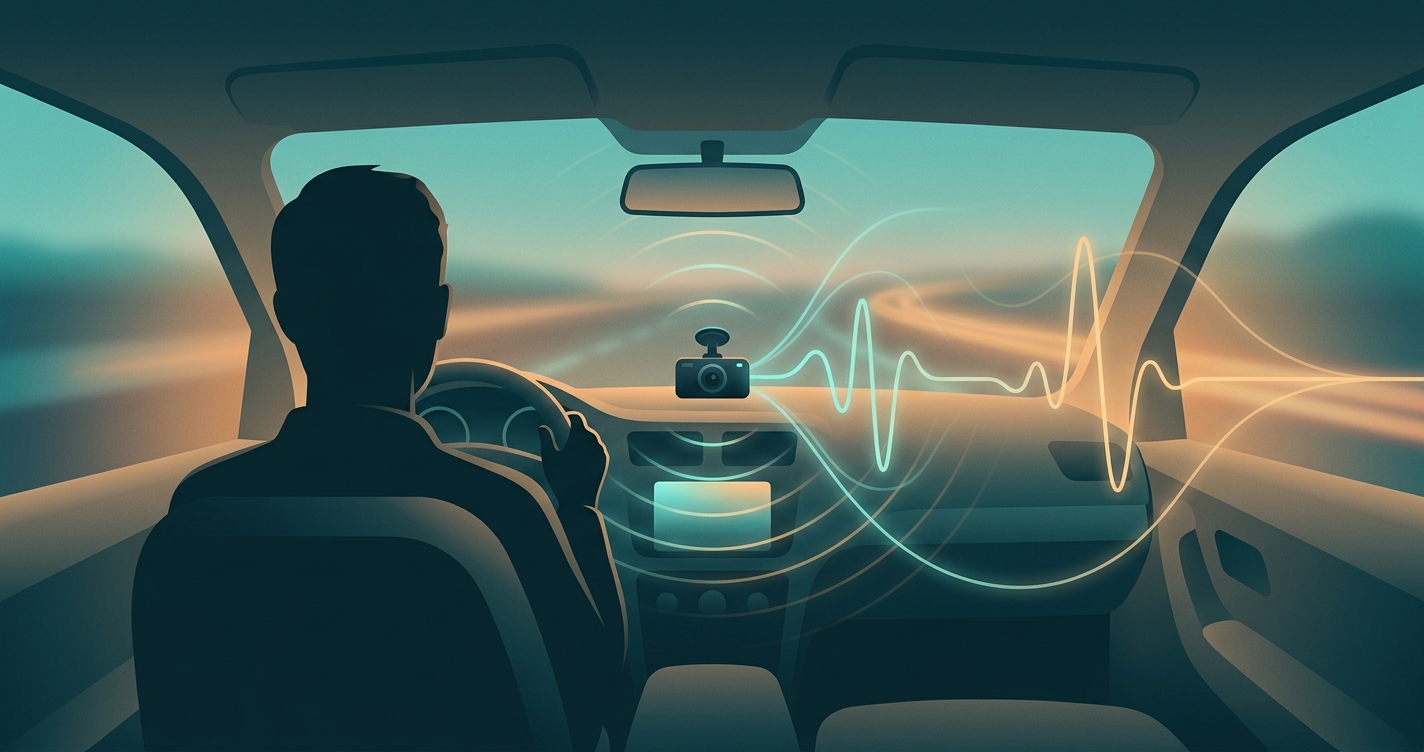
Picture a driver locked in stop-and-go gridlock after a long shift, shoulders tight, jaw clenched, heart rate climbing without them noticing. The car already sees their face through the driver monitoring camera. The open question for automotive engineering teams is whether that same camera should also read the body underneath the expression, recognize a stress spike, and suggest a break before judgment slips. This is the promise behind in-cabin stress detection, and it is moving from research papers into production planning faster than most cabin roadmaps assumed.
A 2023 survey tied to the Travelers Risk Index found that 68 percent of drivers said work-related stress negatively affected their driving performance and road safety, yet almost none had any vehicle system designed to notice it.
What in-cabin stress detection actually measures
In-cabin stress detection does not read emotion directly. It reads the physiological fingerprint that stress leaves on the autonomic nervous system, then infers state from it. The most informative signal is heart rate variability (HRV), the beat-to-beat fluctuation in cardiac rhythm. When the sympathetic nervous system dominates during acute stress, HRV typically narrows and heart rate rises. Respiration rate, pupil behavior, micro-expressions, grip and posture changes, and skin tone shifts all add corroborating evidence.
The breakthrough enabling this in a normal cabin is remote photoplethysmography (rPPG). An ordinary near-infrared or RGB driver-facing camera detects subtle color changes in facial skin caused by blood volume pulsing through capillaries. From that signal a model can estimate heart rate, then derive HRV and respiration without any contact sensor. A 2025 systematic review of AI-enhanced rPPG systems for driver monitoring, drawing on literature through April 2024, documented steady gains in extracting these signals under realistic driving conditions, while flagging motion artifacts, lighting variation, and dataset diversity as the persistent obstacles.
The distinction that matters for product teams is that stress detection is multimodal by necessity. A single elevated heart rate could mean fear, excitement, physical exertion, or a strong coffee. Reliable classification fuses several streams and weighs context. Researchers working with the WESAD dataset and temporal convolutional networks have shown that combining ECG- and PPG-derived features improves unobtrusive stress classification meaningfully over any single channel, and the same fusion logic carries into camera-only cabin systems.
How stress detection compares to neighboring DMS functions
Stress sits alongside fatigue, distraction, and cardiac-event detection in the in-cabin sensing stack. They share hardware but differ in signal source, response time, and intervention logic. The table below frames the practical differences for a cabin architecture decision.
| Monitoring function | Primary signals | Detection window | Typical intervention | Maturity in production |
|---|---|---|---|---|
| In-cabin stress detection | HRV, respiration, facial tension, posture | Seconds to minutes | Suggest break, adjust climate/audio, dampen alerts | Early, mostly pilots |
| Fatigue / drowsiness | Eyelid closure, blink rate, HRV trend | Minutes to hours | Escalating alert, rest recommendation | Mature, regulation-driven |
| Distraction | Gaze direction, head pose | Sub-second to seconds | Immediate attention prompt | Mature |
| Cardiac event detection | Heart rate, rhythm irregularity via rPPG | Seconds | Emergency call, safe-stop assist | Emerging |
A few design implications fall out of this comparison:
- Stress is a slower-burning state than distraction, so the right response is rarely an abrupt alarm. It is a calmer nudge or an environmental change.
- Stress and fatigue share HRV as an input, which means the classifier must separate them rather than conflate a tired driver with a stressed one.
- The same camera and compute that already justify a fatigue or distraction system can host stress detection as an incremental software layer, which changes the cost conversation for OEMs.
So will the car actually tell you to pull over?
Yes, but the better systems are deliberately gentle about it. A blunt "you are stressed, pull over" command tends to backfire by adding irritation to an already activated driver. The emerging design pattern is graduated and context-aware. A first response might lower cabin temperature, shift audio to a calmer profile, or hold back non-urgent notifications. If physiological markers stay elevated and converge with erratic inputs such as harsh braking or lane wandering, the system escalates to a spoken suggestion to take a break at the next safe location.
The intervention also has to respect driving context. Recommending a stop in dense merging traffic is worse than waiting. This is where stress detection benefits from fusion with ADAS map and traffic data, so a prompt arrives when pulling over is genuinely feasible. The goal is a system that earns trust by being right and well-timed, not one that nags.
Industry applications
OEM cabin platforms
For OEMs, stress sensing is a differentiator that rides on hardware already being installed to meet driver-monitoring mandates. Branded as a well-being feature, it supports adaptive cabin experiences: ambient lighting, climate, seat, and audio that respond to physiological state. Because it reuses the driver-facing camera and edge processor, the marginal bill of materials is low, and the feature can be delivered or improved over the air.
Tier-1 sensing suppliers
Tier-1 suppliers own the integration problem. Their challenge is delivering a stress model that performs across skin tones, glasses, lighting, vibration, and partial occlusion, then validating it against ground-truth physiology. Suppliers that package stress as one mode within a unified vitals and state engine, rather than a bolt-on, give OEMs a cleaner integration path and a single calibration pipeline.
Commercial and fleet operators
Fleets carry the clearest financial logic. Chronic and acute stress degrade decision-making and reaction time, and the 68 percent figure from the 2023 driver survey points to a widespread, largely unmanaged risk. A camera-based system that flags sustained stress patterns, without storing identifiable health records, lets safety teams adjust scheduling, routing, and workload before incidents happen rather than reconstructing them afterward.
Current research and evidence
The research base is converging on a consistent picture. Physiological measures reliably track driver state: a January 2023 systematic review of in-vehicle secondary distraction found 21 studies using physiological signals such as heart rate, skin response, and eye activity to characterize driver stress and load. Work on conditionally automated driving has shown that multimodal physiological and ocular signals detect cognitive distraction more robustly than any single channel, reinforcing the fusion approach.
On the sensing side, the AI rPPG systematic review (2025) confirms that camera-derived heart rate and HRV are increasingly viable in moving vehicles, with deep-learning models improving signal extraction against motion and lighting noise. Parallel work on unobtrusive stress detection using temporal convolutional networks over ECG and PPG demonstrates that the underlying classification problem is tractable when features are well chosen.
Two caveats run through the literature and deserve emphasis. First, dataset diversity remains limited, so models risk uneven performance across demographics unless training data is broadened. Second, controlled-study accuracy does not automatically transfer to a vibrating, sunlit, real-world cabin. Bridging that gap is the central engineering task between a promising prototype and a shippable feature.
The future of in-cabin stress detection
The trajectory points toward stress sensing becoming a quiet background layer rather than a standalone alert. Three shifts are likely. First, integration: stress, fatigue, distraction, and cardiac monitoring will merge into one continuous state estimate from shared hardware, removing the artificial boundaries between them. Second, personalization: systems will learn an individual baseline, since absolute HRV varies widely between people and only deviation from a personal norm is meaningful. Third, proactive cabin response: the vehicle will act on early signals through environment and interface changes long before a pull-over prompt is ever needed.
Regulatory momentum behind driver monitoring means the camera and compute will be present in most new vehicles regardless. Stress detection is well positioned to ride that installed base. The defining question for the next few years is not whether cars can sense stress, but how to intervene in a way that drivers accept and trust.
Frequently asked questions
Can a camera really detect stress without touching the driver? Yes, within limits. Using rPPG, a driver-facing camera estimates heart rate and HRV from subtle skin color changes, then combines that with respiration, facial tension, and posture to infer stress. Accuracy depends heavily on lighting, motion, and how many signals are fused, and contactless estimates remain inference rather than clinical measurement.
Will the car force me to stop if I am stressed? No. Realistic systems escalate gradually, starting with subtle cabin adjustments and moving to a spoken break suggestion only if stress markers stay elevated and driving inputs degrade. The driver stays in control, and prompts are timed to when pulling over is actually safe.
How is stress detection different from fatigue detection? They share signals like HRV but describe different states. Fatigue builds over minutes to hours and shows in eyelid and blink behavior, while stress is a faster autonomic spike. A well-designed classifier separates the two so a tired driver and a stressed driver get different, appropriate responses.
What about driver privacy? The leading approach processes signals on the edge inside the vehicle and works from derived state indicators rather than storing identifiable medical records. For fleets, the value is in aggregate, anonymized patterns that inform scheduling and workload, not in building personal health files.
Circadify is actively working in this space, developing camera-based cabin sensing that treats stress as one mode within a unified driver-state engine. Automotive teams evaluating in-cabin stress detection for an upcoming program can start a conversation at circadify.com/custom-builds/automotive-cabin.