
In-Cabin Health Monitoring vs Smartwatch Driver Tracking
A research comparison of in-cabin health monitoring vs wearable driver tracking on accuracy, comfort, and compliance for OEMs, Tier-1 suppliers, and fleets.
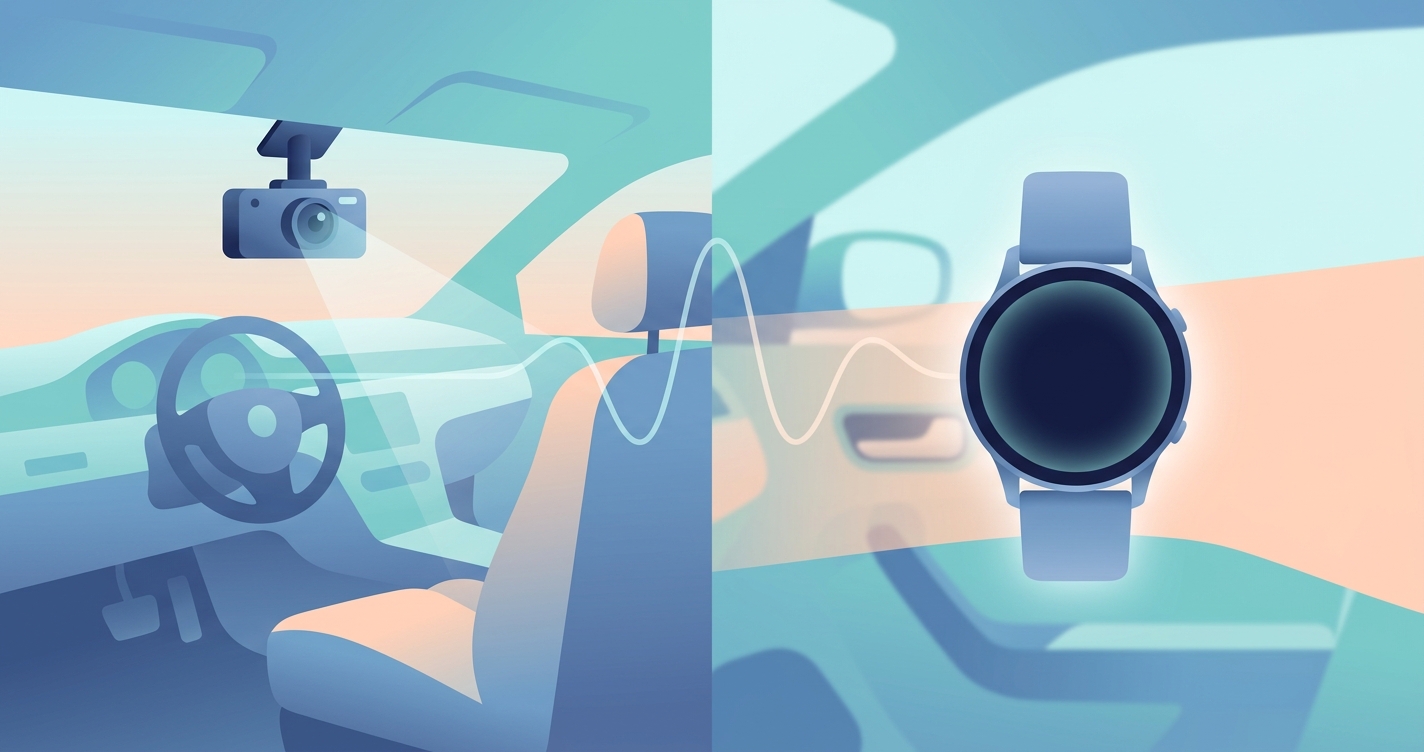
Every program that sets out to read a driver's physiology eventually confronts a structural choice: put the sensor on the driver, or build it into the vehicle. That decision shapes everything downstream, from data quality to whether the system is ever actually used. The debate over in-cabin health monitoring vs wearable driver tracking is no longer theoretical for automotive OEMs, Tier-1 suppliers, and fleet operators, because regulatory timelines and falling camera costs have moved both approaches from pilot to production. The question is which architecture delivers usable vital signs without depending on a driver's willingness to wear, charge, and tolerate a device shift after shift.
Independent rPPG validation work has reported mean absolute error below 3 beats per minute for camera-based heart rate in automotive test conditions, while market leaders reported only a 78% compliance rate for the best-performing driver smart bands in 2025. The gap between what a sensor can measure and what a driver consistently wears is the real engineering problem.
In-cabin health monitoring vs wearable: two sensing architectures
The core distinction is contact. A wearable measures physiology through skin contact at the wrist or finger, using photoplethysmography (PPG), accelerometry, and sometimes electrodermal activity. An in-cabin system measures the same signals at a distance, primarily through remote photoplethysmography (rPPG), where an inward-facing camera detects micro-color changes in facial skin caused by the cardiac pulse. Both estimate heart rate, heart rate variability, respiration, and stress indicators. They diverge sharply on how that signal is acquired and who has to cooperate.
Wearables hold a real advantage in motion isolation. A wrist sensor moves with the driver, so it does not lose the subject when the head turns or the cabin darkens. The cost is contact-dependent failure: loose straps, sweat, tattoos, and dark skin tones all degrade wrist PPG, and the device only works when worn and charged. In-cabin sensing removes the contact requirement entirely, which matters for compliance, but it inherits the hardest problems in computer vision: motion artifact from road vibration, rapidly changing illumination, occlusion from sunglasses, and skin-tone-dependent signal strength.
The table below summarizes how the two architectures compare on the dimensions that matter to a procurement or integration team.
| Dimension | In-Cabin (Camera / rPPG) | Wearable (Smartwatch / Band) |
|---|---|---|
| Signal acquisition | Contactless, facial rPPG | Skin contact, wrist or finger PPG |
| Heart rate accuracy | MAE under 3 bpm in test conditions | Clinical-grade at rest, degrades in motion |
| Compliance dependency | None, passive, always on | High, must be worn and charged |
| Motion robustness | Sensitive to head movement, vibration | Strong; sensor moves with driver |
| Lighting sensitivity | High, needs NIR for night | None |
| Skin tone / tattoo effect | Present, algorithm-dependent | Present, contact-dependent |
| Hardware ownership | Built into vehicle by OEM/Tier-1 | Driver or fleet provided |
| Data continuity | Continuous per drive | Gaps when removed or uncharged |
| Privacy profile | Camera in cabin | Body-worn, off-duty tracking risk |
| Integration with ADAS/DMS | Native, shares the DMS camera | Requires separate data pipeline |
Read together, the trade-off is clear. Wearables win on raw motion-tolerant signal quality but lose on the human factors that determine whether data exists at all. In-cabin systems win on coverage and integration but demand more sophisticated signal processing to match wearable accuracy in a moving vehicle.
Where each approach earns its place
The choice rarely comes down to a single metric. It depends on the program's primary goal, the operating environment, and who controls the hardware.
- Regulatory-driven OEM programs favor in-cabin sensing because the inward-facing camera is already mandated. The EU General Safety Regulation, with driver drowsiness and attention warning requirements phasing in through 2024 and beyond, pushes a camera into the cabin regardless of health monitoring goals. Adding rPPG to that existing sensor avoids a second bill of materials.
- Commercial and long-haul fleets weigh compliance heavily. A wearable that a driver removes mid-shift produces no data exactly when fatigue risk peaks. Passive in-cabin sensing eliminates that failure mode.
- High-precision research or medical-adjacent use cases may still prefer contact sensors, where motion-isolated signal quality is the priority and the subject population is cooperative.
- Mixed fleets with legacy vehicles sometimes adopt wearables first because they do not require a vehicle retrofit, then migrate to in-cabin sensing as fleets renew.
Industry Applications
Automotive OEM integration
For OEMs, in-cabin vital signs are increasingly a software feature layered onto a sensor that ships for other reasons. The same driver monitoring system (DMS) camera that tracks eyelid closure and gaze can run rPPG inference, turning a compliance component into a health platform. This native integration with ADAS and DMS pipelines is something a wrist wearable cannot match, because the wearable lives outside the vehicle's safety architecture and must push data across a separate channel with its own latency and reliability constraints.
Fleet driver health monitoring
Fleet operators frame the decision around duty-cycle coverage and driver acceptance. Wearable programs run into a predictable pattern: enthusiastic early adoption followed by declining wear rates. Even strong programs cap out below full compliance, and the missing data is not random, it correlates with the drivers and shifts most at risk. Contactless driver monitoring sidesteps this by making participation passive. The trade is a privacy conversation about in-cabin cameras, which fleets manage through clear data governance and edge processing that keeps raw video in the vehicle.
Tier-1 sensor integration
For Tier-1 suppliers, the architecture decision determines the engineering roadmap. A camera-based path requires investment in motion-robust rPPG algorithms, near-infrared illumination for night driving, and skin-tone-balanced training data. A wearable path requires device hardware, charging logistics, and a connectivity stack. Most serious automotive programs are converging on the camera because it consolidates fatigue detection, distraction monitoring, and vital signs into one sensor that the OEM already plans to install.
Current research and evidence
The evidence base for contactless sensing has strengthened quickly. In March 2024, engineers at the University of Michigan demonstrated a low-cost in-car camera system using AI to estimate vital signs, including blood flow changes in the face, as a route to detecting impaired drivers ahead of regulatory deadlines. On the algorithm side, motion-robust rPPG work has reported mean square error around 2.79 bpm for heart rate monitoring in outdoor driving conditions, and modern automotive-oriented pipelines report mean absolute error under 3 bpm in standardized test conditions. A 2024 review of vehicle driver health monitoring systems published in the peer-reviewed literature catalogued the shift from contact electrocardiography toward camera-based and radar-based contactless methods as the dominant research direction.
The wearable literature is mature on accuracy but candid about adoption. Smartwatch-based driver alertness studies confirm that wrist motion and physiological sensors can flag drowsiness, yet field deployment data tells the harder story: market leaders reported a 78% compliance rate even for the best-performing smart bands in 2025, against 62% for other wearable form factors. Independent driver monitoring assessments, including work summarized by AAA, repeatedly find that a safety system's real-world benefit depends on consistent engagement, which structurally favors passive sensing.
A useful way to read this body of work: wearables have closed the accuracy question and left the compliance question open, while in-cabin sensing has closed the compliance question and is rapidly closing the accuracy question.
The future of in-cabin vs wearable driver health sensing
The trajectory points toward consolidation on the in-cabin camera, with wearables retreating to specialized and transitional roles. Three forces drive this. First, regulation puts a camera in the cabin regardless, making rPPG a marginal-cost feature rather than a new sensor. Second, sensor fusion is maturing: combining the DMS camera with radar and seat-based ballistocardiography can recover the motion robustness that pure rPPG lacks, narrowing the gap with contact sensors. Third, edge AI lets vital sign inference run inside the vehicle, easing the privacy concerns that have slowed in-cabin adoption.
Wearables will not disappear. They remain valuable where contact precision is essential, where vehicles cannot be retrofitted, and as a bridge in mixed fleets. But the long-term direction for automotive-grade driver health monitoring is contactless, integrated, and always on, because that is the only architecture that does not depend on a driver choosing to participate every shift.
Frequently asked questions
Is camera-based in-cabin monitoring as accurate as a smartwatch? At rest, contact wearables remain the accuracy benchmark. In a moving vehicle the gap narrows: motion-robust rPPG has reported heart rate error under 3 bpm in test conditions, while wrist PPG accuracy itself degrades during motion. For automotive use the practical question is accuracy on data that actually gets collected, where passive cameras avoid the compliance gaps that erode wearable datasets.
Why does driver compliance favor in-cabin sensing? A wearable only produces data when worn and charged. Even strong fleet programs report compliance below 80%, and the missing data correlates with high-risk shifts. In-cabin sensing is passive, so coverage does not depend on driver behavior.
Can both approaches be combined? Yes. Some programs fuse in-cabin cameras with wearables or seat-based sensors to balance motion robustness against coverage. Sensor fusion is an active research direction for recovering signal quality during head movement and changing light.
What about driver privacy with in-cabin cameras? Edge processing keeps raw video inside the vehicle and transmits only derived metrics, which addresses much of the concern. Wearables carry their own privacy exposure through off-duty body tracking, so neither approach is privacy-free.
Circadify is addressing this space directly, building camera-based driver fatigue, drowsiness, and stress detection designed to integrate with the DMS sensor OEMs and Tier-1 suppliers are already deploying. Teams evaluating an in-cabin vital signs architecture can request a sensor integration consultation through our automotive program inquiry.