What In-Cabin Health Monitoring Means for Truck Drivers
A clear explainer on truck driver health monitoring: what cabin systems track, how rPPG cameras work, and why the technology protects drivers, not just fleets.
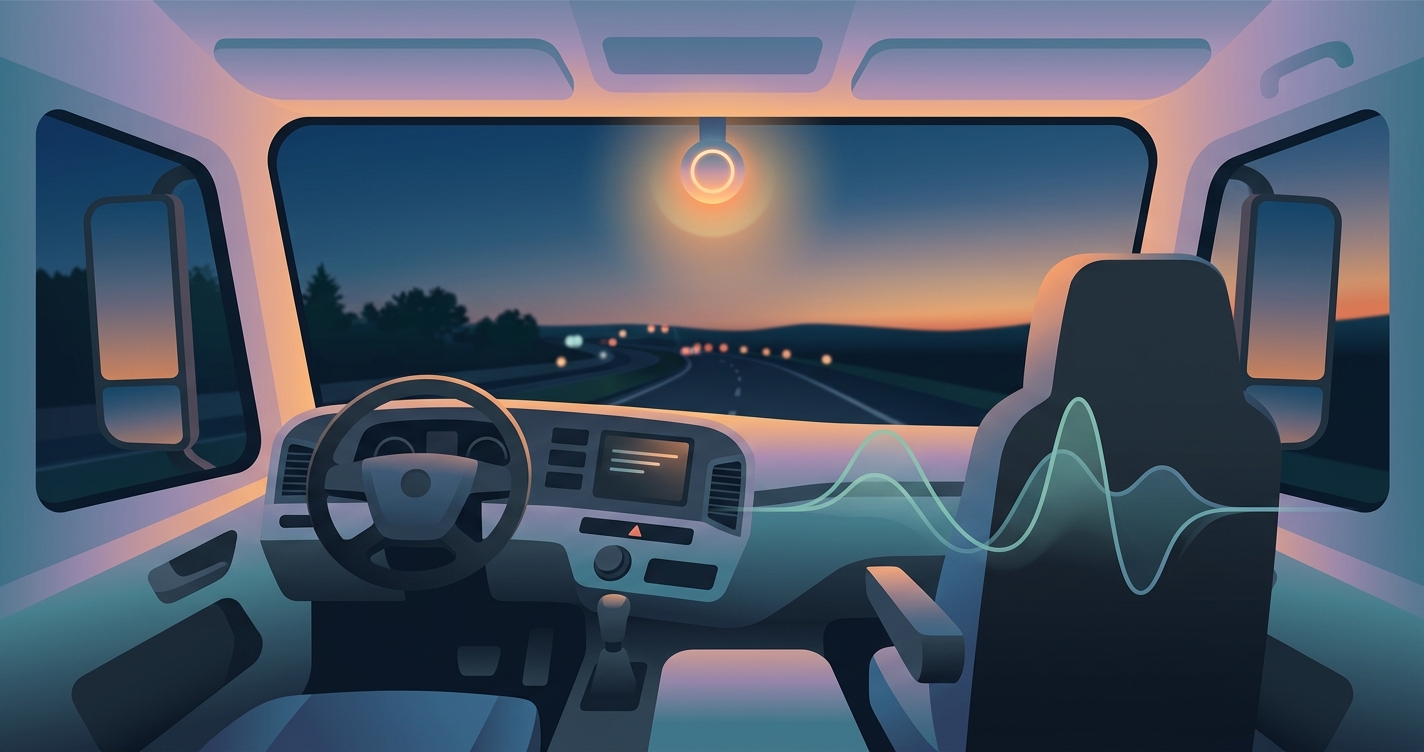
Long-haul trucking asks the human body to do something it was never built for: stay alert and seated for ten or eleven hours, often at night, frequently after poor sleep, week after week. The result is a workforce carrying a heavier health burden than almost any other occupation in transport. Truck driver health monitoring through in-cabin cameras has entered this picture not as a surveillance gimmick but as a quiet early-warning layer, watching for the physiological shifts that precede a crash or a medical emergency. For drivers who have heard rumors about cameras in the cab, the honest version of the story is more reassuring than the rumor, and worth understanding in detail.
"Approximately 28 to 50 percent of commercial truck drivers show signs of obstructive sleep apnea, a rate far above the general population, and roughly 65 percent report feeling drowsy at the wheel.", synthesized from CDC and Federal Motor Carrier Safety Administration data, with prevalence figures echoed in a 2024 Portuguese prospective cohort of heavy truck drivers.
What truck driver health monitoring actually tracks
The phrase truck driver health monitoring covers a narrow, specific set of signals, and it helps to be precise about them. A modern in-cabin system uses an inward-facing camera, the same hardware that watches for eyelid closure and head nod, paired with a technique called remote photoplethysmography, or rPPG. The camera detects microscopic color changes in the skin of the face caused by blood flowing beneath it with each heartbeat. From that signal, software can estimate heart rate, heart rate variability, and respiration rate without anything touching the driver.
What it tracks, in plain terms:
- Heart rate and heart rate variability, where the ratio of low-frequency to high-frequency activity is a recognized marker of fatigue and stress
- Respiration rate, one of the earliest signals to drift as a driver tires or as illness sets in
- Drowsiness indicators such as eyelid closure duration, blink rate, and head position
- Signs of acute physiological distress that may precede a cardiac or neurological event
What it does not do matters just as much. A camera-based system does not record continuous video of the driver's face for a manager to scroll through, it does not diagnose disease, and it does not read location or conversation. It converts a video stream into a handful of numbers about alertness and vital signs, and most of the raw footage never leaves the device.
How cabin monitoring compares to older approaches
Fleets have tried to manage fatigue and driver wellness for decades. The table below sets the camera-based approach against the methods it is starting to complement or replace.
| Approach | What it measures | Driver effort required | Early warning capability | Privacy footprint |
|---|---|---|---|---|
| Trucker health camera (rPPG + DMS) | Heart rate, HRV, respiration, drowsiness | None, fully passive | High, detects shifts before behavior changes | Low, processes on-device, shares metrics not video |
| Wearable wristband | Heart rate, sleep, steps | Must wear and charge daily | Moderate, depends on compliance | Moderate, continuous personal data |
| Steering and lane sensors | Vehicle drift, steering input | None | Low, reacts after impairment shows | Very low |
| Hours-of-service logs | Time driving vs resting | Manual or automated logging | Low, time-based not body-based | Low |
| Periodic medical exams | Blood pressure, BMI, apnea screening | Scheduled clinic visit | Very low, snapshot only | Low |
The key distinction is timing. Logs and medical exams describe a driver's risk in the abstract or after the fact. A trucker health camera reads the body in the moment, and physiological signals such as a rising LF/HF ratio or slowing respiration often shift before a driver consciously feels tired.
Why this protects the driver, not just the employer
The fear is understandable: a camera in the cab sounds like a tool for catching drivers doing something wrong. In practice, well-designed commercial driver vital monitoring is built around the driver's body, and the benefits land on the person behind the wheel first.
Consider the health profile the data describes. NIOSH and CDC surveys have found roughly 69 percent of long-haul drivers are obese, nearly double the rate of other working adults, and 17 percent are morbidly obese. Sleep-disordered breathing is widespread and frequently undiagnosed. These conditions raise the risk of a sudden event on the road, and a driver rarely gets advance notice from their own perception.
- A drowsiness alert that nudges a driver to pull over protects that driver from the crash they would otherwise be in
- Trend data showing a creeping resting heart rate or worsening overnight recovery can prompt a driver to seek screening for apnea or cardiac issues
- Detection of acute distress can trigger an emergency response faster than a driver alone could call for help
- Objective fatigue data can support a driver's case for adequate rest, rather than being pushed to keep moving
The protective framing is not marketing. Long-haul driver wellness has lagged for structural reasons, including irregular schedules and limited access to care on the road, and passive monitoring is one of the few tools that meets drivers where they actually are, in the cab.
Industry Applications
Fleet safety and insurance
For fleet operators, fatigue is a contributing factor in roughly 13 percent of commercial motor vehicle crashes. Real-time drowsiness and vital-sign signals let safety teams intervene before an incident rather than reconstruct it afterward. Aggregated, de-identified trends also help insurers and risk managers understand exposure across a fleet without singling out individuals.
OEM and Tier-1 Integration
Automotive manufacturers and their suppliers are folding rPPG-capable cameras into the same driver monitoring hardware that regulators in the European Union, Japan, and China increasingly require. Building vital-sign capability on top of an already-mandated camera is far cheaper than adding new sensors, which is why commercial vehicle platforms are expected to ship with this capability in the 2026 and 2027 model years.
Driver health programs
Forward-looking carriers are using cabin metrics as the front end of voluntary wellness programs, connecting drivers to telehealth and apnea screening when their own trend data suggests a problem. This reframes monitoring as a benefit rather than a checkpoint.
Current research and evidence
The scientific base for camera-based vital monitoring has grown quickly. A 2024 systematic review of AI innovations in rPPG systems for driver monitoring, published through IEEE Xplore, found that deep learning and multimodal data fusion have substantially improved the accuracy of heart-rate and HRV extraction from in-cabin video. Researchers have specifically targeted the hard cases that matter for trucking, including nighttime driving and harsh, shifting illumination, by fusing visible and infrared imaging so the signal survives a tunnel exit or a low-sun glare.
Work published in MDPI sensors journals has combined rPPG with motion tracking using convolutional neural networks and bidirectional long short-term memory models, reporting that fusing physiological and behavioral signals detects fatigue more reliably than either stream alone. On the clinical side, a 2024 Portuguese prospective cohort study of heavy truck drivers reported obstructive sleep apnea prevalence approaching 78 percent in its sample, reinforcing how much undiagnosed risk sits in the cab and how valuable passive screening could be.
Researchers are candid about the open problems. Detecting stable physiological metrics under dynamic driving conditions remains difficult, and datasets still under-represent the diversity of real driver populations across skin tone, age, and body type. These are engineering and data challenges rather than fundamental barriers, and they are the focus of active 2024 and 2025 work.
The future of truck driver health monitoring
The direction is toward systems that are passive, private, and predictive. Expect on-device processing to become the norm, so vital-sign math happens inside the camera module and only summary metrics leave the truck. Expect tighter links between cabin monitoring and rest scheduling, where objective fatigue readings, not just clock-based hours-of-service rules, shape when a driver should stop. And expect the health angle to broaden carefully from drowsiness toward early flags for cardiac and metabolic events, always framed as a prompt to seek care rather than a diagnosis.
Regulation will pull the same direction. As driver monitoring camera mandates expand to heavy commercial vehicles, the marginal cost of adding vital-sign capability drops toward zero, and the question shifts from whether trucks will carry this technology to how the resulting data is governed in the driver's favor.
Frequently asked questions
Does in-cabin health monitoring record video of me the whole drive? Most camera-based systems are designed to process video on the device and output only metrics such as heart rate, alertness level, and drowsiness alerts. The continuous raw footage typically is not stored or streamed to a manager. Specifics depend on the system and fleet policy, so drivers should ask how their particular setup handles data retention.
Can the camera tell if I have a medical condition? No. These systems estimate vital signs and alertness, not diagnoses. What they can do is surface trends, such as a steadily rising resting heart rate, that may be worth discussing with a doctor or that suggest screening for conditions like sleep apnea.
Does it work at night and in bad lighting? Modern systems combine visible and infrared imaging specifically so they keep functioning at night, in tunnels, and through glare. Robustness in difficult lighting was a major focus of 2024 research, though performance still varies across hardware.
Is this just a way for my employer to monitor me? The strongest value of commercial driver vital monitoring lands on the driver first, through drowsiness alerts, faster emergency response, and objective evidence for needed rest. How a fleet uses the data depends on its policies, which is why driver-centered governance and de-identified reporting matter.
Circadify is building camera-based driver fatigue, drowsiness, and vital-sign monitoring designed to put the driver's wellbeing at the center of the system rather than treating it as an afterthought. Fleet and trucking companies exploring how in-cabin health monitoring fits their vehicles and their drivers can start a conversation through our automotive program inquiry.