How to Cut Long-Haul Crashes With Driver Vital Monitoring
Learn how advanced driver vital monitoring and rPPG camera technology can predict fatigue, reduce long-haul truck crashes, and improve fleet safety.
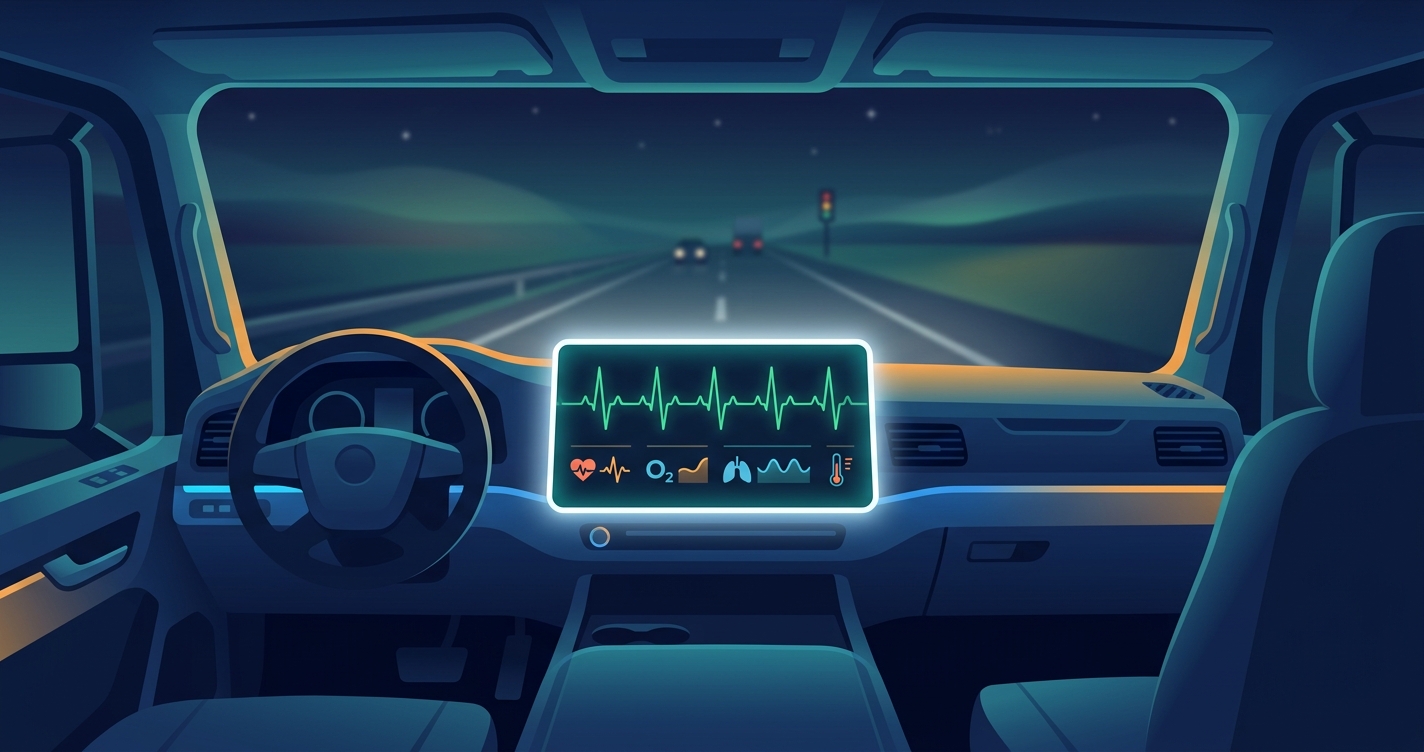
Commercial transportation operates on a highly constrained margin of efficiency and safety, where a localized failure in driver attention can result in catastrophic outcomes. The introduction of inward-facing cameras brought a baseline level of observability to fleet cabins, allowing safety managers to track rudimentary indicators like gaze direction, phone usage, and eyelid closure. However, these systems inherently monitor the late stages of exhaustion, alerting a central dispatcher only when a driver is already physically struggling to stay awake. By upgrading from simple video logging to physiological tracking, safety teams and automotive Tier-1 suppliers are now exploring long-haul driver fatigue monitoring systems that read the body's internal signals long before physical failure occurs. Advanced driver monitoring systems (DMS) can now extract heart rate, heart rate variability (HRV), and respiration metrics directly from standard cabin video feeds, shifting the operational paradigm from reactive alarms to proactive health intelligence.
"Driver fatigue remains one of the most stubborn variables in commercial transportation, contributing to approximately 13% of all commercial motor vehicle crashes and heavily factoring into the 5,472 large-truck crash fatalities recorded in 2023.", National Highway Traffic Safety Administration (NHTSA) and Federal Motor Carrier Safety Administration (FMCSA) CrashStats
Rethinking long-haul driver fatigue monitoring
Relying exclusively on traditional eyelid tracking means waiting for the physical breakdown of the driver to begin. When a fully loaded semi-truck travels at highway speeds, a three-second microsleep covers more than the length of a football field. Effective long-haul driver fatigue monitoring requires systems that detect the physiological slide into exhaustion before the driver's eyes ever close.
Using remote photoplethysmography (rPPG), artificial intelligence models can detect the microscopic shifts in facial skin color caused by blood pumping beneath the surface. This allows a standard RGB or near-infrared (NIR) camera to measure a driver's heart rate and HRV without physical contact. Because HRV shifts predictably as the autonomic nervous system transitions from wakefulness into drowsiness, this physiological data acts as a biological early warning system.
When a driver begins to fatigue, the parasympathetic nervous system becomes more dominant, altering the beat-to-beat variations in the heart rhythm. Standard telematics platforms record the result of this fatigue, a harsh braking event, a lane departure, or a sudden steering correction. By contrast, in-cabin vital sign monitoring measures the internal state causing those physical errors, giving the driver and the fleet manager a critical buffer of time to react safely.
Comparing cabin monitoring architectures
Evaluating different monitoring approaches requires understanding how data is sourced, processed, and utilized in a heavy-duty trucking environment.
| Feature | Traditional Video Telematics | Advanced Vital Sign Monitoring (rPPG) | Wearable Biometric Devices |
|---|---|---|---|
| Primary Metric | Eyelid closure (PERCLOS), head nod | Heart rate, HRV, respiration rate | Heart rate, electrodermal activity |
| Alert Timing | Reactive (driver is already falling asleep) | Proactive (detects autonomic shifts early) | Proactive |
| Hardware Needs | Standard cabin camera | Standard cabin camera with AI processing | Smartwatches, chest straps, rings |
| Driver Friction | Low (passive monitoring) | Low (completely contactless) | High (requires charging, wearing) |
| Environmental Limits | Struggles with sunglasses | Operates via NIR light through lenses | Subject to sensor displacement |
Core requirements for highway implementation
When evaluating a vital monitoring system, OEMs and fleet managers should look for specific architectural capabilities that function reliably in moving vehicles:
- Native integration with existing edge-computing hardware to process video locally without cloud latency or continuous cellular dependence.
- Support for near-infrared (NIR) sensors to maintain measurement stability in dark cabins or during nighttime long-haul routes.
- Advanced sensor fusion that combines physiological signals (HRV) with behavioral data (gaze, steering input) for high-confidence alert thresholds.
- Robust data privacy protocols that process vital signs entirely on the device and only transmit anonymized, aggregated risk scores to dispatch dashboards.
- Dynamic noise filtering to account for intense cabin vibrations and varying road surfaces that typically disrupt standard optical sensors.
Industry Applications for Fleets and OEMs
The transition to physiological tracking changes how different stakeholders manage risk and approach vehicle design.
Fleet management companies
For large transport fleets, crash reduction directly impacts insurance premiums, liability exposure, and total cost of ownership. Dispatch teams equipped with vital monitoring can receive rolling risk scores based on a driver's physiological state over a long-haul route. If a driver's HRV indicates severe autonomic fatigue, dispatch routing software can automatically direct them to the nearest rest stop before a critical error occurs. Furthermore, treating the cabin as a health monitoring space supports driver retention. Rather than acting strictly as a surveillance tool, the system functions as a wellness feature, ensuring drivers are not pushed beyond their physical limits.
Automotive oems and tier-1 suppliers
Commercial vehicle manufacturers face strict international regulations, such as the European General Safety Regulation (GSR), which mandates advanced driver distraction and drowsiness warning systems in new models. By building rPPG capabilities into native DMS software, Tier-1 suppliers can offer a premium safety tier that exceeds basic regulatory requirements, utilizing the exact same camera hardware already installed for compliance. This software-defined approach allows OEMs to push over-the-air (OTA) updates that upgrade a standard drowsiness camera into a comprehensive physiological sensor without retooling the dashboard.
Current research and evidence
Recent engineering studies highlight the massive performance gains of combining visual and physiological data in automotive environments. A 2024 analysis of multimodal fatigue detection published in IEEE Transactions on Intelligent Transportation Systems demonstrated that combining traditional facial landmark tracking with physiological signals like HRV and electrodermal activity yields detection accuracies above 93%.
Similarly, researchers evaluating non-contact vital sign monitoring in commercial trucking environments found that camera-based extraction of cardiac rhythms strongly correlates with medical-grade ECG data, even in the vibration-heavy environment of a truck cabin. The primary challenge historically has been motion artifacts, the natural bouncing of the driver's head. However, as the spatial-temporal neural networks powering these systems grow more sophisticated, the error rate introduced by sudden lighting changes and vehicle movement continues to drop to negligible levels.
By analyzing the continuous flow of pixel data, AI models are now capable of filtering out the noise of the road, isolating the precise frequencies that correspond to the human pulse. This allows the system to remain highly accurate even when a driver shifts in their seat or drives through dappled sunlight.
The future of driver vital monitoring
The next generation of cabin monitoring will move beyond fatigue prevention to encompass broader occupational health monitoring. If a camera can read a pulse accurately enough to detect sleepiness, it can also establish a baseline for an individual driver over hundreds of hours on the road. The system could theoretically detect sudden cardiac anomalies, acute stress spikes in heavy traffic, or respiratory distress.
For the commercial trucking industry, this represents a shift toward holistic driver protection. Instead of merely preventing crashes, the vehicle itself becomes a diagnostic space that protects the driver from sudden medical emergencies in remote areas. Future iterations of this technology will likely interface directly with Advanced Driver Assistance Systems (ADAS). If a driver's vital signs indicate a severe medical event, such as a heart attack or a stroke, the vehicle could autonomously activate hazard lights, gradually reduce speed, and safely pull itself to the shoulder while automatically notifying emergency services.
Frequently asked questions
How does a camera detect a driver's heart rate in a moving truck? The camera uses remote photoplethysmography (rPPG) to capture microscopic changes in skin pixel intensity caused by cardiac blood flow. Deep learning algorithms isolate these pulse signals from ambient noise, cabin vibrations, and lighting changes to calculate the heart rate continuously.
Will vital sign monitoring replace traditional eyelid tracking? No. The most robust engineering approach uses sensor fusion. By combining physiological data (like heart rate variability) with behavioral markers (like eye aspect ratio, blinking rate, and head pose), the system creates a comprehensive, multi-layered fatigue profile that is highly resistant to false positives.
Does camera-based vital monitoring require constant internet access? Modern edge-computing architectures allow the AI to process raw video frames directly on the vehicle's onboard processing unit. The camera calculates the heart rate locally and only needs a minimal, intermittent connection to send simple text-based alerts or numerical risk scores to a fleet manager, which protects driver privacy and minimizes bandwidth costs.
Can wearing sunglasses block physiological fatigue detection? Standard RGB cameras can struggle to read vital signs through heavy tint. However, most modern automotive DMS setups utilize near-infrared (NIR) cameras. NIR light penetrates most standard sunglass lenses, allowing the system to continue reading the skin on the upper face and the micro-movements of the eyes simultaneously.
For automotive teams and fleet operators looking to cut long-haul crashes, implementing physiological tracking is the most direct path to modernizing cabin safety. Circadify is actively building the software infrastructure required for high-accuracy, edge-processed vital sign monitoring that meets the rigorous demands of commercial transportation. To learn how to integrate these capabilities into your hardware or fleet operations, submit an Automotive program inquiry today.