Edge Computing vs Cloud Processing for DMS Vital Signs Data
A research-focused analysis of edge vs cloud driver monitoring vital signs architectures, covering latency, privacy, bandwidth, validation, and automotive safety tradeoffs.
Edge Computing vs Cloud Processing for DMS Vital Signs Data
For automotive teams evaluating edge vs cloud driver monitoring vital signs architectures, the real question is not which side wins outright. It is which functions belong in the cabin, which belong in the backend, and which ones become risky if they depend on network availability. That distinction matters more now because driver monitoring is expanding beyond gaze and eyelid tracking into contactless heart-rate, respiration, stress, and unresponsiveness signals that may need to support safety interventions in real time.
"An edge device in the vehicle can anonymize facial identity before any video frames are transmitted to the data server." — Ashutosh Mishra, Jaekwang Cha, and Shiho Kim, Computational Intelligence and Neuroscience (2022)
Edge vs cloud driver monitoring vital signs: the architecture debate has shifted
A few years ago, it was still possible to talk about cloud processing as the default path for automotive AI. That is getting harder to defend for vital-sign sensing inside the cabin.
Vital-sign workflows built on camera data produce a mix of requirements that do not sit comfortably in one place. Some workloads are immediate and safety-linked. Others are heavier, slower, and better suited to backend systems. If a system is estimating driver pulse variability, checking whether a person is responsive, or deciding whether to escalate an alert, waiting on a round trip to the cloud starts to look like a design liability.
That is why edge-first thinking keeps showing up in recent automotive research. In a 2025 benchmark study, Tayssir Bouraffa, Dimitrios Koutsakis, and Salvija Zelvyte tested deep-learning rPPG models in automotive conditions and found that motion and changing illumination remain central problems for in-cabin vital-sign estimation. That matters because noisy data needs filtering and confidence scoring before a safety system acts on it. Putting that work onboard reduces dependence on network quality at exactly the moment the cabin environment is already unstable.
Cloud processing still has a role. It is useful for model training, fleetwide analytics, post-event review, and software improvement across programs. But the closer a function gets to driver-state intervention, the stronger the case for local execution becomes.
Where edge and cloud fit best
| Function | Edge processing fit | Cloud processing fit | Why it matters for DMS vital signs |
|---|---|---|---|
| Real-time driver-state inference | Strong | Weak | Safety actions cannot depend on unstable connectivity |
| Facial anonymization and privacy filtering | Strong | Limited | Sensitive biometric data can be minimized before transmission |
| Fleetwide trend analysis | Limited | Strong | Better suited to aggregated historical datasets |
| Model training and retraining | Weak | Strong | Compute-heavy workflows belong off vehicle |
| Event-triggered logs and diagnostics | Medium | Strong | Edge captures events, cloud supports review and audits |
| OTA model distribution | Weak | Strong | Central coordination is still a backend function |
Why latency changes the answer
Latency is not just a performance metric in this category. It changes what kind of product you are building.
A music recommendation feature can survive delay. A driver-monitoring system that may flag drowsiness, stress escalation, or unresponsiveness cannot treat delay as a minor inconvenience. The system does not need perfect medical interpretation in milliseconds, but it does need reliable, immediate confidence scoring around driver state.
Hossein Ahmadvand and Fouzhan Foroutan made this tradeoff explicit in their 2025 work on vehicular edge computing. Their framework sorted vehicular applications by privacy and deadline sensitivity, then placed the most time-critical and privacy-sensitive functions closer to the user layer. In their reported results, the privacy- and latency-aware allocation approach improved service quality by 55% over baseline methods. The paper is broader than driver monitoring alone, but the logic maps well to cabin sensing: the faster and more sensitive the decision, the harder it is to justify shipping raw data away first.
That is also where the architecture discussion stops being abstract. In-cabin vital-sign systems are often not processing one clean pulse stream. They are handling face tracking, illumination normalization, motion compensation, quality estimation, and often multimodal context from the rest of the DMS stack.
- Edge processing reduces dependence on backhaul latency.
- Edge processing keeps degraded network conditions from becoming degraded safety behavior.
- Edge processing lets product teams decide on alerts even when the vehicle has weak connectivity.
- Cloud processing remains useful when the work is analytical, historical, or fleetwide rather than immediate.
Privacy and bandwidth push the same direction
Privacy concerns and network economics often get treated as separate issues. For in-cabin vital signs, they usually point in the same direction.
Vital-sign estimation from cabin cameras deals with some of the most sensitive data in a vehicle: facial imagery, behavioral patterns, and physiological signals. Mishra, Cha, and Kim's 2022 privacy-preserved in-cabin monitoring study is useful here because it does not just say privacy matters. It describes a concrete edge workflow in which facial features are extracted onboard and facial identity is anonymized before frames are sent onward. That is a much more realistic automotive pattern than assuming raw video should be streamed indefinitely to a remote service.
Bandwidth pressure adds another reason to keep the first pass in the vehicle. Continuous cabin video, especially when combined with other ADAS and telemetry signals, becomes expensive to transmit and hard to justify retaining. McKinsey's work on the future of automotive computing has made the same broader point: software-defined vehicles are moving toward hybrid cloud-edge models because low-latency functions, resilience, and data governance are difficult to support with cloud-only execution.
Key architecture tradeoffs for automotive teams
| Design question | Edge-first answer | Cloud-first answer | Practical consequence |
|---|---|---|---|
| What happens if connectivity drops? | Core monitoring continues | Performance may degrade or pause | Edge is more defensible for safety-linked functions |
| How much raw biometric data leaves the car? | Less | More | Edge lowers privacy exposure surface |
| Where are heavy analytics easiest to run? | Harder | Easier | Cloud still wins for large-scale retrospective analysis |
| How quickly can alerts fire? | Faster | Slower and more variable | Edge is better for responsive interventions |
| How easy is global model iteration? | Harder | Easier | Cloud simplifies centralized improvement cycles |
Industry applications for different buyers
OEM platform teams
For OEMs, this is mostly an E/E architecture problem. Cabin vital signs cannot sit off to the side as a novelty feature if they are expected to contribute to driver engagement logic, unresponsive-driver workflows, or future assisted-driving safeguards. The architecture has to decide early which functions are safety-critical, which are privacy-sensitive, and which ones are best left to the backend.
Tier-1 suppliers
Tier-1s have a different challenge: they need reusable stacks. A one-off design that works only in pristine network conditions is hard to sell across regions and programs. Edge-heavy processing gives suppliers a cleaner story when customers ask about fail-safe behavior, cabin privacy, and multi-market deployment.
Fleet operators
Fleets care less about elegant architecture diagrams and more about whether the system stays reliable on actual routes. Long-haul, mining, and mixed-terrain operations are a bad place to discover that a safety-relevant inference path depended on steady cloud access. For fleets, cloud systems are still useful for dashboards, policy reviews, and trend analysis across drivers. They are less convincing as the first place a fatigue or unresponsiveness signal gets interpreted.
Current research and evidence
The current evidence points toward hybrid architecture, with the critical first layer on the edge.
The 2025 automotive rPPG benchmark from Bouraffa, Koutsakis, and Zelvyte showed why. Automotive cabins remain difficult signal environments. Models that look strong in lab datasets still run into motion, illumination shifts, and real-world variability inside a vehicle. That does not argue against camera-based vital-sign sensing. It argues for handling the first stage of signal quality assessment and inference as close to the sensor as possible.
The 2022 privacy-preserved cabin-monitoring paper by Mishra, Cha, and Kim adds another important point: privacy protection becomes much more practical when identity-sensitive processing happens onboard first. That architecture can reduce transmitted raw biometrics and still preserve the ability to escalate unusual events when needed.
The 2025 vehicular edge-computing work from Ahmadvand and Foroutan broadens the picture beyond one cabin use case. Their framework treats privacy and timing as resource-allocation variables, not afterthoughts. That is exactly how DMS vital-sign data should be handled.
Finally, policy pressure is moving in the same direction. The European Transport Safety Council's 2025 summary of Euro NCAP's 2026 updates makes clear that direct driver monitoring, impairment detection, and unresponsive-driver intervention are becoming more central in safety assessment. Once monitoring affects intervention, teams need predictable latency and predictable local behavior.
Selected sources and what they imply
| Source | Authors or institution | Main takeaway for architecture |
|---|---|---|
| Deep Learning-based rPPG Models towards Automotive Applications: A Benchmark Study (2025) | Tayssir Bouraffa, Dimitrios Koutsakis, Salvija Zelvyte | In-cabin rPPG is feasible, but motion and lighting make local quality control important |
| Privacy-Preserved In-Cabin Monitoring System for Autonomous Vehicles (2022) | Ashutosh Mishra, Jaekwang Cha, Shiho Kim | Edge anonymization can reduce privacy exposure before transmission |
| Latency and Privacy-Aware Resource Allocation in Vehicular Edge Computing (2025) | Hossein Ahmadvand, Fouzhan Foroutan | Time-critical, privacy-sensitive workloads belong closer to the vehicle |
| ETSC summary of Euro NCAP 2026 protocols (2025) | European Transport Safety Council | Driver monitoring is becoming more intervention-linked and less optional |
| McKinsey analysis on automotive computing and SDVs (2024) | McKinsey & Company | Hybrid cloud-edge architecture is becoming standard in software-defined vehicles |
The future of DMS vital-sign architecture will be split, not pure
I do not think most serious automotive programs will land on a pure edge or pure cloud answer. The more likely result is a layered stack.
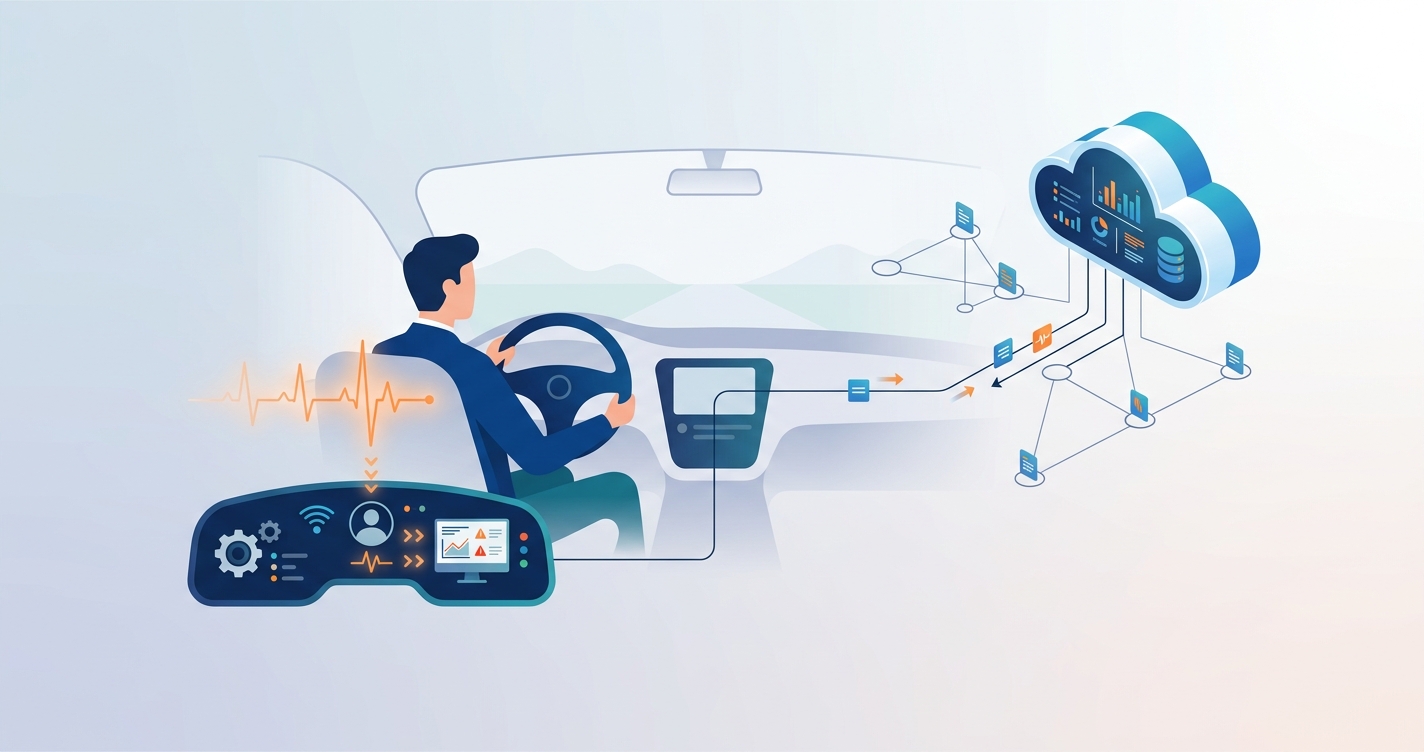
The first layer stays local. That includes signal capture, face-region processing, data-quality scoring, privacy filtering, immediate driver-state inference, and any safety-linked alerting. The second layer becomes selective upload: event summaries, compressed metadata, exceptions, and validation logs. The third layer lives in the cloud: analytics across fleets, model retraining, architecture tuning, and deployment management.
That split is not flashy, but it fits how automotive systems usually mature. The functions that must work every time get pulled closer to the car. The functions that benefit from scale get pushed outward.
For DMS vital signs, that means the edge is where trust starts.
- Edge is where latency becomes predictable.
- Edge is where privacy controls are easiest to enforce before transmission.
- Cloud is where trend analysis, retraining, and cross-fleet comparison make sense.
- Hybrid architecture is where most production programs will probably settle.
Frequently Asked Questions
Is edge computing always better than cloud processing for DMS vital signs?
Not always. Edge is usually better for real-time inference, privacy filtering, and safety-linked decisions. Cloud is usually better for retraining, historical analysis, fleet dashboards, and software distribution.
Why is cloud-only processing risky for driver monitoring?
Because cabin monitoring may need to function during weak or inconsistent connectivity. If a core driver-state decision depends on a remote round trip, latency and availability become product risks.
Does edge processing solve privacy concerns by itself?
No. It helps, but governance still matters. Edge designs reduce exposure by keeping more biometric processing inside the vehicle and transmitting less raw data, which is a strong starting point rather than a complete privacy strategy.
What architecture are most automotive teams moving toward?
A hybrid model. Immediate sensing and alert logic stay on the vehicle, while the cloud supports analytics, retraining, validation review, and OTA improvement.
For teams planning in-cabin health sensing, solutions like Circadify's automotive cabin work are aimed at that hybrid reality: contactless sensing that can fit real vehicle architectures rather than a cloud-only demo path. For related context, see our analysis of driver health analytics from raw data to actionable alerts and why vital signs matter for autonomous vehicle safety.