
Will my car tell me if I'm too angry to drive safely before I regret it?
How driver stress detection systems sense anger and emotional arousal in the cabin, and what OEMs and Tier-1 suppliers need to know to deploy it.
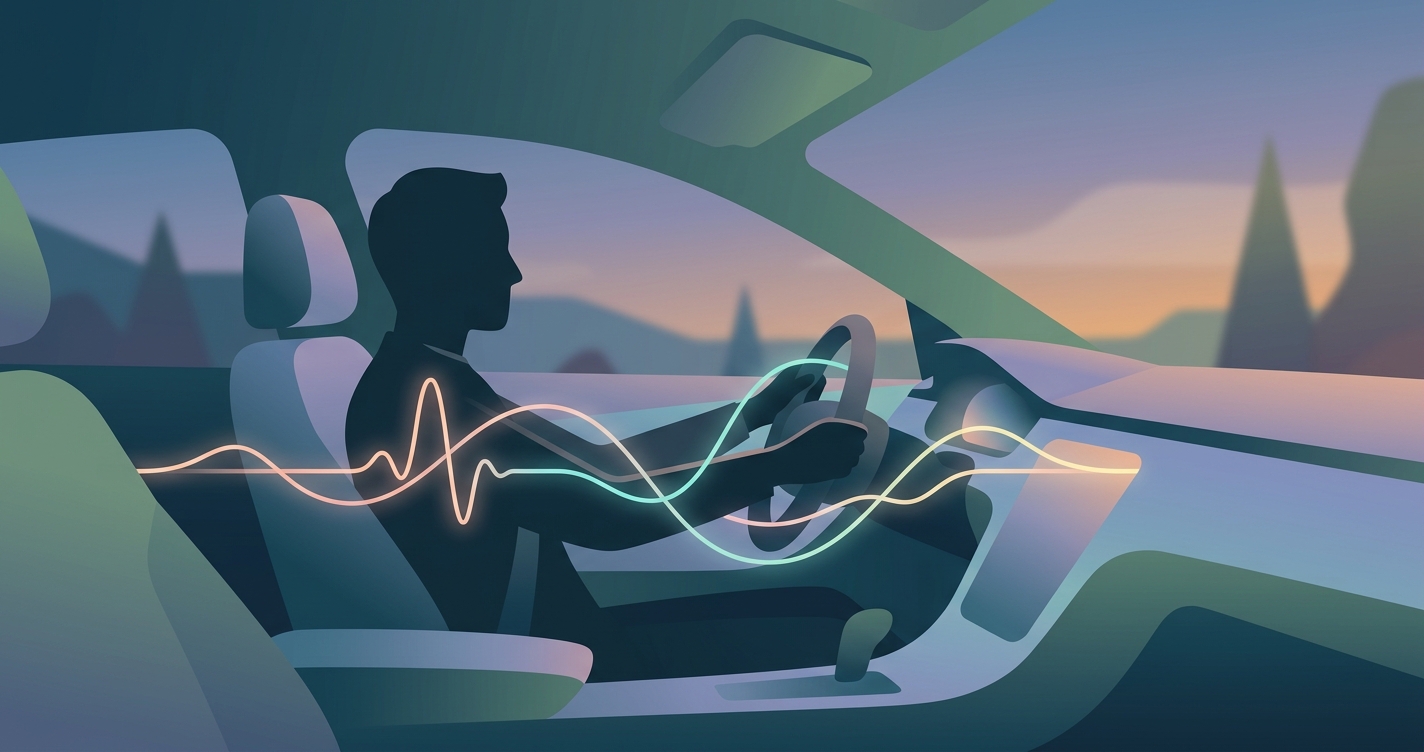
A car that recognizes the moment you tip from frustrated into furious is no longer a concept reel. The same camera and sensor stack that already watches for drowsy eyes can read the physiological and facial signatures of anger, and the question for automotive engineering teams is shifting from whether this is possible to how reliably it can be done in a moving cabin. Driver stress detection sits at the center of that shift, because anger is not just an emotional state. It is a measurable change in heart rhythm, facial muscle activity, grip, and steering behavior that arrives seconds to minutes before the aggressive maneuver a driver later regrets.
For OEMs, Tier-1 suppliers, and fleet operators, the appeal is direct: emotional incapacitation is a crash factor that current safety systems mostly ignore. Drowsiness and distraction have well-funded detection pipelines. Anger does not, despite being one of the most consistent predictors of risky driving.
Aggressive driving behaviors contribute to a meaningful share of fatal crashes, and the AAA Foundation for Traffic Safety has reported that roughly 80 percent of drivers admit to expressing significant anger or aggression behind the wheel at least once in the prior year.
Why driver stress detection is the next frontier in cabin sensing
Driver stress detection works by combining signals that each capture a different layer of the body's response to anger. No single channel is decisive, which is why modern research consistently points toward sensor fusion rather than a single magic sensor.
The physiological layer is the most studied. When a driver becomes angry, the sympathetic nervous system activates, heart rate rises, and heart rate variability (HRV) compresses. Remote photoplethysmography (rPPG) can extract these cardiac signals from skin color changes captured by an in-cabin camera, with no contact required. A 2024 systematic review of rPPG for driver monitoring led by researchers publishing in IEEE Access screened 344 studies and analyzed 29 in depth, concluding that deep learning has substantially improved signal extraction while flagging robustness under motion and lighting as the central open problem.
The behavioral layer adds context. Facial expression models built on convolutional neural networks classify anger from brow, mouth, and eye-region movements. Driving control inputs such as abrupt throttle, hard braking, and sharp steering corrections corroborate the emotional read so the system is not acting on a single grimace at a red light.
Here is how the main sensing approaches compare for detecting anger and acute stress in the cabin.
| Sensing approach | Primary signal | Strengths | Limitations | Cabin readiness |
|---|---|---|---|---|
| rPPG (camera) | Heart rate, HRV from skin | Contactless, reuses DMS camera, captures autonomic arousal | Sensitive to motion, lighting, skin tone diversity | Maturing |
| Facial expression AI | Brow, mouth, eye muscle patterns | Direct read of anger, fast inference | Confounded by occlusion, sunglasses, individual variation | High |
| Driving control signals | Throttle, braking, steering | Already on the bus, no new hardware | Indirect, lags the emotional onset | High |
| Voice and acoustic | Pitch, loudness, speech tempo | Captures verbal aggression, cheap | Silent drivers, passenger noise | Moderate |
| Contact sensors (wheel, seat) | PPG, GSR, grip pressure | High signal quality | Requires hand contact, added BOM cost | Moderate |
The pattern across the research is consistent. Camera-based methods are attractive because they reuse hardware that regulation is already pushing into vehicles, while contact sensors deliver cleaner data at the cost of added components and dependence on the driver touching the right surface.
- HRV compression, especially reductions in SDNN, is among the most repeated physiological markers of induced driving anger.
- Ultra-short-term HRV windows of two minutes or less can classify stress and fatigue states with accuracies above 90 percent in controlled work.
- Facial-feature models have reached roughly 87 percent accuracy for event-related driving anger using smartphone-captured expressions with gradient-boosted classifiers.
- Multi-feature fusion of facial, physiological, voice, and control data is the dominant direction for road rage detection systems.
Industry applications for emotional monitoring
Passenger vehicle OEMs
For passenger programs, anger detection extends a driver monitoring system (DMS) that may already exist for regulatory reasons. The intervention design matters as much as the detection. Subtle countermeasures, such as adjusting cabin lighting, lowering audio, suggesting a route with fewer stops, or offering a calming voice prompt, are more defensible than aggressive alerts that could themselves provoke a driver. A 2024 comparative study of emotion-aware in-car feedback published in MDPI Sensors examined how different feedback modalities affect driver state, reinforcing that the response strategy is a safety design problem, not just a UX choice.
Tier-1 suppliers
For suppliers, emotional monitoring is a software differentiator layered onto existing camera and compute platforms. The commercial advantage lies in delivering a fused stress and anger model that runs on the edge alongside drowsiness and distraction, sharing the same image pipeline. That keeps bill-of-materials impact low while opening a feature that OEMs can market and that insurers may eventually reward.
Fleet and commercial operators
Fleets carry the clearest financial case. Aggressive driving raises crash liability, fuel cost, and vehicle wear. An emotional state flagged in real time, paired with coaching analytics after the trip, gives safety managers a lever they currently lack. Stress monitoring is especially relevant for long-haul and last-mile drivers operating under schedule pressure, where chronic stress and acute anger compound fatigue.
Current research and evidence
The evidence base for driver stress detection has grown quickly but unevenly. Physiological work is strong. Studies of ultra-short-term HRV under real-world driving, including research published in PMC on stress detection during actual commutes, show that autonomic markers track stress reliably enough for classification. A pilot study on detecting emotional arousal and aggressive driving with neural networks, conducted with young drivers in Duluth and published through PMC, demonstrated that combining physiological and behavioral inputs improves identification of aggressive states over any single channel.
Facial and multimodal work is advancing in parallel. Research on attentional convolutional networks for driver emotion recognition, published in Frontiers, reported gains in anger classification by directing the model toward the most informative facial regions. Separate work on multi-feature fusion road rage detection systems argues that facial expression, voice, control inputs, and physiology together produce more dependable triggers than facial data alone.
Three limitations recur across this literature and define the engineering agenda:
- Dataset diversity. Many models are trained on narrow populations, raising fairness and reliability concerns across age, skin tone, and gender. The 2024 rPPG review specifically called out limited population representation.
- Motion and lighting robustness. Contactless cardiac extraction degrades with vibration, sun flicker, and head movement, the exact conditions of normal driving.
- Ground truth for emotion. Anger is harder to label than eye closure. Induced-anger studies and self-report each carry bias, complicating validation.
The future of driver stress detection
The trajectory points toward emotional state becoming a standard channel inside the broader in-cabin health stack rather than a standalone feature. As DMS cameras and infrared illuminators reach near-universal fitment under safety frameworks, the marginal cost of adding a stress and anger model is mostly software and validation. Expect three developments.
First, fusion at the edge. Anger detection will increasingly run on the same processor as drowsiness and distraction, sharing the image pipeline and producing a unified driver-state estimate rather than separate scores.
Second, graded and personalized intervention. Systems will learn individual baselines so that a normally expressive driver is not constantly flagged, and they will escalate responses only when physiological arousal and behavioral risk align.
Third, integration with vehicle dynamics and ADAS. A high-confidence anger state could inform following-distance settings, throttle response shaping, or the timing of advisory messages, turning detection into measurable risk reduction rather than a dashboard notification.
The hardest remaining work is not sensing the emotion. It is proving that detection plus a well-designed response lowers incident rates without irritating drivers or introducing bias. That is a validation and human-factors challenge, and it is where serious program investment will concentrate over the next several years.
Frequently asked questions
Can a car really detect anger before a driver acts on it? The physiological onset of anger, including rising heart rate and compressed HRV, often precedes the aggressive maneuver. Camera-based rPPG and facial models can capture these changes in real time, which creates a window for early intervention. Reliability still depends on sensor fusion and robust handling of motion and lighting.
How is driver stress detection different from drowsiness detection? Drowsiness relies heavily on eye closure, blink rate, and head pose, which are visually distinct. Stress and anger require physiological cues such as heart rate and HRV plus facial and behavioral signals, because the visual signature of anger is more variable across individuals and easier to confuse.
Does emotional monitoring require new hardware? Often not. Much of the work reuses the in-cabin camera and compute already specified for driver monitoring. Contact sensors in the wheel or seat can improve signal quality but add cost and depend on driver contact, so camera-based fusion is the common starting point.
What is the biggest barrier to deployment? Validation and fairness. Models must perform across diverse drivers and survive real-world motion and lighting, and any intervention has to reduce risk without provoking the driver. These human-factors and dataset challenges, not the core algorithms, are the gating issues.
Circadify is actively working in this space, developing camera-based cabin monitoring that brings fatigue, drowsiness, and stress detection into a single in-cabin pipeline for automotive programs. Teams evaluating emotional monitoring features can start an automotive program inquiry at circadify.com/custom-builds/automotive-cabin.