Driver Monitoring for Electric Vehicle Fleets: Unique Fatigue Patterns Explained
A research-based look at driver monitoring electric vehicle fleet fatigue, including stop-start workload, quiet cabins, range anxiety, and new in-cab sensing demands.
Driver Monitoring for Electric Vehicle Fleets: Unique Fatigue Patterns Explained
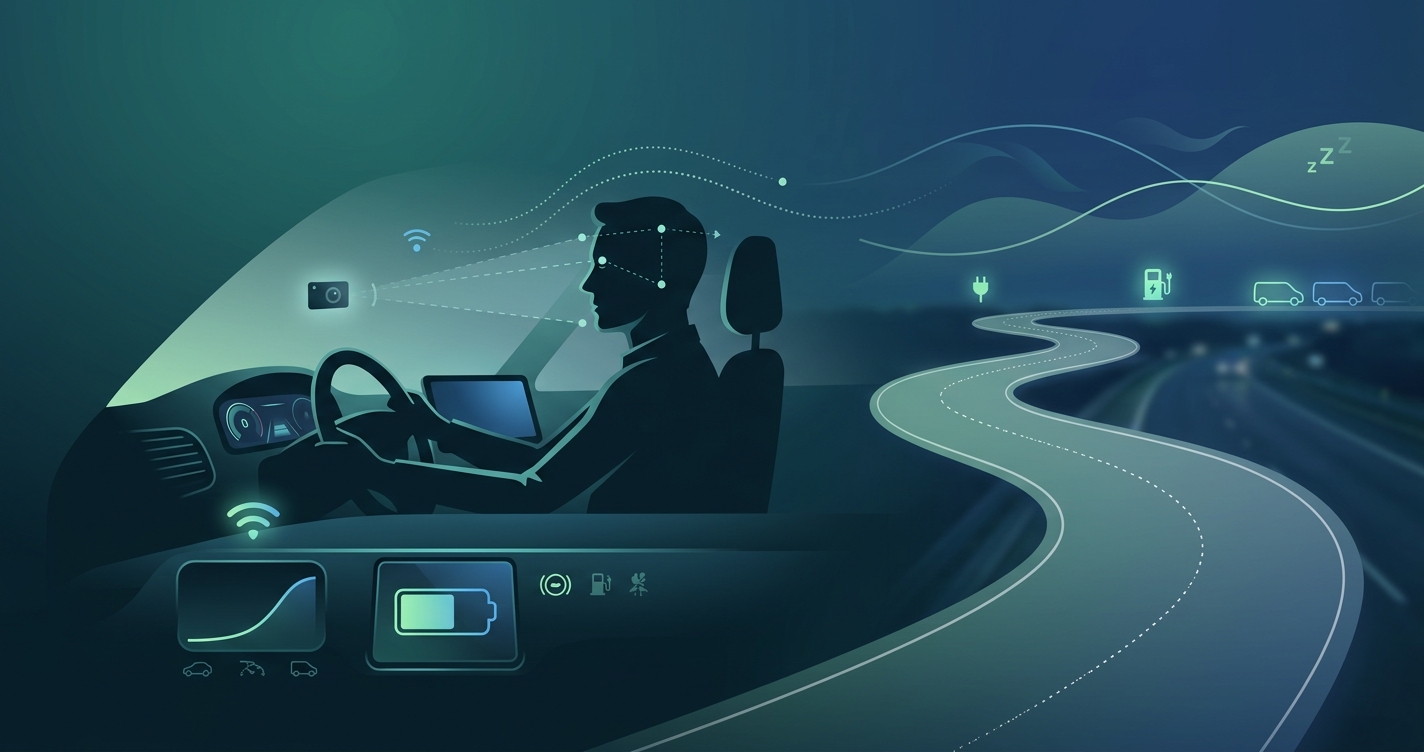
The phrase driver monitoring electric vehicle fleet fatigue can sound slightly odd at first, because many people assume electric fleets should simply be less tiring to operate. In one sense, that is true. Battery-electric vans and trucks are quieter, smoother, and easier to handle in stop-start traffic than diesel vehicles. But fleet fatigue does not disappear when the powertrain changes. It shifts. The daily strain in an EV fleet often comes from a different mix of load: urban density, regenerative-braking behavior, route uncertainty, charging windows, and the mental overhead of managing range in a real operating schedule. That is why EV fleet safety teams are starting to treat driver monitoring as more than a generic drowsiness feature.
"Drivers of electric vans experienced less stress and fatigue, had lower heart rates, and were more mentally alert than when driving diesel vans." — University of Cambridge summary of the 2024 DHL and Ford Pro electric van study
Driver monitoring electric vehicle fleet fatigue is different from diesel-era fatigue
EV fleets do not erase fatigue risk. They reorganize it.
For a long-haul diesel program, fatigue often centers on extended time-on-task, highway monotony, circadian pressure, and the usual hours-of-service problem. An electric fleet may still face those pressures, especially in heavier-duty operations, but many early EV deployments are concentrated in urban delivery, service fleets, municipal operations, and recurring depot-based routes. That changes the driver-state picture.
In 2024, DHL, Ford Pro, and researchers at the University of Cambridge reported that electric van drivers showed lower stress and lower heart rates than when they drove diesel equivalents. That matters, but it does not mean driver monitoring becomes less important. It means the system may need to watch for a more mixed pattern: lower baseline physiological strain in some settings, paired with higher cognitive overhead around range management, charging timing, and dense stop-and-go work.
That distinction shows up in the research. A 2023 review by Takashi Abe of the University of Tsukuba in Sleep Advances argued that PERCLOS remains one of the most validated measures for passive drowsiness detection, but that future systems should combine eyelid-closure metrics with other behavioral and physiological signals. EV fleets are a good example of why. If the work pattern blends classic fatigue with route stress and task switching, a one-signal model can miss what operations teams actually care about.
- Quieter cabins may reduce stress and vibration-related fatigue.
- Urban EV routes may increase cognitive load through constant stopping, pedestrians, cyclists, and time pressure.
- Charging constraints can create decision stress near the end of a shift.
- Regenerative braking behavior changes pedal use and vehicle feel, which can alter workload and vigilance demands.
- Depot-based EV fleets often run predictable routes, making event-based fatigue analytics more useful than generic thresholds.
Why EV fleet fatigue looks different in practice
| Fleet condition | Common diesel pattern | EV fleet pattern | Monitoring implication |
|---|---|---|---|
| Cabin environment | More vibration, engine noise, heat | Quieter cabin, smoother ride | Lower baseline stress may mask later attention drift |
| Route profile | Highway-heavy for many fleets | More urban and regional stop-start duty | More cognitive switching and distraction exposure |
| Energy management | Fuel availability rarely shapes in-shift decisions | State of charge and charging windows can affect choices | Driver-state data should be read alongside route and battery context |
| Vehicle control feel | Conventional braking response | Regenerative braking changes deceleration behavior | Systems may need to distinguish adaptation from impairment |
| Safety objective | Prevent microsleeps and prolonged fatigue events | Prevent both drowsiness and overload-related errors | Multimodal monitoring becomes more valuable |
That table gets at the main point: the EV problem is not always "more fatigue." Sometimes it is a different fatigue signature.
The operational patterns behind EV fleet fatigue
One of the more interesting findings in EV research is that the driver can feel better overall while still facing moments of higher mental demand. That sounds contradictory, but fleet managers already know the pattern. A route can be physically easier and cognitively busier at the same time.
A University of Twente line of research on eco-driving feedback and range anxiety found that EV driver interfaces can raise cognitive workload when they constantly push efficiency cues into the driving task. In other words, the system meant to help conserve range can also add mental overhead. That matters for commercial fleets, where range is not an abstract consumer concern. It affects dispatch confidence, charging discipline, route sequencing, and whether a driver feels pressure to compensate late in the shift.
The same issue appears with regenerative braking. Research cataloged through the University of Waterloo and other driving-systems work shows that regenerative-braking calibration changes how the driver manages deceleration and pedal transitions. Strong one-pedal behavior can reduce repetitive braking effort, which may help with fatigue. But it also means adaptation matters. A monitoring system that sees unusual head movement, speed correction, or glance behavior has to tell the difference between a fatigued driver and one responding to a different control feel in a new vehicle class.
This is where a lot of DMS deployments get too simple. They assume fatigue is a single downhill curve. In EV fleets, it can look more like a layered operating state:
- early-shift alertness in a low-noise cabin
- mid-route workload spikes in congested stop-start traffic
- decision stress when energy margins tighten
- end-of-shift vigilance drop during charging, queueing, or return-to-base activity
A monitoring program that only flags eyelid closure will catch part of that story, not all of it.
Industry applications for EV fleet driver monitoring
Urban delivery fleets
This is probably the clearest EV use case right now. Delivery vans run dense routes with frequent stops, curbside risk, schedule pressure, and constant re-entry into traffic. The quieter EV platform may reduce stress, as the Cambridge-DHL-Ford work suggests, but the route itself remains mentally busy. Monitoring systems in these fleets need to distinguish between momentary scanning behavior and true inattention.
Municipal and service fleets
Municipal EVs, utility vehicles, and field-service vans often mix driving with repeated task transitions. Drivers are not just driving. They are parking, checking tablets, handling equipment, talking to dispatch, and restarting the route. That pattern produces attention fragmentation more than classic highway drowsiness. Driver monitoring can be useful here if alerts are calibrated for task-switching environments rather than only prolonged eyelid closure.
Medium-duty commercial EVs
As electric trucks move into regional hauling and heavier duty cycles, the fatigue model starts to blend old and new pressures. There is still time-on-task fatigue, but now it sits alongside charging constraints, route replanning, and evolving HMI demands. That makes state fusion more important. Safety teams need to combine driver-state signals with battery state, route deviation, dwell time, and dispatch events.
Current research and evidence
The strongest evidence still comes from the broader fatigue field, but it is increasingly relevant to EV operations.
Brian C. Tefft of the AAA Foundation for Traffic Safety reported in 2018 that drowsiness was a factor in 9.5% of crashes in the SHRP 2 naturalistic driving dataset, with even higher risk among severely sleep-deprived drivers. That is a reminder that the core fatigue problem has not gone away just because the fleet electrified.
Takashi Abe's 2023 review in Sleep Advances called PERCLOS one of the most validated passive drowsiness indicators, while also arguing that future systems should integrate additional behavioral and physiological measures. That recommendation fits EV fleets well, because their fatigue profile is less tied to one variable and more tied to context.
The Cambridge-DHL-Ford Pro work from 2024 adds another important layer. Drivers in electric vans showed lower stress and improved alertness markers relative to diesel vans. I think this is exactly the sort of result that can be misread if you are not careful. It does not say EV fleets no longer need monitoring. It says their monitoring stack may need to focus less on brute-force fatigue assumptions and more on detecting the transitions between comfort, overload, distraction, and genuine drowsiness.
Research on task-induced fatigue by Philip P. Jackson and Lisa M. Kennedy makes that point in a more general way. Fatigue effects depend heavily on the task environment. For EV fleets, that means route density, stop frequency, charging behavior, and interface design are not side details. They are part of the fatigue model.
Research signals shaping EV fleet monitoring design
| Source | Institution | What it suggests for EV fleets |
|---|---|---|
| Brian C. Tefft (2018) | AAA Foundation / SHRP 2 analysis | Drowsy driving remains a serious crash factor regardless of powertrain |
| Takashi Abe (2023) | University of Tsukuba / Sleep Advances | PERCLOS still matters, but multimodal detection is the next step |
| DHL, Ford Pro, University of Cambridge (2024) | Commercial EV field study | Electric vans may lower stress while changing how fatigue presents |
| University of Twente EV workload research | Human factors / EV interface research | Efficiency prompts and range concerns can increase cognitive workload |
| Jackson and Kennedy task-fatigue work | Driver fatigue research | Fatigue countermeasures need to match the actual task demands |
What EV fleet driver monitoring systems should measure
A useful EV monitoring stack should still include the basics: eye closure, gaze direction, head pose, distraction events, and escalating alerts. But fleet operators are getting more value when those signals are combined with operating context.
That usually means looking at:
- route density and stop frequency
- time of day and shift duration
- charging-window pressure
- repeated harsh deceleration or correction events
- dwell-time irregularities at depots or chargers
- interactions between distraction, battery state, and route completion risk
This matters because the same face signal can mean different things in different moments. A long blink at 2:30 a.m. on a regional route may suggest physiological drowsiness. Repeated off-road glances near a depot with 8% battery may reflect charging and dispatch stress. Both matter, but they are not the same operational event.
The future of driver monitoring in electric fleets
The next phase will probably look less like a stand-alone fatigue camera and more like a driver-state layer inside a broader EV operations stack. Fleet platforms already know route shape, battery level, charger availability, and schedule pressure. Driver monitoring becomes more useful when it can interpret human behavior inside that operating picture.
That has a few practical consequences.
First, EV fleets should expect more context-aware alerting. A generic drowsiness threshold is not enough for a driver doing 140 urban stops with constant curb interaction. Second, safety teams will want models that separate low-arousal drowsiness from high-load overload. Those are different failure modes. Third, in-cabin sensing will probably move toward multimodal inputs, especially as camera-based vital-sign estimation matures for automotive environments.
There is a temptation to frame EV fleets as automatically safer because the vehicles feel calmer to drive. There is some truth in that. But calm is not the same as low-risk. A smoother vehicle can reduce stress while the operation around it gets more complex. That is the real reason EV fleets need better driver monitoring, not less of it.
Frequently Asked Questions
Are electric vehicle fleets less fatiguing to drive than diesel fleets?
In some cases, yes. The 2024 Cambridge, DHL, and Ford Pro work found lower stress and heart-rate markers in electric van driving. But lower baseline stress does not remove fatigue risk. It changes the pattern fleets need to monitor.
Why would EV fleets need a different driver monitoring model?
Because the job often includes more stop-start driving, charging constraints, interface prompts, and route-density pressure. Those conditions can raise cognitive load even when the vehicle itself feels smoother.
Is classic drowsiness detection still useful in EV fleets?
Yes. Research from the AAA Foundation and Takashi Abe's 2023 review both support ongoing use of validated drowsiness signals like PERCLOS. The difference is that EV fleets often benefit from combining those signals with operating context.
What should fleet safety leaders compare when evaluating EV driver monitoring systems?
They should compare distraction detection, fatigue detection, alert logic, route-context integration, event review workflows, and whether the platform can interpret driver-state events alongside battery and dispatch data.
For teams building EV fleet safety programs, solutions like Circadify are being developed for custom automotive and in-cabin monitoring workflows that connect camera-based driver-state sensing with broader operational context. For more, see Circadify's automotive cabin page, along with related Quick Scan Vitals coverage of last-mile driver fatigue detection and driver monitoring KPIs.