How can my truck spot my fatigue even if I've had coffee?
How a driver fatigue detection camera reads physiological signals like heart rate variability and microsleep that coffee masks but never erases.
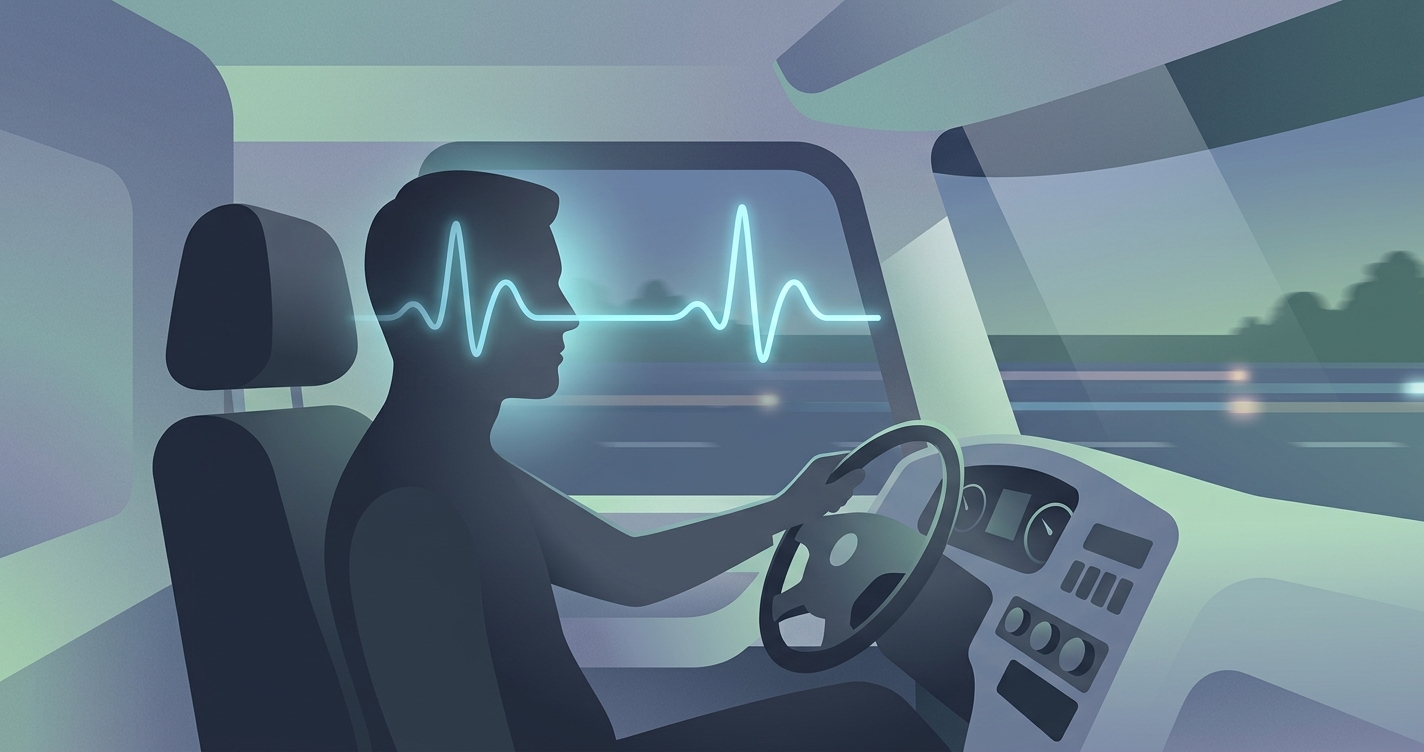
Coffee is the oldest fatigue countermeasure in trucking, and it is also one of the most misleading. A driver who downs a large cup at a fuel stop feels sharper within twenty minutes, yet the sleep pressure built up over a long shift has not gone anywhere. Caffeine blocks the brain's adenosine receptors and dampens the feeling of tiredness, but it does not repay sleep debt or reset the body's autonomic stress response. This gap between perceived alertness and actual physiological state is exactly the problem a modern driver fatigue detection camera is built to close. For fleet management teams, the practical question is no longer whether a camera can see drowsy eyes, but whether it can read the deeper bodily signals that a stimulant temporarily hides.
"PERCLOS, defined as the percentage of time the eyes are more than 80 percent closed, remains one of the most validated indices for passive drowsiness detection, yet it may not capture moderate drowsiness or fatigue driven by factors other than imminent sleep onset." - Synthesis of PERCLOS validation research, PMC review (2023)
Why a driver fatigue detection camera looks past alertness
Early in-cabin systems treated fatigue as a behavioral event. They waited for the eyelids to droop, the head to nod, or the lane position to wander, then triggered an alert. The trouble is that those signs are late indicators. By the time they appear, the driver may already be cycling through microsleeps lasting a few seconds each. Caffeine complicates this further by suppressing the obvious behavioral tells while the underlying nervous system continues drifting toward sleep.
A current-generation driver fatigue detection camera fuses two layers of evidence. The first layer is behavioral and well established: PERCLOS, blink duration, yawn frequency, gaze direction, and head pose. The second layer is physiological, and it is where the technology has advanced most. Using remote photoplethysmography (rPPG), a standard near-infrared or RGB camera detects minute color changes in facial skin caused by blood flow with each heartbeat. From that signal the system estimates heart rate and, more importantly, heart rate variability (HRV).
HRV is the spacing variation between consecutive heartbeats, and it reflects the balance between the sympathetic (alerting) and parasympathetic (resting) branches of the autonomic nervous system. As genuine fatigue sets in, that balance shifts in measurable ways. Caffeine can mask how tired a driver feels, but the autonomic drift associated with accumulated fatigue and circadian low points is far harder to disguise.
Behavioral signals versus physiological signals
The distinction matters because each signal type fails in different conditions. Behavioral cues can be fooled by stimulants, sunglasses, or a driver consciously keeping their eyes wide. Physiological cues are harder to suppress voluntarily but demand more from the camera and the processing pipeline. The table below compares how the two approaches behave in real fleet conditions.
| Detection signal | What it measures | Strength | Weakness after caffeine |
|---|---|---|---|
| PERCLOS / eye closure | Percent of time eyes are mostly closed | Well validated, low compute | Suppressed while caffeine sustains eye-opening |
| Blink duration and rate | Slow, long blinks of microsleep onset | Catches drowsiness behavioral tells | Reduced early, returns late in the fatigue curve |
| Head pose and nodding | Postural loss of muscle tone | Clear late-stage indicator | Appears only after danger is already present |
| rPPG heart rate | Beat-to-beat pulse from facial blood flow | Continuous, contactless | Caffeine raises HR but baseline drift still readable |
| Heart rate variability (HRV) | Autonomic balance over time | Tracks fatigue masked by stimulants | Needs stable signal and longer windows |
| Multimodal fusion | Behavioral plus physiological combined | Earliest reliable warning | Highest engineering and validation burden |
The pattern is clear. No single channel is robust on its own, and the channels most resistant to caffeine are also the most technically demanding. This is why fusion has become the dominant design philosophy.
How fusion catches what coffee hides
The reason multimodal fusion works is that caffeine and fatigue act on different systems. A stimulant props up conscious alertness and the behavioral signals tied to it, while the slower physiological drift continues underneath. A camera that watches both layers can flag the contradiction: eyes that stay open but a pulse pattern and HRV signature consistent with deepening fatigue.
- Behavioral channels degrade first when caffeine is in play, so a system that relies only on eyes will report a falsely rested driver.
- rPPG-derived heart rate and HRV provide a parallel reading that does not depend on the driver looking tired.
- Combining the two lets the system detect a mismatch, which is often a stronger fatigue indicator than either signal alone.
- Time matters: HRV trends need a rolling window of data, so the camera builds a baseline across the shift rather than judging a single frame.
For a fleet, the operational payoff is earlier and more trustworthy alerts. Instead of waking a driver who is already in a microsleep, the goal is to surface the warning while there is still margin to pull over, swap drivers, or schedule a break.
Industry applications for fleet operators
Long-haul and overnight freight
Night driving collides with the circadian low between roughly 2 a.m. and 6 a.m., when fatigue risk peaks regardless of how much coffee has been consumed. A physiological-aware camera is most valuable here because behavioral suppression from caffeine is common and the underlying risk is highest. Fleets running overnight lanes gain a monitoring layer that does not assume an alert-looking driver is actually rested.
Mixed-shift delivery fleets
Urban and regional delivery drivers cycle through irregular schedules and frequent stimulant use to manage them. Continuous in-cabin physiological monitoring helps distinguish a driver who is genuinely fit to continue from one who is masking fatigue, supporting fairer and safer dispatch decisions.
Driver coaching and risk scoring
Beyond real-time alerts, the data feeds longer-term analytics. Aggregated HRV and drowsiness trends help safety managers identify chronic fatigue patterns across routes and shift designs, turning isolated events into actionable scheduling policy rather than after-the-fact incident reports.
Current research and evidence
The shift toward physiological sensing is grounded in a growing body of peer-reviewed work. A 2024 systematic review published in IEEE Xplore on AI innovations in rPPG systems for driver monitoring documented how deep learning has improved the extraction of pulse signals from facial video and the fusion of those signals with behavioral data, enabling fatigue detection earlier than visible behavior alone allows.
Researchers publishing in MDPI in 2024 demonstrated a non-invasive fatigue detection method combining rPPG with motion tracking through a convolutional neural network and bidirectional long short-term memory model, reinforcing that multi-modal fusion outperforms single-signal approaches. A separate 2024 MDPI study showed that heart rate variability features extracted from electrocardiogram windows as short as two minutes can classify driver fatigue, and that accounting for sex differences in HRV improves precision, a finding relevant to building camera systems that generalize across diverse driver populations.
On the behavioral side, the 2023 PMC review of PERCLOS-based technologies confirmed the metric's strong validation in simulated and on-road driving while cautioning that it can miss moderate drowsiness and non-sleep-related impairment. Taken together, the literature points the same direction: behavioral indices remain useful, but physiological signals close the gaps, particularly the gap created by stimulants.
The honest caveat from this research is that rPPG accuracy depends on stable conditions. Varying cabin lighting, vibration, and motion all challenge signal quality, and training datasets still need broader population representation. These are active engineering problems rather than settled ones.
The future of driver fatigue detection cameras
The trajectory points toward systems that treat fatigue as a continuous physiological state rather than a binary alarm. Expect tighter sensor fusion that blends rPPG with respiration estimation and stress markers, edge processing that keeps biometric data inside the vehicle, and personalized baselines that learn each driver's normal rhythm so deviations stand out faster. Regulatory momentum, including European driver monitoring mandates, is also pushing physiological awareness from a premium feature toward a baseline expectation. For fleets, the practical horizon is a cabin that understands the difference between a driver who feels awake and a driver who is genuinely fit to drive.
Frequently asked questions
Can a camera really detect fatigue after I drink coffee?
Yes, because caffeine mainly suppresses the subjective feeling of tiredness and the behavioral signs tied to it. A driver fatigue detection camera that reads physiological signals such as heart rate variability through rPPG can pick up autonomic drift that a stimulant does not reverse, then flag the mismatch between alert-looking eyes and a fatigued nervous system.
What is rPPG and how does it work in a truck cabin?
Remote photoplethysmography uses a camera to detect tiny color changes in facial skin caused by blood flow with each heartbeat. From that signal the system estimates heart rate and heart rate variability without any contact sensors, which lets it monitor physiological state continuously during a shift.
Is physiological detection more reliable than eye-tracking alone?
Each signal has weaknesses. Eye-tracking can be suppressed by stimulants or eyewear, while physiological signals need stable conditions and longer data windows. Research consistently shows that fusing both layers produces earlier and more reliable fatigue detection than either approach used by itself.
Does this technology store my biometric data?
That depends on system design. Many current architectures favor edge processing, where physiological signals are analyzed inside the vehicle and only fatigue events or scores are shared, reducing how much raw biometric data leaves the cabin.
Circadify is actively building in this space, developing camera-based cabin monitoring that reads driver fatigue, drowsiness, and stress from physiological signals rather than appearance alone. Fleet and automotive teams evaluating robust fatigue detection can start an automotive program inquiry at circadify.com/custom-builds/automotive-cabin.