What Driver Drowsiness Detection Misses Without Vital Signs
Eye-only drowsiness systems flag fatigue late. A look at driver drowsiness detection limits and why vital signs reveal early fatigue OEMs are missing.
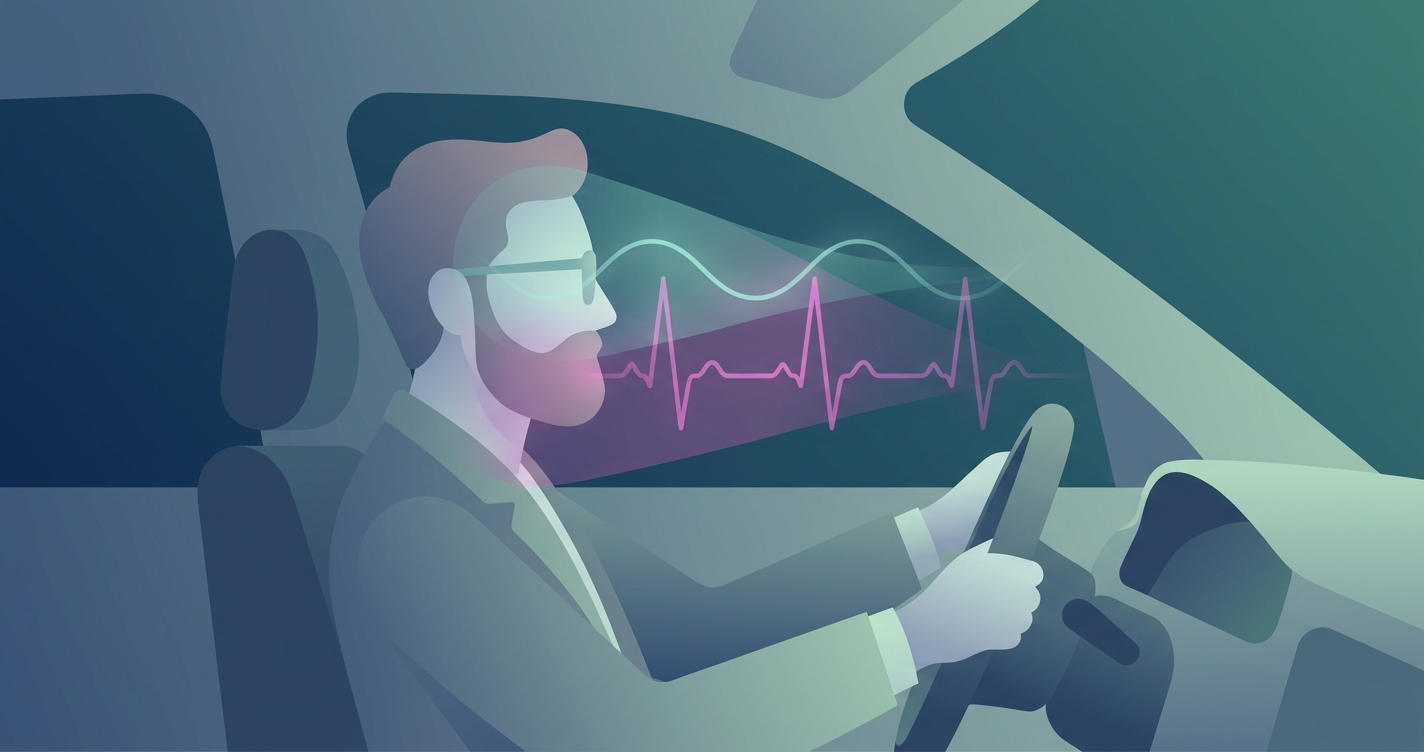
Most driver monitoring programs treat fatigue as a problem the eyes will eventually reveal. The dominant approach watches eyelid closure, blink dynamics, gaze direction, and head pose, then raises an alert once those signals cross a threshold. That model has a structural weakness that engineering teams are starting to confront directly: by the time the eyelids tell the story, the driver is already deep into impairment. Understanding the driver drowsiness detection limits of eye-only systems is now central to any in-cabin sensing roadmap, because the autonomic nervous system shifts minutes before a single droopy eyelid appears. The same inward-facing camera that tracks the eyes can also read pulse, respiration, and heart rate variability, and that physiological layer is where the earliest fatigue signal actually lives.
"Behavioral signs of drowsiness detected by PERCLOS, such as eye closure, often manifest only 1 to 3 minutes before the peak risk of an accident," notes a 2023 review of PERCLOS-based technologies published in the journal Clocks and Sleep, which also found that the metric struggles to capture moderate or situational drowsiness.
The driver drowsiness detection limits hiding in eye-only systems
PERCLOS, the percentage of time the eyes are closed over a rolling window, remains the validated workhorse of camera-based drowsiness detection. It performs well in one specific case: a sleep-deprived driver visibly nodding off. The trouble is that real fatigue rarely announces itself that cleanly. The 2023 Clocks and Sleep review concluded that PERCLOS is less reliable for moderate or situational drowsiness, less sensitive in older drivers, and largely blind to fatigue that stems from inattention rather than imminent sleep onset. It also fires late by design, since eyelid behavior is a downstream consequence of an autonomic state that has been changing for several minutes.
The deeper issue is what eyelids cannot encode. Fatigue is an autonomic process before it is a behavioral one. As a driver tires, sympathetic and parasympathetic balance shifts, heart rate variability changes, and breathing patterns drift. None of that is visible in a blink. A driver who has had coffee, who is fighting microsleeps with willpower, or who is in the early time-on-task decline can keep their eyes wide open while their physiology is already degrading. An eye-only model scores that driver as alert.
This matters because the operational window is narrow. If the behavioral signal arrives one to three minutes before peak crash risk, a system built only on that signal has almost no time to escalate, warn, and allow a corrective action. A monitoring stack that reads vital signs fatigue indicators alongside the eyes can in principle move the alert earlier, into a window where a rest-stop prompt or a graded warning still changes the outcome.
Eye tracking versus vital signs: what each layer sees
The two sensing layers are not competitors so much as different vantage points on the same driver. Eye and head signals capture the late, visible collapse of alertness. Vital signs capture the early, invisible autonomic drift. The comparison below frames how they differ on the dimensions OEM and Tier-1 evaluators actually weigh.
| Dimension | Eye and head tracking (PERCLOS, blink, gaze) | Vital signs layer (rPPG heart rate, HRV, respiration) |
|---|---|---|
| What it measures | Visible behavioral output of fatigue | Autonomic nervous system state |
| Timing of signal | Late, often 1 to 3 minutes before peak risk | Earlier, can precede behavioral decline |
| Moderate or situational drowsiness | Frequently missed | Detectable via HRV and respiration shifts |
| Effect of caffeine masking | Driver may appear alert | Underlying autonomic change still visible |
| Sunglasses, occlusion, head down | Signal degrades or is lost | Pulse and respiration still recoverable from skin and motion |
| Distinguishes fatigue from distraction | Limited | Stronger, autonomic signature differs |
| Hardware required | Existing inward-facing DMS camera | Same camera, additional processing |
| Maturity in production | High, regulation-driven | Emerging, active research stage |
The practical takeaway is not that eye tracking is wrong. It is that an eye-only system is structurally incomplete. The signals it reads are real but they arrive late, and several common conditions, from eyewear to caffeine to glance-down behavior, can blank or mislead it. A richer stack treats the eyes as confirmation of a state the body has been signaling for minutes.
Key gaps that vital signs help close:
- Early autonomic drift that precedes any change in eyelid behavior
- Moderate fatigue that never produces dramatic eye closure
- Caffeine-masked fatigue where alertness is performed but not felt
- Periods of occlusion when the eyes are not cleanly visible
- Separating genuine drowsiness from simple distraction or cognitive load
Industry applications for a combined fatigue stack
Passenger vehicle OEMs
European General Safety Regulation requirements have pushed driver drowsiness and attention warning into mainstream production, which means nearly every new model already carries the inward-facing camera. That installed base is the opening. Adding a vital signs layer to hardware that already exists changes the value proposition from regulatory compliance to genuine early warning, without a new sensor bill of materials. For product planners, the question shifts from whether to add a camera to what else that camera should be allowed to measure.
Commercial fleets and long-haul trucking
Fleet operators carry the heaviest fatigue exposure and the strongest financial incentive to detect it early. Drowsy driving is severely underreported in crash data: the Governors Highway Safety Association estimated more than 6,300 deaths in suspected drowsy driving crashes in 2023, roughly ten times the 633 fatalities NHTSA recorded officially, because fatigue leaves no testable physical evidence. For a fleet, an alert that arrives minutes earlier, and that is not fooled by a fuel-stop coffee, is the difference between a logged warning and a prevented rollover.
Tier-1 suppliers and integrators
For suppliers, the vital signs layer is a differentiation path on top of a commoditizing DMS market. Two modules can claim identical eye-tracking specifications, but a supplier offering an earlier autonomic fatigue signal from the same camera has a defensible story to tell OEM customers. The integration challenge is real, but the sensor is already on the vehicle.
Current research and evidence
The research base for moving fatigue detection upstream into physiology is now substantial. A systematic review of heart rate variability for driver fatigue detection, published in PubMed-indexed literature, found that HRV reflects autonomic nervous system changes that can be measured non-invasively during real driving, with machine learning models reaching reported accuracies as high as 94 percent in optimized conditions. The same body of work documents that lower RMSSD, reduced high-frequency power, and a declining LF/HF ratio track with rising fatigue.
A 2024 study in the MDPI journal Sensors on early drowsiness detection used second-order derivative analysis of HRV from a non-contact ECG approach with machine learning, specifically targeting the window before behavioral signs appear. Other work has shown that usable HRV features can be extracted from electrocardiogram segments as short as two minutes, and that accounting for sex differences in HRV improves model precision, both of which matter for in-cabin systems that need fast, individualized alerts.
The convergence point is camera-based measurement. Remote photoplethysmography, or rPPG, recovers pulse and HRV from subtle color changes in facial skin captured by an ordinary camera. The 2023 PERCLOS review and related work explicitly recommend combining PERCLOS with HRV and other physiological indicators, with some integrated systems pairing eye-closure metrics and webcam-derived photoplethysmographic signals. That is the architecture an inward-facing automotive camera is uniquely positioned to deliver, because the sensor that watches the eyes can read the skin at the same time.
The evidence is not yet settled. Reported HRV accuracy ranges widely across studies, from roughly 44 percent to 100 percent, driven by differences in study design, the cause of fatigue, and individual variation. In-cabin conditions add motion, vibration, and lighting challenges. The honest position is that vital signs are a powerful complement still maturing toward production robustness, not a finished replacement for behavioral cues.
The future of driver drowsiness detection
The direction of travel is toward fusion rather than a single dominant signal. The most credible near-term architecture combines the late but reliable behavioral layer with the early but still-maturing autonomic layer, letting each cover the other's blind spots. Eyes confirm; vital signs forecast. As rPPG processing hardens against motion and lighting, the alert window should move earlier, from seconds-before-microsleep toward minutes-before-impairment.
Three shifts are likely to define the next phase:
- Multimodal fusion becoming the default specification rather than an add-on
- Personalization, where the system learns an individual's baseline HRV and respiration rather than applying population thresholds
- Continuity, where the same physiological stream that flags fatigue also surfaces stress and acute health events, turning the DMS camera into a broader cabin health sensor
The strategic implication for buyers is that the inward-facing camera is being underused. It already sees the eyes. The remaining value is in everything else it can read from the same frame.
Frequently asked questions
Why do eye-only drowsiness systems detect fatigue late?
Because eyelid closure is a downstream behavioral output of fatigue, not its first sign. The autonomic nervous system shifts minutes before the eyes change, and research on PERCLOS found that visible eye-closure signs often appear only one to three minutes before peak crash risk, leaving little time to intervene.
What can vital signs reveal that eye tracking cannot?
Vital signs such as heart rate variability and respiration capture the early autonomic drift of fatigue, moderate drowsiness that never produces dramatic eye closure, and caffeine-masked fatigue where a driver looks alert but is physiologically impaired. They also help separate genuine fatigue from simple distraction.
Does adding vital signs require new hardware in the cabin?
Generally no. Remote photoplethysmography recovers pulse, heart rate variability, and respiration from the same inward-facing camera that already performs eye and head tracking. The added capability is largely a processing and algorithm question rather than a new sensor on the bill of materials.
Is camera-based vital sign fatigue detection proven enough for production?
It is maturing. Studies report strong HRV-based accuracy in controlled conditions, but results vary with study design, fatigue cause, and in-cabin motion and lighting. The pragmatic path is fusing vital signs with established behavioral cues so each layer compensates for the other's weaknesses.
Circadify is building toward this exact gap, developing camera-based fatigue, drowsiness, and stress detection that reads the autonomic signals an eye-only system never sees. Automotive OEMs and Tier-1 teams evaluating how a vital signs layer compares to behavior-only monitoring can request a feature comparison and start a program inquiry at circadify.com/custom-builds/automotive-cabin.