How does a car know I'm falling asleep at the wheel without touching me?
How driver drowsiness detection camera systems read eyes, blinks, and head pose to flag fatigue without contact, and what fleets should know about the technology.
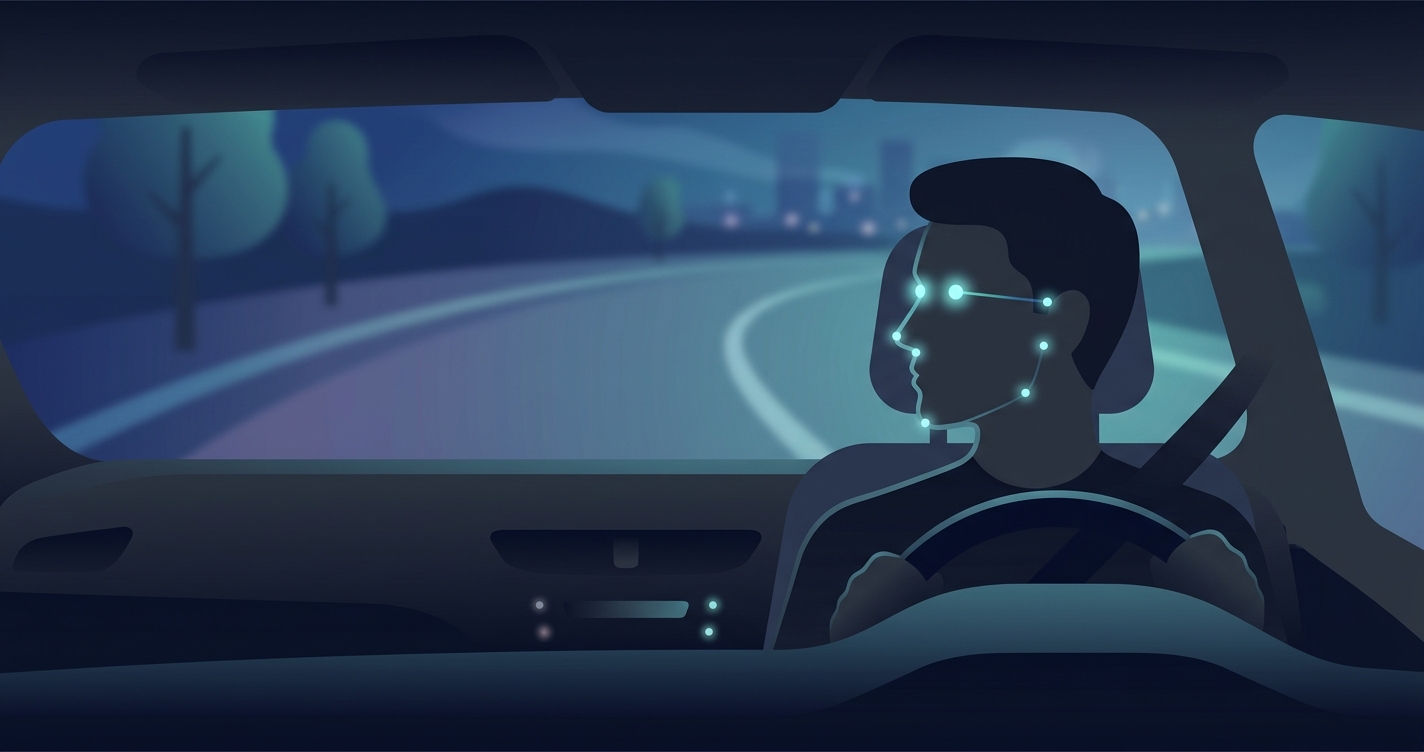
A vehicle that senses fatigue before the driver consciously registers it sounds like a stretch, yet the core method is surprisingly grounded in measurable physiology. A driver drowsiness detection camera does not read minds and does not require a wristband, chest strap, or any electrode taped to the skin. It watches the face the same way an alert passenger might notice a friend's eyelids drooping, then converts those observations into numbers a computer can act on. For fleet operators weighing fatigue programs, understanding what the camera actually measures, and where it still struggles, matters more than any marketing claim about accuracy.
The Governors Highway Safety Association estimates more than 6,300 people died in suspected drowsy driving crashes in 2023, roughly ten times the 633 fatalities recorded in official NHTSA tallies for the same year, a gap that points to severe underreporting of fatigue on the road.
What a driver drowsiness detection camera actually measures
A driver drowsiness detection camera is a near-infrared imaging sensor, usually mounted on the steering column, dashboard, or A-pillar, paired with a small processor running computer vision models. Near-infrared matters because it works in full darkness and sees through most sunglasses, so the system keeps functioning at 3 a.m. on a rural highway, exactly when drowsy crashes peak. The camera captures the face many times per second and extracts facial landmarks, the geometric points around the eyes, brows, nose, and mouth, then tracks how those points move over time.
The single most established metric is PERCLOS, the percentage of time the eyes are closed or nearly closed over a rolling window. Decades of research treat PERCLOS as a reliable proxy for the slow, heavy eyelid behavior that precedes microsleeps. The camera does not need to touch the driver because eyelid closure, blink duration, blink frequency, gaze direction, yawning, and head nodding are all visible signals. Layered together, they describe a fatigue state without a single sensor on the body.
- Eye closure and PERCLOS: long, slow closures signal advancing drowsiness.
- Blink dynamics: blink duration lengthens and blink rate shifts as alertness drops.
- Head pose: nodding, drifting, and the classic head-bob are strong late-stage indicators.
- Yawning: mouth-opening geometry adds a behavioral confirmation signal.
- Gaze and fixation: unfocused or fixed-stare patterns can flag cognitive disengagement.
The detection logic is non-contact by design. Compared with body-worn fatigue monitors, the camera trades direct physiological access for zero driver compliance burden, which is the deciding factor in most fleet deployments.
| Detection method | Contact required | Key signals | Works in the dark | Driver compliance burden |
|---|---|---|---|---|
| Camera (driver drowsiness detection camera) | None | PERCLOS, blinks, head pose, yawning, gaze | Yes, via near-infrared | None, passive |
| Steering and lane behavior | None | Steering corrections, lane drift | Indirect | None, but slow to react |
| Wearable (wristband, headband) | Yes | Heart rate, EEG, skin response | Yes | High, must wear daily |
| Self-report or scheduling | Yes | Subjective alertness ratings | N/A | High, unreliable |
How the camera turns pixels into a fatigue score
The pipeline starts with face detection, then locates landmarks frame by frame. Modern systems use convolutional neural networks trained on large image sets to classify eye state, open versus closed, far more robustly than older threshold rules. Researchers have reported deep learning models distinguishing drowsy from alert states with accuracy figures above 99 percent in controlled datasets, though real-world numbers are lower because cabins are messy environments.
Once eye state is classified, the processor computes PERCLOS across a sliding window of seconds. A common operational threshold treats sustained eye closure beyond a set percentage of the window as a drowsiness flag. The system fuses that with head-pose drift and yawning so a single noisy signal does not trigger a false alarm. When the fused score crosses a threshold, the vehicle issues an escalating alert: a chime, a seat or steering vibration, or in fleet platforms a notification routed to a safety dashboard.
Why non-contact sensing suits fleets
For a fleet, the appeal is operational, not just technical. A camera needs no daily setup, cannot be forgotten at home, and applies the same standard to every driver across every shift. That uniformity is what makes camera-based fatigue monitoring scalable across hundreds of vehicles, where wearable programs tend to collapse under compliance problems.
Industry applications
Long-haul and commercial trucking
Commercial drivers face elevated fatigue risk because of long hours, night driving, and monotonous highway segments. A driver drowsiness detection camera gives safety managers an objective trigger rather than relying on a driver to self-assess, which research consistently shows people do poorly. Alerts can be logged, trended, and tied to dispatch decisions about rest breaks.
Last-mile and urban delivery fleets
Stop-and-go routes mask fatigue differently than highway driving. Camera systems that track gaze disengagement and micro-nods catch the cognitive lapses that lane-based methods miss in low-speed environments, where steering signals are too noisy to be useful.
Passenger vehicle OEM programs
For OEMs, the same camera stack increasingly serves double duty, supporting drowsiness detection, distraction monitoring, and regulatory driver-attention requirements from a single in-cabin sensor, which lowers per-vehicle hardware cost.
Current research and evidence
The strongest evidence base sits behind PERCLOS. Studies validating PERCLOS thresholds during real driving, including work examining post-night-shift drivers, support its use for catching advanced sleepiness, while researchers caution that it is weaker at detecting the earliest stages of fatigue. That limitation drives the current research direction toward sensor fusion.
A 2024 study by the AAA Foundation for Traffic Safety estimated that 17.6 percent of fatal crashes from 2017 to 2021 involved a drowsy driver, far above the 1.8 percent suggested by some official datasets. NHTSA has also estimated that fatigue-related crashes causing injury or death cost society roughly 109 billion dollars annually, excluding property damage. Those figures explain the commercial pull toward reliable, passive detection.
Recent peer-reviewed work, including systems published through IEEE venues that combine eye-closure and yawning classification, and MDPI research pairing PERCLOS with facial physiological signals, points to a clear consensus: no single visual cue is sufficient, but fused visual signals are robust. Known challenges documented across these studies include occlusion from eyewear, variable cabin lighting, large head movements, and individual differences in baseline blink behavior.
The future of driver drowsiness detection cameras
The next stage moves from behavior to physiology, still without contact. Remote photoplethysmography, or rPPG, extracts heart rate and heart-rate variability from subtle color changes in facial skin captured by the same camera. Combining behavioral fatigue cues with contactless cardiovascular signals could push detection earlier, into the window before eyelids visibly droop, which is where the current PERCLOS approach is weakest.
Expect tighter fusion of drowsiness, distraction, and stress detection on shared in-cabin hardware, edge processing that keeps facial data inside the vehicle for privacy, and fleet analytics that turn raw alerts into trend lines a safety director can act on. The trajectory is toward a single passive sensor that characterizes driver state continuously rather than a narrow alarm that fires only at the last moment.
Frequently asked questions
Does the camera record video of me the whole time?
Most production systems process frames on-device and extract numeric features such as eye state and head pose rather than storing continuous video. Edge processing keeps facial imagery inside the vehicle, which addresses both privacy concerns and data-handling cost for fleets.
Will sunglasses or glasses stop it from working?
Near-infrared cameras see through most sunglasses and standard lenses, which is why they are used instead of regular cameras. Heavy frames, reflective coatings, or low-set caps can still cause occlusion, one reason systems fuse head pose and other signals rather than relying on the eyes alone.
How early can a camera detect drowsiness?
PERCLOS-based detection is strong for advanced sleepiness but weaker at the earliest stages. Adding head-nod, yawning, and emerging contactless heart-rate signals is the active research path toward earlier warning before a microsleep occurs.
Is camera-based detection better than a wearable for a fleet?
For scale, usually yes, because cameras require no daily compliance and apply a consistent standard to every driver. Wearables offer direct physiological data but depend on drivers consistently wearing and charging them, which is hard to sustain across a large fleet.
Circadify is actively building in this space, developing camera-based driver fatigue, drowsiness, and stress detection for cabin monitoring that fuses behavioral and contactless physiological signals. Automotive OEMs, Tier-1 suppliers, and fleet teams evaluating non-invasive fatigue programs can start an automotive program inquiry at circadify.com/custom-builds/automotive-cabin.