Driver Drowsiness Detection AI: How It Works in 2026
How driver drowsiness detection AI reads eyes, blinks, and head motion to flag fatigue in 2026, and what OEMs and Tier-1 teams should weigh before deployment.
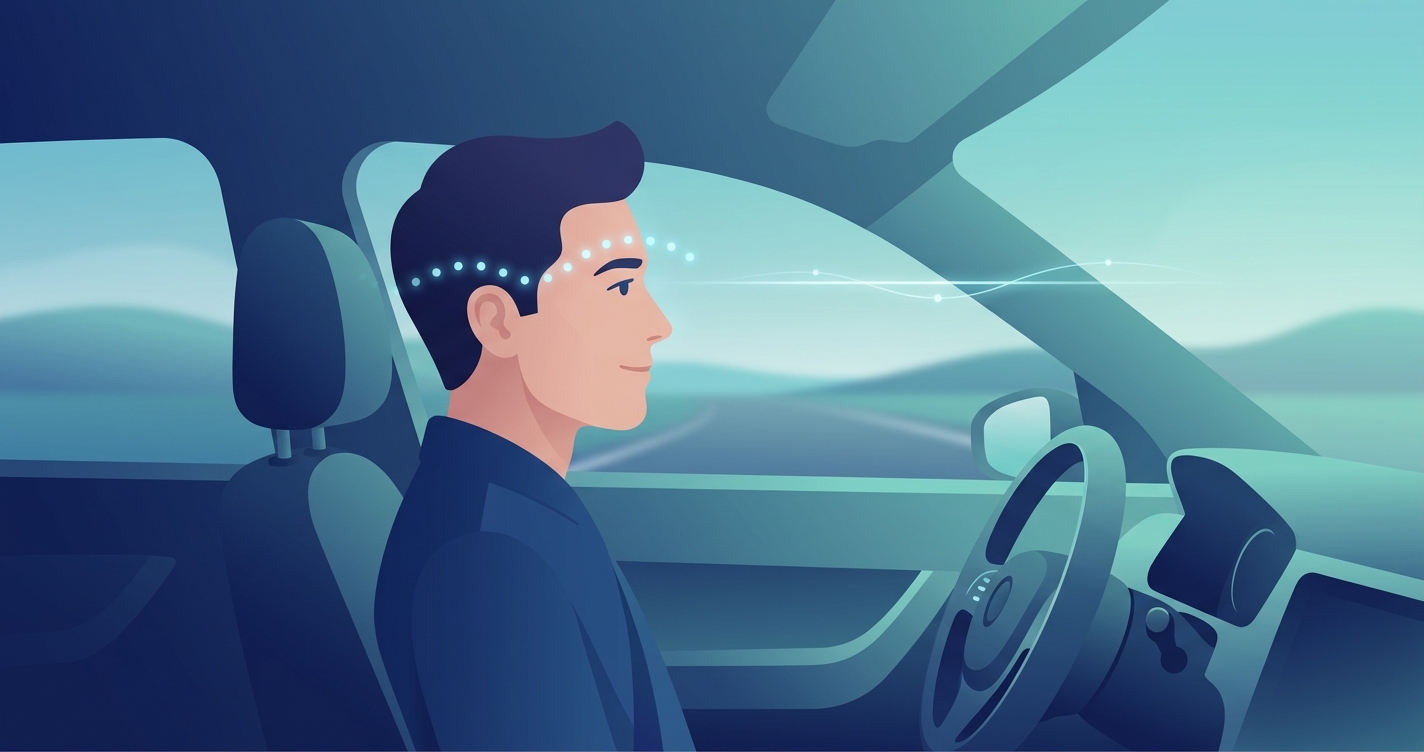
The inward-facing camera that ships in most new vehicles started as a regulatory checkbox, but it has quietly become one of the most capable safety sensors in the cabin. In 2026, driver drowsiness detection AI no longer relies on a single eyelid trick or a steering-wheel jiggle. It reads a layered set of facial and behavioral cues, weighs them against a model of how alert the same driver looked ten minutes ago, and decides whether the person behind the wheel is sliding toward sleep. For automotive OEMs, Tier-1 suppliers, and fleet operators, the question has shifted from whether cameras can spot fatigue to how reliably they can do it across faces, lighting, and real driving conditions.
A 2024 study by the AAA Foundation for Traffic Safety estimated that drowsy drivers were involved in 17.6 percent of all fatal crashes in the United States between 2017 and 2021, far above the figures captured in official police reports.
How driver drowsiness detection AI reads the face
At its core, driver drowsiness detection AI is a computer-vision pipeline trained to translate pixels into physiological state. A near-infrared camera mounted on the steering column, dashboard, or A-pillar captures the driver's face at 30 to 60 frames per second, including in total darkness. The model first locates the face, then maps dozens of landmark points around the eyes, brows, nose, and mouth. From those landmarks it extracts the signals that correlate with fatigue.
The most established of these is PERCLOS, or the percentage of time the eyes are more than 80 percent closed over a rolling window. Decades of sleep research treat PERCLOS as a strong behavioral proxy for drowsiness because slow eyelid closure tracks the brain's struggle to stay awake. Modern systems layer additional cues on top of it:
- Blink dynamics, including blink rate, blink duration, and the speed of reopening
- Eye-gaze fixation and the loss of normal scanning behavior across the road scene
- Head pose and the slow nodding or drifting that precedes a microsleep
- Yawn frequency and mouth-opening patterns detected through facial geometry
- Eye-aspect ratio trends that flag prolonged partial closure
What makes the 2026 generation different from earlier rule-based systems is that deep-learning models fuse these cues rather than firing on any single threshold. A driver squinting into a low sun is not the same as a driver whose eyes are slowly closing, and a fused model is far better at telling those situations apart.
Why multiple signals beat a single threshold
Early eye tracking drowsiness systems triggered alerts whenever eyelid closure crossed a fixed line. That produced nuisance alerts during sunglasses use, glances at mirrors, or routine blinking, and drivers learned to ignore them. Sensor fusion solves the false-alarm problem by requiring agreement across several independent cues before a fatigue alert escalates, while still reacting quickly when the evidence is overwhelming.
| Detection approach | Primary signal | Strengths | Limitations |
|---|---|---|---|
| Steering and lane sensors | Vehicle behavior | No camera needed, low cost | Reacts late, after performance already degrades |
| Single-cue eye tracking | PERCLOS only | Simple, well validated | High false alarms with glasses, glare, glances |
| Multi-cue camera AI | Eyes, head, mouth fused | Earlier and more robust detection | Needs good camera placement and lighting design |
| Camera plus physiology (rPPG) | Face cues plus heart and breathing rate | Detects fatigue and broader impairment | Higher compute, more validation work needed |
Industry applications of drowsy driving technology
The same underlying pipeline serves very different buyers, and the integration choices change with each use case.
Passenger vehicle oems
For OEMs, drowsy driving technology is increasingly a compliance and rating issue. European safety regulations now expect driver-attention and drowsiness warning capability, and consumer safety rating programs reward it. The engineering priority here is a system that runs on automotive-grade silicon, respects strict privacy rules by processing video on the edge, and rarely annoys the driver. A nuisance alert is not just irritating; it trains the customer to distrust the feature.
Commercial Fleets
Fleet operators care less about ratings and more about loss prevention. Long-haul and last-mile drivers accumulate sleep debt that they cannot reliably self-assess, and AI fatigue alerts give safety managers an objective, continuous record. In fleet deployments, drowsiness scores often feed a back-office dashboard so that coaching can happen before a near miss becomes a claim.
Tier-1 Suppliers
Tier-1 suppliers sit between silicon vendors and automakers, and they own the hard problem of making smart car sleep detection work across every cabin geometry, camera, and customer specification. Their challenge is portability: a model tuned on one vehicle's camera angle and lighting must generalize to the next program without a full retrain.
Current research and evidence
The research base behind eye tracking drowsiness has matured well beyond proof of concept. PERCLOS remains the most cited behavioral measure because work originating from the US Federal Highway Administration and later validation studies linked it to lapses in alertness more reliably than subjective self-report. Sleep scientists, including work associated with researchers such as Charles Czeisler at Harvard Medical School, have long documented that drivers are poor judges of their own impairment, which is precisely why an external sensor matters.
Recent computer-vision literature in 2024 and 2025 has focused on three problems. The first is robustness across diverse faces, eyewear, and lighting, addressed by larger and more representative training datasets. The second is real-time performance on embedded hardware, since a fatigue model is useless if it cannot run on the chip a vehicle actually ships. The third is multimodal fusion, where camera-based remote photoplethysmography, or rPPG, adds heart-rate and breathing-rate estimates to the behavioral picture. The scale of the problem keeps this work funded: the AAA Foundation has estimated that fatigue-related crashes causing injury or death carry an annual cost near 109 billion dollars in the United States alone.
Independent benchmarking is still the weak point. There is no single agreed public dataset that lets buyers compare vendors on equal footing, so procurement teams should treat any headline performance claim with caution and insist on testing against their own vehicles, drivers, and routes.
The future of driver drowsiness detection AI
The trajectory for the next several years points toward systems that do more than count closed eyes. Three shifts are already underway.
- Convergence of drowsiness and impairment detection, where the same camera flags fatigue, distraction, and early signs of a medical event from one video stream
- Physiological fusion through rPPG, adding contactless heart-rate and respiration trends that can reveal fatigue the face has not yet shown
- Personalization, where the model learns an individual driver's normal baseline so it can spot deviation rather than relying on population averages
- Tighter coupling with vehicle automation, so that a confirmed drowsiness state can adjust following distance, prompt a handover, or guide a safe stop
The end state is a cabin sensor that understands the driver as a continuously changing physiological system, not a face to be scored once per second. Getting there depends less on a single algorithm breakthrough and more on disciplined data collection, careful camera placement, and validation across the full range of people and conditions a vehicle will encounter.
Frequently asked questions
How does driver drowsiness detection AI work without touching the driver? It uses a near-infrared camera to watch the driver's face and extracts measurable cues such as eyelid closure, blink duration, head nodding, gaze drift, and yawning. A machine-learning model fuses these signals into a fatigue estimate, all without any physical contact or wearable.
Does the system work in the dark or with sunglasses? Near-infrared illumination lets the camera see clearly at night and through many tinted lenses. Dense or mirrored sunglasses can still obscure the eyes, which is why robust systems also rely on head pose, gaze patterns, and mouth cues so they are not dependent on a clear eye view alone.
How is camera-based fatigue detection different from steering-based alerts? Steering and lane sensors infer fatigue from how the car is being driven, which means they react only after performance has already slipped. A camera observes the driver directly, so it can flag the slow eyelid closure and head drift that precede an error, often earlier than vehicle-behavior methods.
Is video sent to the cloud? In most modern designs the analysis runs on an edge processor inside the vehicle, and only a drowsiness score or event flag leaves the device rather than raw video. This edge-first approach is central to meeting privacy expectations in passenger and commercial programs.
Circadify is building camera-based driver fatigue, drowsiness, and stress detection designed for the realities of in-cabin deployment, from edge processing to multi-cue fusion and rPPG-based vital signs. Automotive OEMs, Tier-1 suppliers, and fleet teams evaluating this space can start an automotive program inquiry and request a product demo at circadify.com/custom-builds/automotive-cabin.