
Driver Drowsiness AI: How Training Data Impacts Accuracy
Discover why the quality and demographic diversity of training data are critical for a reliable driver drowsiness detection AI and accurate vital sign monitoring.
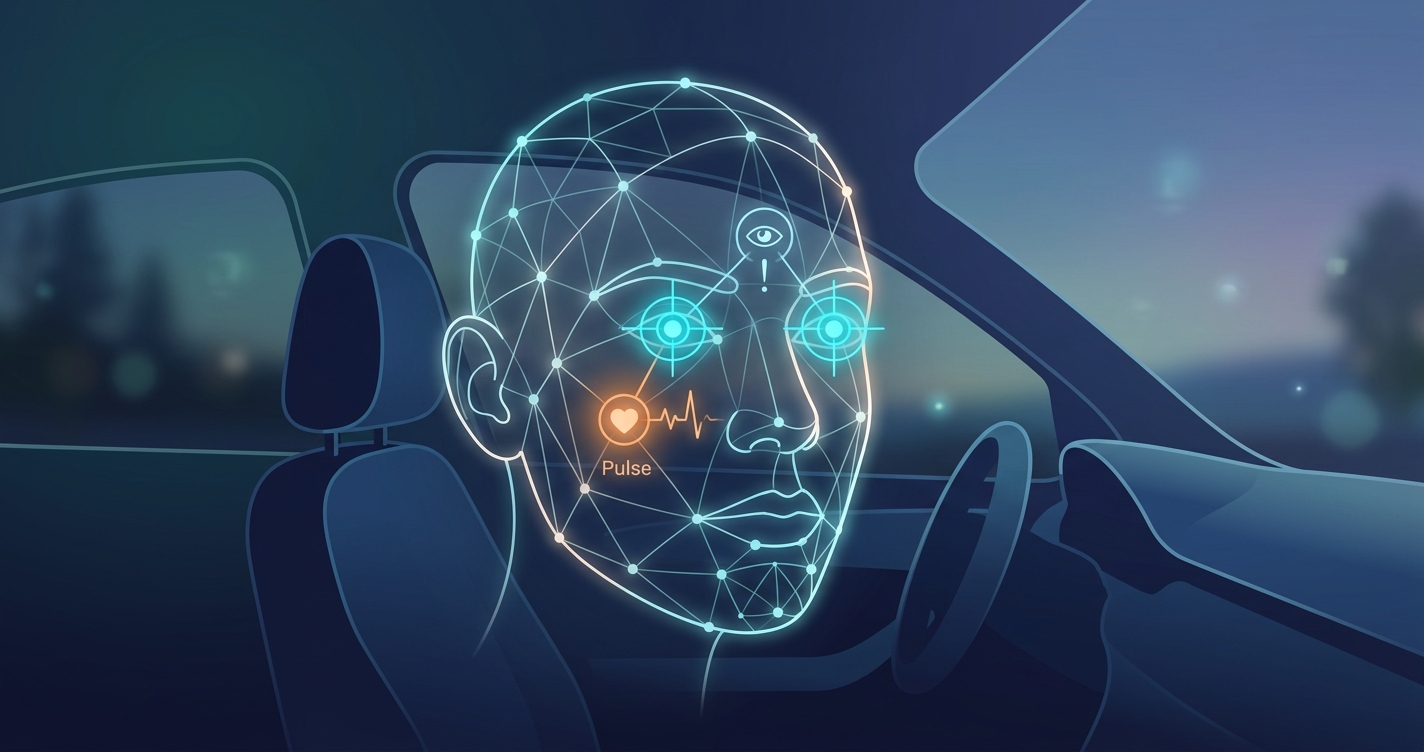
In the push to meet European General Safety Regulation mandates, automotive OEMs and Tier-1 suppliers are equipping modern vehicle cabins with inward-facing cameras. The initial engineering goal was basic compliance through tracking eye closure and gaze vectors. However, as the industry transitions toward physiological tracking, the reliability of a driver drowsiness detection AI has become the primary focus for cabin safety teams. A system is only as reliable as the data used to train it. When algorithms are trained on narrow datasets, they fail under the complex, dynamic conditions of real-world driving. The quality, demographic diversity, and environmental variance of the training data dictate whether a camera can accurately read a driver's state or if it will produce dangerous false negatives.
"Traditional remote photoplethysmography algorithms evaluated on standard public datasets show a mean absolute error of 5.2 beats per minute for lighter skin tones, but that error rate jumps to 14.1 beats per minute for individuals with darker skin, revealing a critical gap in automotive sensor reliability." (National Institutes of Health, Evaluation of Remote Monitoring Technology Across Skin Tones, 2023).
Building robust driver drowsiness detection AI
The architecture of a driver drowsiness detection AI relies on deep learning networks, specifically Convolutional Neural Networks and Recurrent Neural Networks. These models process video feeds in real time to classify behavioral markers like blink duration, yawning frequency, and head pose. Early models relied heavily on public databases such as the NTHU Drowsy Driver Dataset. While useful for initial academic benchmarking, these datasets lack the complexity required for production-grade automotive deployment.
For example, modern automotive cabins do not rely solely on standard RGB color cameras. To ensure operation at night, they utilize near-infrared sensors. A sophisticated AI fatigue detection system must be trained on a paired dataset containing both RGB and near-infrared video streams. If a model trained exclusively on daylight RGB video is suddenly fed an infrared stream, the artificial intelligence cannot interpret the grayscale contrasts, leading to a complete system failure.
Furthermore, when engineering teams add remote photoplethysmography to extract vital signs like heart rate and respiration from the facial video feed, the training data requirements become exponentially stricter. A remote photoplethysmography algorithm measures micro-variations in light reflecting off the human face to detect the pulse of blood beneath the skin. If the DMS machine learning model was trained primarily on subjects with Fitzpatrick Type I and II skin tones (lighter skin), the system will struggle to detect accurate physiological signals on subjects with Fitzpatrick Type V and VI skin tones (darker skin). Higher melanin concentrations absorb more light, which lowers the signal-to-noise ratio in optical camera readings. Without diverse training data, the algorithm cannot calibrate for this absorption difference, leading to inaccurate fatigue assessments.
| Variable | Standard Public Datasets | Automotive-Grade Multimodal Datasets |
|---|---|---|
| Demographic Spread | Heavily skewed to European descent | Stratified across global demographics |
| Skin Tone Inclusion | Primarily Fitzpatrick Types I - III | Mandatory inclusion of Types IV - VI |
| Lighting Variance | Controlled clinical or office lighting | Dynamic in-cabin, low light, and direct IR |
| Ground Truth Labeling | Subjective fatigue scale surveys | Medical-grade ECG and capnography |
A reliable driver monitoring system algorithm must maintain high accuracy despite numerous environmental disruptions. Common variables that confuse algorithms trained on poor data include:
- Sharp shadows cast by high-contrast daylight moving across the vehicle cabin.
- Variable infrared reflection off corrective lenses, sunglasses, or safety glasses.
- Low signal-to-noise ratios caused by inadequate camera sensitivity in nighttime driving scenarios.
- Non-standard seating positions that obscure traditional facial landmarking points used by computer vision models.
- Heavy facial hair or cosmetic makeup that alters the expected reflectance properties of the skin.
Industry applications in automotive cabin architectures
Advancing the driver monitoring system algorithm
Tier-1 suppliers face immense pressure to deliver software that runs efficiently on constrained edge computing hardware while maintaining high driver monitoring accuracy. The integration of behavioral tracking and vital sign monitoring requires advanced sensor fusion. Training these fused models requires synchronized data streams where video footage is precisely aligned with medical-grade ground truth sensors like electrocardiograms. If a model is trained on asynchronous or poorly labeled data, the resulting artificial intelligence will misinterpret a sudden change in heart rate as an artifact rather than a sign of acute stress or the onset of microsleep.
Moreover, deploying these models on automotive-grade system-on-chip architectures means the AI must be highly optimized. A massive neural network trained on cloud servers might achieve perfect accuracy in a laboratory, but it will cause latency and overheating when crammed into a vehicle dashboard. Training data must be curated to teach the model how to make accurate inferences using the fewest possible frames per second. The training dataset must include examples of compressed, low-resolution video to simulate the actual bandwidth constraints of an embedded edge processor.
Validating AI fatigue detection for fleet platforms
Commercial fleet management companies require robust AI fatigue detection to protect drivers on long-haul routes. Unlike passenger vehicles where trips are generally short, commercial trucks operate continuously across drastic lighting changes from dawn to dusk. Training data for commercial systems must heavily feature extended continuous driving sessions to capture the gradual physiological decline associated with fatigue.
A sudden drop in respiration rate or a steady decline in heart rate variability often precedes physical eye closure. Algorithms trained exclusively on actors faking sleep in a static studio cannot recognize these subtle, genuine physiological transitions. Fleet operators need systems that can analyze a driver over a ten-hour shift, recognizing when a driver's baseline heart rate shifts from a rested state to a fatigued state. Therefore, the data used to build these fleet-specific models must include long-form temporal data, capturing the true biological progression of exhaustion in real-world heavy goods vehicles.
Current research and evidence
The academic community has aggressively audited the performance of automotive computer vision models. A 2023 systematic review published in the MDPI journal Sensors analyzed deep learning models for drowsiness detection. The researchers noted that while median laboratory accuracies frequently exceeded 94 percent, these metrics often collapsed when applied to out-of-distribution real-world data. The review highlighted dataset bias as the primary culprit for this discrepancy. When algorithms face demographic profiles or lighting conditions absent from their training data, their precision and recall scores plummet, resulting in high false positive rates. A system that constantly alerts a wide-awake driver due to poor algorithm confidence will quickly be disabled by the user, defeating the purpose of the safety mandate.
Specific to vital sign extraction, a 2021 study by Krish Kabra and colleagues explored the demographic bias inherent in public remote photoplethysmography datasets. Their research confirmed that popular datasets like UBFC-rPPG are disproportionately composed of subjects with lighter skin tones. Consequently, the mean absolute error for heart rate estimation increased significantly when these standard algorithms were tested on diverse populations. The study concluded that mitigating this bias requires intentional dataset curation and the use of synthetic data augmentation to train models on a complete spectrum of human physiology.
The future of driver drowsiness detection AI
The next evolution of driver drowsiness detection AI involves establishing a personalized baseline for every individual behind the wheel. Instead of comparing a driver to a generic, static dataset, future models will use initial driving minutes to calibrate to the specific heart rate, respiration pattern, and blink dynamics of the current user. This personalized edge computing approach requires training data that features the same individuals across varying states of alertness over multiple months.
Furthermore, synthetic data generation is emerging as a critical tool for training robust models. By utilizing advanced graphics engines and generative AI, engineering teams can create photorealistic synthetic drivers of every age, ethnicity, and facial structure, placed under every possible cabin lighting condition. This allows developers to simulate rare edge cases, such as the exact moment of a microsleep event during a flashing emergency vehicle light scenario, without risking human subjects.
Frequently asked questions
How does training data affect driver monitoring accuracy?
Training data teaches the artificial intelligence what fatigue looks like across different scenarios. If the data only includes well-lit environments and specific demographics, the system will fail to recognize fatigue in low-light conditions or on drivers with different physical characteristics. Diverse data ensures the algorithm generalizes to all real-world drivers.
Why is remote photoplethysmography sensitive to skin tone?
Remote photoplethysmography uses optical cameras to measure the micro-color changes in skin caused by blood flow. Because melanin absorbs light, darker skin tones reflect less light back to the camera. This reduces the strength of the optical signal. Algorithms must be trained on diverse skin tones to learn how to amplify and process these lower-intensity signals accurately.
What is ground truth in AI fatigue detection?
Ground truth refers to the objective, factual data used to train and validate a machine learning model. For physiological fatigue detection, ground truth cannot just be a video of someone looking tired. It must include data from medical-grade sensors, such as an electrocardiogram for heart rate or an electroencephalogram for brain activity, to prove the subject was genuinely fatigued.
Can synthetic data replace real human testing in automotive AI?
Synthetic data is a powerful supplement that helps cover edge cases and demographic gaps that are difficult to capture in the real world. However, it cannot entirely replace real human testing. Validation must always occur using real-world, in-cabin footage to ensure the algorithms operate safely before deployment in consumer vehicles.
For automotive engineers building the next generation of cabin safety, relying on generic algorithms trained on narrow datasets is a significant risk. Building a reliable system requires highly diverse, carefully validated data pipelines. Circadify develops physiological tracking technology with validation pipelines focused on inclusive, demographic-wide performance. To review our validation protocols and explore how we can support your specific engineering requirements, submit an Automotive program inquiry.