DMS Vitals vs. Eye Tracking Alone: A 2026 Comparison
For automotive OEMs and Tier-1 suppliers, comparing eye tracking with DMS vital signs is critical. Discover why sensor fusion outperforms eye metrics alone.
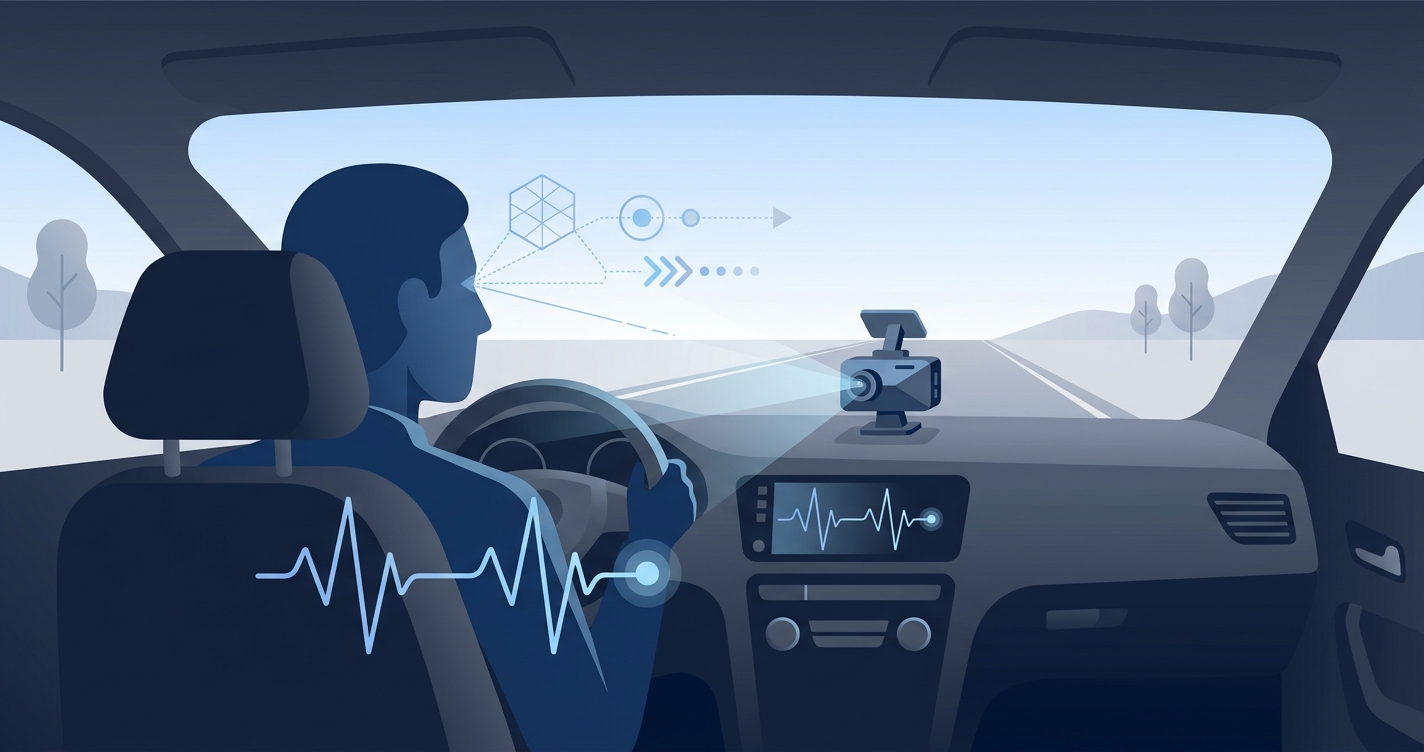
For automotive OEMs and Tier-1 engineering teams finalizing cabin architectures for 2026 production cycles, the definition of driver fatigue is undergoing a fundamental shift. Historically, driver monitoring programs have relied almost entirely on tracking behavioral cues, specifically eyelid closure, blink rate, and head pose. While these visible metrics offer a reliable proxy for end-stage drowsiness, relying on them exclusively introduces a dangerous lag. By the time a driver's head nods or their eyes stay closed for extended durations, severe physiological fatigue has already set in. Engineers are now moving beyond surface-level behavioral tracking and evaluating multimodal systems. The integration of physiological data, extracted through the exact same camera hardware, is fundamentally altering the performance parameters of in-cabin safety.
"Changes in the autonomic nervous system, specifically variations in heart rate and pupillary response, reliably precede behavioral markers of drowsiness. Fusing these physiological signals with traditional visible metrics provides a significantly earlier and more accurate classification of fatigue onset." , Y. Zhang et al., Assessment of Combination of Automated Pupillometry and Heart Rate Variability to Detect Driving Fatigue, Frontiers in Neuroscience, 2022.
The Limitations of Eye Tracking and the Need for DMS Vital Signs
Most existing driver monitoring modules calculate fatigue using a metric known as PERCLOS (percentage of eyelid closure over the pupil). When paired with gaze tracking and head orientation algorithms, this forms the baseline for regulatory compliance in regions like the European Union. However, for engineering teams aiming to build zero-accident vehicle architectures, behavioral tracking alone has distinct performance ceilings.
The core limitation is physiological lag. The autonomic nervous system begins to downregulate long before a driver consciously struggles to keep their eyes open. If a system only watches the eyelids, it reacts to the physical symptom rather than predicting the cognitive state. Furthermore, eye tracking is highly susceptible to external interference. Reflective sunglasses, thick optical frames, and rapid changes in ambient cabin lighting can disrupt pupillary detection algorithms. When a driver wears heavily tinted polarized lenses, standard visible-light and near-infrared (NIR) eye tracking can experience momentary failure rates, degrading the system's confidence score exactly when monitoring is most critical.
To solve this, Tier-1 suppliers are integrating DMS vital signs into their software stacks. By utilizing remote photoplethysmography (rPPG), the same inward-facing camera that tracks the eyes can also measure microscopic shifts in facial skin color caused by capillary blood flow. This non-contact method calculates heart rate variability (HRV) and respiration rate, creating a sensor fusion model that combines the behavioral output of the eyes with the autonomic output of the heart. Hemoglobin in the blood absorbs light differently depending on oxygenation levels; rPPG software amplifies these invisible color shifts to extract a pulse wave.
| Monitoring Approach | Primary Input Metrics | Environmental Limitations | Fatigue Detection Timing |
|---|---|---|---|
| Eye Tracking Alone | Eyelid closure, blink rate, head pose | Degraded by thick glasses, polarized sunglasses | Late (reactive to physical drooping) |
| DMS Vitals Alone | Heart rate variability, respiration | Degraded by extreme head movement or vibration | Early (predictive via autonomic shifts) |
| Sensor Fusion | Eyelid closure + HRV + respiration | Highly robust against singular sensor failure | Predictive and validated across physical states |
When engineering a robust driver monitoring architecture, comparing the isolated metrics against a fused approach reveals several technical advantages:
- Reduction of false positives during complex lighting transitions, as physiological extraction provides continuous data even if pupillometry momentarily fails due to reflections or shadows.
- Earlier fatigue classification, capturing the physiological shift from sympathetic to parasympathetic nervous system dominance before the onset of dangerous microsleeps.
- Improved reliability for edge-case demographics, including drivers wearing facial coverings, heavy cosmetics, or varying optical prescriptions that obscure facial landmarks.
- Elimination of physical wearables, allowing fleet and passenger vehicles to passively acquire critical health data without requiring driver intervention or manual sensor attachment.
Industry Applications
Automotive oems and tier-1 suppliers
For automakers, the transition from pure eye tracking to multimodal physiological monitoring is driven by the need for higher system accuracy and differentiation in the Advanced Driver Assistance Systems (ADAS) market. Engineering teams are not replacing the camera hardware; they are extracting richer algorithmic data from the existing video feed. By deploying optimized rPPG software models on the vehicle's edge-compute processors (utilizing dedicated NPUs or GPUs), OEMs can achieve highly accurate heart rate estimation in the cabin without adding weight, wiring harnesses, or new physical sensors to the steering wheel. This approach also aligns with future Euro NCAP roadmaps, which increasingly reward vehicles that can detect sudden driver incapacitation.
Fleet management companies
For commercial fleet operators, the stakes of driver fatigue are exceptionally high. Traditional eye-tracking units often alert the driver only when a lane departure is imminent or when the driver is actively falling asleep. Integrating vital sign analysis allows fleet safety programs to track baseline physiological stress and fatigue accumulation over a multi-hour logistics shift. This predictive capability enables dispatchers to recommend rest stops proactively, rather than reacting to a jarring auditory alert triggered by a closing eyelid at highway speeds. Over a large commercial fleet, this proactive intervention translates to lower insurance premiums and a measurable reduction in catastrophic accidents.
Current research and evidence
The technical feasibility of extracting reliable physiological signals in moving vehicles has been rigorously documented in recent automotive engineering literature. A primary challenge has historically been motion artifacts and variable lighting inside the cabin, which can distort the optical signals required for both eye tracking and rPPG.
In 2018, researchers Ewa M. Nowara, Tim K. Marks, Hassan Mansour, and Ashok Veeraraghavan introduced SparsePPG, demonstrating the viability of camera-based vital signs estimation specifically in near-infrared (NIR) spectrums. Their work directly addressed the severe illumination changes and motion artifacts inherent to driving, proving that advanced signal processing algorithms could successfully denoise raw rPPG data from a single camera channel, even in low-light conditions.
Building on the need for multi-sensor integration, Y. Zhang et al. (2022) published findings evaluating the combination of automated pupillometry and HRV. Their research concluded that while pupillary light reflex variations are strong behavioral indicators of fatigue, coupling them with HRV data derived from the autonomic nervous system creates a superior, highly accurate detection threshold that single-metric behavioral models simply cannot match.
Furthermore, a 2024 study by Qihuang Gao and colleagues in Scientific Reports tackled the persistent issue of abnormal illumination in automotive environments. By utilizing multi-modal features extracted from both visible light and infrared images, their algorithms achieved fatigue detection accuracy rates exceeding 91% even in severely degraded lighting conditions. This research confirms that when eye tracking struggles due to environmental factors like harsh sunlight or pitch darkness, physiological feature extraction can step in to maintain the system's operational integrity.
The future of driver monitoring
Looking toward the 2026 production year and beyond, the artificial intelligence models governing cabin monitoring will view the driver as a complete physiological entity. The binary approach of "awake versus asleep" is rapidly being replaced by continuous cognitive load and fatigue tracking. As edge processing becomes more efficient, the latency of running complex rPPG algorithms alongside dense facial landmark tracking will approach zero, allowing vehicles to make split-second decisions about whether a driver is fit to take control of an autonomous system.
This evolution will eventually extend far beyond fatigue. The same hardware and software combination capable of detecting the slow onset of drowsiness via HRV can be tuned to detect sudden, acute medical events. Automotive engineers are already mapping the physiological signatures of cardiac arrhythmias, severe blood sugar fluctuations, and other emergencies, setting the stage for vehicles that actively monitor long-term driver health and intervene safely when a medical crisis occurs behind the wheel.
Frequently asked questions
Why is eye tracking alone insufficient for modern driver monitoring? Eye tracking measures behavioral symptoms like eyelid closure and head nodding, which occur late in the fatigue cycle. It is also highly susceptible to failure when the driver wears polarized sunglasses, heavily tinted lenses, or during rapid changes in ambient cabin lighting.
How does heart rate variability (HRV) indicate driver fatigue? HRV is directly controlled by the autonomic nervous system. As a driver transitions from an alert state to a fatigued state, the balance shifts from sympathetic to parasympathetic dominance. This physiological shift alters the rhythm of the heart, allowing algorithmic systems to detect drowsiness before the eyes begin to physically droop.
Do vital sign monitoring systems require additional sensors in the steering wheel? No. Modern systems utilize remote photoplethysmography (rPPG), a software-based method that extracts micro-color changes in facial skin from the existing inward-facing ADAS camera. This allows for non-contact physiological monitoring without adding new hardware or wearables.
Can a camera measure vital signs in the dark? Yes. Advanced driver monitoring modules use near-infrared (NIR) illuminators and sensors. Recent algorithmic advancements allow rPPG software to extract reliable heart rate and respiration data from NIR video feeds, functioning effectively during nighttime driving or in dark tunnels.
For engineering teams and Tier-1 suppliers moving beyond traditional eye-tracking architectures, achieving high-confidence fatigue detection requires multi-sensor algorithmic approaches. Circadify is actively supporting these technical transitions by providing advanced, camera-based physiological monitoring solutions tailored for the demanding environments of modern vehicle cabins. To learn more about integrating non-contact health parameters into your next production cycle, review the technical specifications for our automotive program builds.