
DMS Vital Signs: What Your Fleet Data Actually Tells You
A research breakdown of which DMS vital signs predict driver risk, how to read fleet vital sign reports, and how managers should act on in-cabin health metrics.
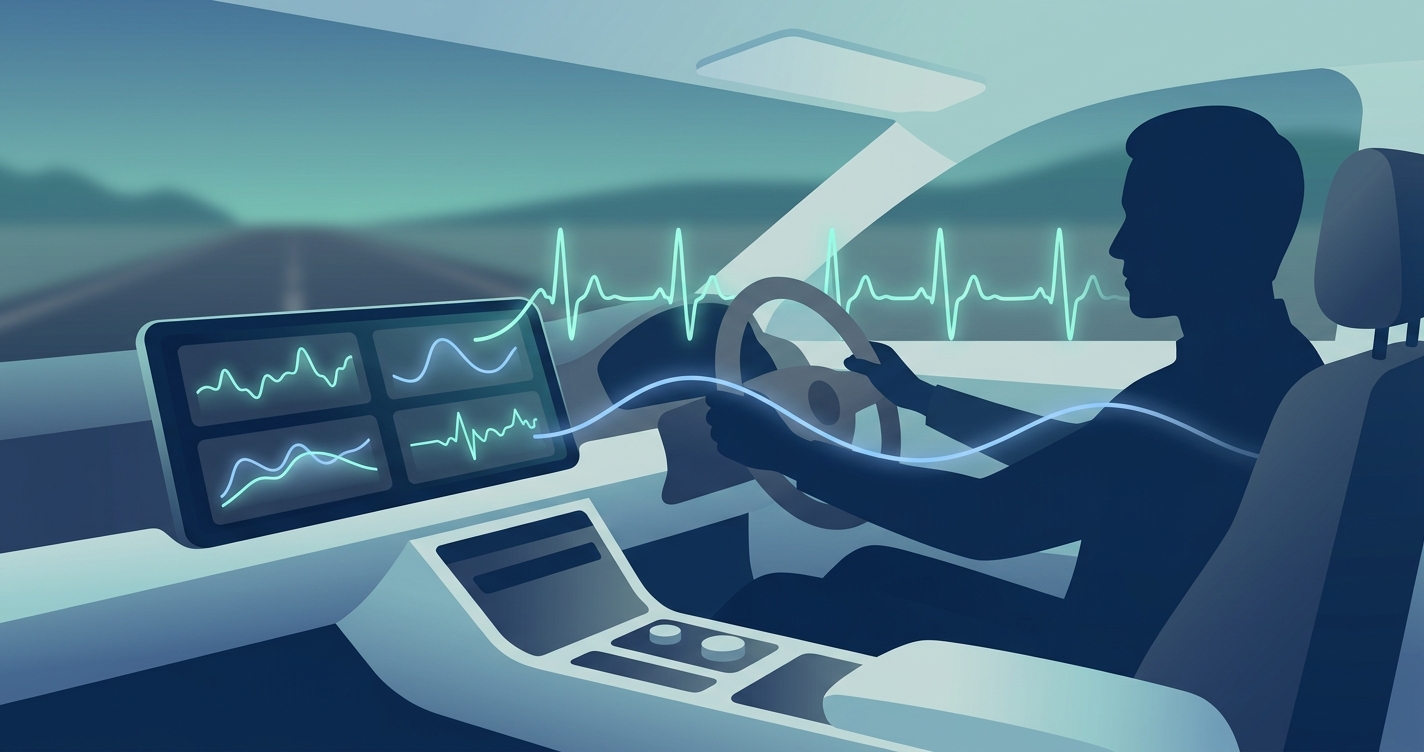
Most fleet operators now own a driver monitoring system, but far fewer know how to read what it produces. A modern in-cabin camera streams a continuous record of physiological state, yet the dashboard often reduces that record to a single green or red light. The gap between raw signal and operational decision is where most of the value leaks out. Understanding DMS vital signs means understanding which measurements actually predict an incident, which are noise, and which deserve a manager's attention before a shift even begins. This report breaks down the readings that matter and the response thresholds that turn driver monitoring data insights into fewer crashes and lower claims.
"Fatigue-related events are estimated to account for 30 to 40 percent of heavy truck crashes in the United States, yet most occur with no braking and no evidence the driver recognized the danger.", U.S. fatigue risk management research summary, 2024
What DMS vital signs actually measure
The term DMS vital signs covers two layers of data that fleets often conflate. The first layer is behavioral: eyelid closure (PERCLOS), blink rate, yawn frequency, head pose, and gaze direction. The second layer is physiological, derived through remote photoplethysmography (rPPG), where the camera detects micro color changes in facial skin caused by blood flow. From that signal a system can estimate heart rate, heart rate variability (HRV), respiration rate, and trend indicators for stress.
The physiological layer is where the predictive power lives. Behavioral cues like a drooping eyelid tell you a driver is already impaired. Vital sign trends can shift earlier. Research published in 2024 using rPPG to derive HRV, specifically the low-frequency to high-frequency (LF/HF) ratio, found that autonomic changes often precede visible drowsiness. A separate 2024 study combining PPG signals with facial features and head posture in an LSTM model reported high fatigue-detection accuracy by fusing both layers rather than relying on either alone.
For a fleet manager, the practical translation is this: a vital sign report is not a verdict on a single moment. It is a baseline-and-deviation story. The question is never "what is this driver's heart rate" but "how far has this driver drifted from their own normal, and in which direction."
Which readings predict risk, and how to act
Not every metric carries equal weight. The table below maps the most common in-cabin health metrics to what they signal and the operational response a manager should consider.
| Vital sign / metric | What it indicates | Lead time before incident | Recommended manager action |
|---|---|---|---|
| PERCLOS (eyelid closure %) | Active drowsiness, near-microsleep | Seconds to minutes | Immediate in-cab alert; mandate break |
| Heart rate variability (LF/HF) | Autonomic fatigue, declining alertness | Tens of minutes | Flag for early break; review against hours-of-service |
| Respiration rate trend | Fatigue onset, possible illness | Minutes to hours | Cross-check shift length; wellness follow-up |
| Resting heart rate elevation | Stress, early illness, dehydration | Hours to days | Trend review; schedule conversation, not alarm |
| Stress index (HRV-derived) | Acute stress, agitation risk | Minutes | Context check; route or workload review |
| Yawn / blink frequency | Building fatigue | Minutes | Corroborate with HRV before escalating |
A few principles separate fleets that act well from those that drown in alerts:
- Treat single-moment spikes as questions, not conclusions. One elevated reading rarely justifies intervention.
- Weight trend deviations from a driver's personal baseline over fleet-wide averages. A resting heart rate of 78 means different things for different people.
- Combine layers. The strongest predictors fuse a behavioral cue with a physiological trend, which reduces false positives.
- Match action severity to lead time. Seconds of warning need an in-cab alert; days of trend need a quiet conversation.
Industry applications of fleet vital sign reports
Long-haul and heavy trucking
In long-haul operations, the highest-value signal is fatigue accumulating across a shift. HRV trends and respiration drift give managers lead time that PERCLOS alone cannot. Because fatigue crashes cluster between midnight and 6 a.m. and in the late afternoon, vital sign reports that flag autonomic decline during those windows let dispatchers reschedule or insert breaks before a microsleep occurs.
Last-mile and delivery fleets
Delivery work generates a different risk profile: many short stops, urban stress, and tight time pressure. Here stress-index trends and resting heart rate elevation are more useful than deep fatigue metrics. A driver whose baseline heart rate climbs across a week may be getting sick or burning out, both of which raise error rates well before any drowsiness shows.
Mixed and electric vehicle fleets
Quieter cabins and different drive cycles can mask the usual fatigue cues, which makes physiological data more important relative to behavioral data. Vital sign reporting gives EV fleet managers a layer of insight that does not depend on engine noise or vibration to keep drivers stimulated.
Current research and evidence
The evidence base behind DMS vital signs has matured quickly. Work on heart rate variability features extracted from short electrocardiogram windows has shown that even two-minute samples carry usable fatigue signal, and that sex differences affect how those features should be interpreted. That finding matters for fleets: a one-size threshold applied across a diverse driver pool will misclassify people.
On the contactless side, rPPG research in 2024 demonstrated that camera-derived HRV can track the autonomic shifts associated with fatigue without any wearable. Industry analysis from IDTechEx in its 2024 to 2034 in-cabin sensing outlook points to a convergence of camera, near-infrared, and radar sensing for vital parameters, with several major suppliers publicly demonstrating heart rate and breathing monitoring during 2024 and into 2025.
Regulatory pressure is compounding the trend. The EU General Safety Regulation has pushed driver monitoring into new vehicles from mid-2024, which means the underlying camera hardware is becoming standard. Fleets that already operate this hardware are positioned to extract vital sign reporting from sensors they have effectively already paid for. On the crash side, U.S. data recorded 633 drowsy-driving fatalities in 2023, and fatigue is estimated to drive 30 to 40 percent of heavy truck crashes, which frames the size of the prize for fleets that read their data well.
The future of DMS vital signs
The next phase moves from detection to prediction. Today most systems alert when a vital sign crosses a threshold. The emerging model layers DMS vital signs onto circadian and scheduling data to forecast when a given driver is likely to hit a fatigue trough hours ahead, allowing dispatch changes rather than last-second alarms. Three shifts are worth watching:
- Personal baselines replacing fixed thresholds, so each driver is measured against their own normal.
- Sensor fusion across camera, radar, and near-infrared to keep vital sign estimates stable in low light and motion.
- Fleet-level analytics that aggregate individual trends into roster-wide risk maps, helping safety managers allocate attention where it pays off.
The constraint will not be sensing. It will be interpretation. The fleets that win are the ones whose analytics turn a flood of in-cabin health metrics into a small number of clear, ranked actions.
Frequently asked questions
Which DMS vital sign is the single best predictor of driver risk? There is no single best metric. The strongest predictions come from fusing a behavioral cue such as PERCLOS with a physiological trend such as HRV. Behavioral signals confirm active impairment, while vital sign trends provide earlier lead time, so combining them reduces both missed events and false alarms.
Can a camera really measure vital signs accurately in a moving vehicle? Camera-based rPPG estimates heart rate, HRV, and respiration from skin color changes, and 2024 research shows it can track fatigue-related autonomic shifts. Motion and lighting remain challenges, which is why modern systems pair cameras with near-infrared and radar and rely on trends rather than single instantaneous readings.
How should a fleet manager respond to a vital sign alert? Match the response to the lead time. Seconds of warning, such as a PERCLOS spike, warrant an immediate in-cab alert and a mandated break. Slow trends, such as a rising weekly resting heart rate, call for a wellness conversation and schedule review rather than an alarm.
Do these systems require drivers to wear anything? No. The whole point of camera-based DMS vital signs is contactless measurement. Drivers wear nothing, and the data is derived from the same inward-facing camera that many vehicles now carry to meet driver monitoring regulations.
Circadify is building toward this interpretation layer, developing camera-based fatigue, drowsiness, and stress analytics designed to turn raw in-cabin signals into ranked, actionable fleet insight. Automotive OEMs, Tier-1 suppliers, and fleet operators evaluating how to operationalize DMS vital signs can start an automotive program inquiry at circadify.com/custom-builds/automotive-cabin.