Is my car watching for signs of a stroke when I'm stuck in traffic?
How driver monitoring system vitals could flag the physiological signs of a stroke in the cabin, and what OEMs and Tier-1 teams need to weigh before building it.
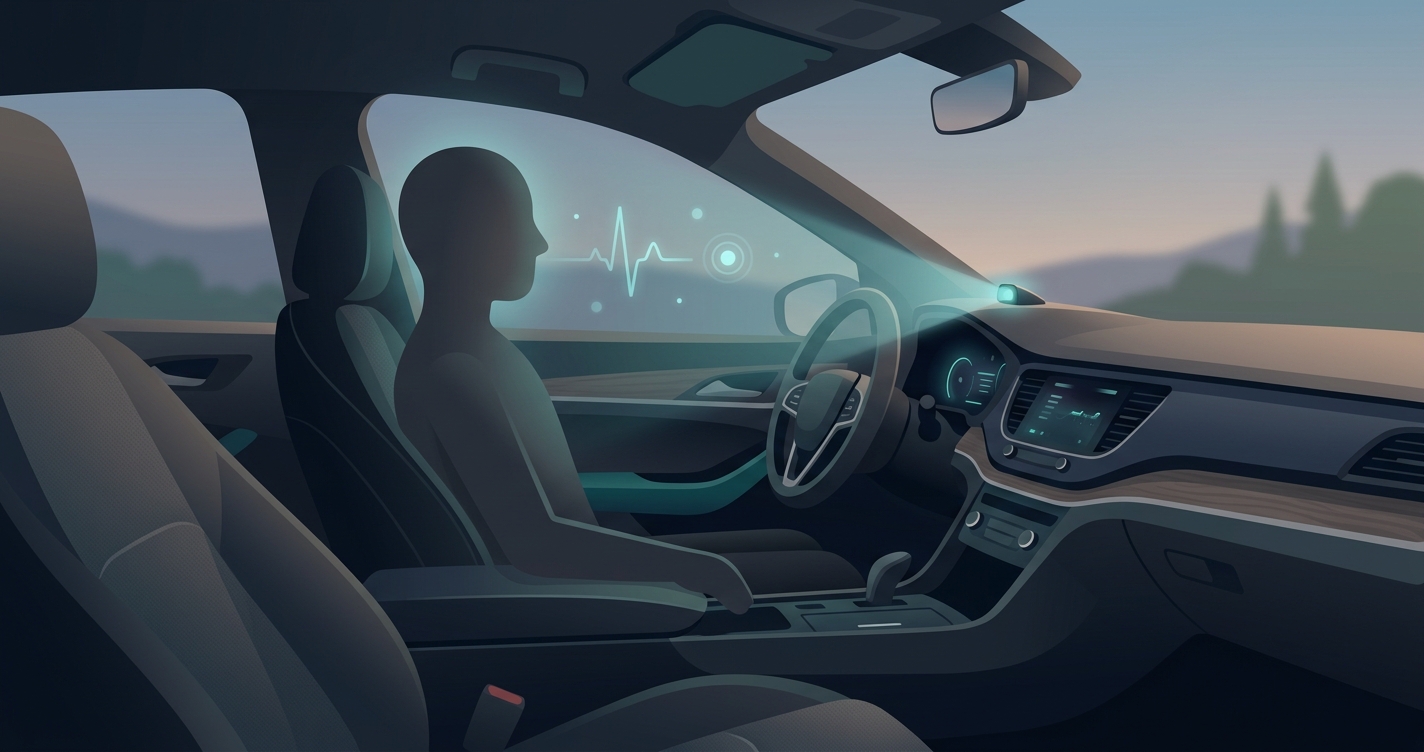
Sitting motionless in stop-and-go traffic, a driver assumes the car is idle too. But the same inward-facing camera that already tracks eyelid closure and head pose is collecting a continuous stream of facial and physiological data, and that stream contains far more than fatigue cues. The question of whether a vehicle could watch for the early signs of a stroke is where driver monitoring system vitals stops being a comfort feature and starts looking like a clinical sensing problem. For automotive OEMs and Tier-1 suppliers building the next generation of safety stacks, this is no longer a hypothetical. The sensors are mounted, the compute is on the bus, and the research base is catching up fast.
A stroke behind the wheel is a uniquely dangerous event. The driver loses motor control, awareness, or both, often without any warning they can act on, and the vehicle becomes a moving hazard. Catching the earliest physiological deviation, even seconds before the driver registers it, changes what the vehicle can do next.
A systematic review of remote photoplethysmography in driver monitoring, published in 2024, screened 344 studies and analyzed 29 in depth, confirming that camera-based extraction of heart rate, respiration, and emotional state is moving from lab demonstration toward in-cabin deployment.
What driver monitoring system vitals can actually observe
A modern driver monitoring system (DMS) sees the face under near-infrared and sometimes RGB illumination at high frame rates. From that signal, contactless methods can estimate several parameters relevant to a cerebrovascular event. Remote photoplethysmography (rPPG) reads subtle color changes in facial skin caused by blood volume pulsing through capillaries, yielding heart rate, heart rate variability, and respiration rate. Computer vision tracks facial landmarks, gaze, and micro-expressions. Together, these give a DMS a window into the body, not just the eyelids.
A stroke produces a cluster of observable changes. The widely taught FAST framework, developed by stroke clinicians, lists Face drooping, Arm weakness, Speech difficulty, and Time to call emergency services. Three of those four signs are at least partially visible to a cabin camera:
- Sudden facial asymmetry or drooping on one side, detectable through landmark tracking.
- Abnormal gaze deviation or unequal eye movement, a recognized acute stroke sign.
- Slurred or absent speech, observable if the cabin has an audio channel.
- Erratic head and posture control as motor function degrades.
- Cardiovascular irregularities such as atrial fibrillation, a major stroke risk factor that rPPG-derived heart rhythm analysis may surface.
The key engineering insight is that none of these signals on its own is conclusive. A yawn distorts facial symmetry; a glance at a mirror moves the gaze. Robust detection depends on fusing several weak signals over time, which is exactly the architecture DMS platforms already use for drowsiness.
How stroke-relevant sensing compares to existing DMS functions
OEM and Tier-1 teams evaluating whether to extend a DMS toward medical event detection need a clear-eyed view of how the workload differs from the fatigue and distraction features already shipping. The comparison below frames the gap.
| Capability | Drowsiness Detection | Distraction Detection | Stroke-Sign Sensing |
|---|---|---|---|
| Primary signals | Eyelid closure, blink rate, head nod | Gaze direction, head pose, hands | Facial asymmetry, gaze deviation, rPPG rhythm, speech |
| Time to onset | Minutes to develop | Seconds | Sudden, often under a minute |
| Tolerance for false positives | Moderate | Moderate | Very low (clinical implication) |
| Sensor reuse | Existing IR camera | Existing IR camera | Same camera, added rPPG + landmark depth |
| Signal stability needs | Established | Established | High; motion and lighting sensitive |
| Response action | Alert, break reminder | Alert, escalation | eCall, safe stop, emergency routing |
| Regulatory framing | Safety feature | Safety feature | Approaches medical-device territory |
The pattern is consistent: the sensor hardware largely already exists, but the confidence threshold, validation burden, and downstream response are substantially heavier for medical event detection.
Industry applications
Passenger vehicle OEMs
For premium and mainstream OEMs, stroke-sign sensing slots into an emergency-response chain that already includes automatic collision notification. A high-confidence detection could trigger graduated responses: a verbal check-in prompt, hazard activation, an automated minimal-risk maneuver in vehicles with the appropriate automation level, and an eCall to emergency services with location and detected symptoms. The differentiator is not the camera but the orchestration of vehicle behavior around a health signal.
Tier-1 suppliers
Tier-1s own the perception stack and are positioned to bundle physiological sensing as a software layer on existing DMS silicon. The commercial case rests on reusing deployed cameras and edge compute rather than adding bill-of-materials cost. The hard part is validation data: stroke events are rare, and naturalistic driving datasets containing them are scarce, which pushes development toward simulated symptoms, clinical partnerships, and transfer learning from medical rPPG research.
Fleet operators
Commercial fleets carry an older, higher-risk driver population and a duty of care that makes medical event detection commercially attractive. A fleet vehicle that recognizes a driver in distress and routes the dispatch center an alert protects the driver, other road users, and the operator's liability position. For long-haul and last-mile fleets already running health-oriented monitoring, stroke-sign detection is an incremental analytics layer rather than a new device program.
Current research and evidence
The supporting science sits at the intersection of two fast-moving fields. On the cerebrovascular side, researchers have demonstrated smartphone and camera-based stroke screening using facial asymmetry and eye deviation, with pilot studies showing that deep learning models can flag acute facial droop from short video clips. These tools were designed for clinical triage, but their underlying features map directly onto what a cabin camera can capture.
On the in-cabin side, the 2024 systematic review of AI-driven rPPG for driver monitoring documented steady gains in heart rate and respiration estimation under real driving conditions, while flagging two persistent constraints: performance degradation under dynamic lighting and vehicle motion, and a shortage of diverse population data. Separately, a clinical evaluation running from March 2023 to June 2024 at Singapore General Hospital compared rPPG-derived blood pressure against automated cuffs, reporting a mean absolute percentage error of 7.52 percent for diastolic predictions, evidence that camera-based vascular sensing is reaching usable accuracy in controlled settings.
The honest read of the evidence:
- Facial and gaze cues for acute stroke are demonstrated in clinical pilots but not yet validated in moving vehicles.
- rPPG vital signs are increasingly reliable in lab and clinical conditions, with cabin robustness still the limiting factor.
- No published work yet shows end-to-end in-cabin stroke detection at the confidence a deployed safety feature would demand.
That gap is the opportunity and the caution. The building blocks are validated independently; the integration and field validation are open work.
The future of in-cabin medical event detection
The trajectory points toward multimodal health monitoring that treats stroke, cardiac events, and seizures as a single class of sudden-incapacitation problems the vehicle should recognize and respond to. Three developments will shape the next few years. First, sensor fusion that combines rPPG rhythm analysis, facial landmark dynamics, voice, and seat-based motion will lift confidence above what any single channel allows. Second, edge processing will keep physiological inference inside the vehicle, addressing privacy and latency at once. Third, regulatory clarity will determine how far OEMs can go, since detection that informs a medical response brushes against medical-device classification in many markets.
The likely near-term product is not a car that diagnoses a stroke. It is a car that detects a high-confidence pattern of sudden physiological and behavioral deviation, withholds a clinical claim, and acts to make the situation safer. That framing keeps the feature inside automotive safety regulation while still delivering the life-saving response that matters in traffic.
Frequently asked questions
Can a car camera really detect a stroke?
Not diagnostically, and no production system claims to today. What is technically feasible is detecting a cluster of physiological and behavioral signs associated with stroke, such as sudden facial asymmetry, gaze deviation, and cardiac rhythm irregularity, and using that pattern to trigger a safety response. The clinical research on facial-asymmetry stroke screening and the automotive rPPG research on vital signs exist; the validated in-vehicle integration does not yet.
How is stroke sensing different from drowsiness detection?
Drowsiness builds over minutes and tolerates a higher false-positive rate. A stroke is sudden and its detection carries clinical weight, so the confidence threshold and validation burden are far higher. Both use the same camera, but stroke sensing adds rPPG rhythm analysis, finer facial landmark tracking, and a much more consequential response chain.
What would the car do if it detected a stroke sign?
A graduated response is most likely: a verbal check-in prompt to rule out a false alarm, then hazard activation, an automated safe stop where vehicle automation allows, and an emergency call with location and detected symptoms. The vehicle acts on a risk pattern rather than issuing a medical diagnosis.
Does this require new hardware?
Largely no. The inward-facing DMS camera and edge compute already deployed for fatigue and distraction can supply the raw signal. The added work is in software, signal robustness under cabin conditions, and the validation data needed to reach safety-grade confidence.
Circadify is actively working in this space, building camera-based in-cabin sensing that extends driver monitoring system vitals toward the sudden-incapacitation events that matter most in traffic. Automotive teams evaluating a program can start an inquiry at circadify.com/custom-builds/automotive-cabin.