Is your car about to become your doctor in a traffic jam?
In-cabin health monitoring is moving from sci-fi to reality. We explore the camera-based tech that can detect medical emergencies behind the wheel.
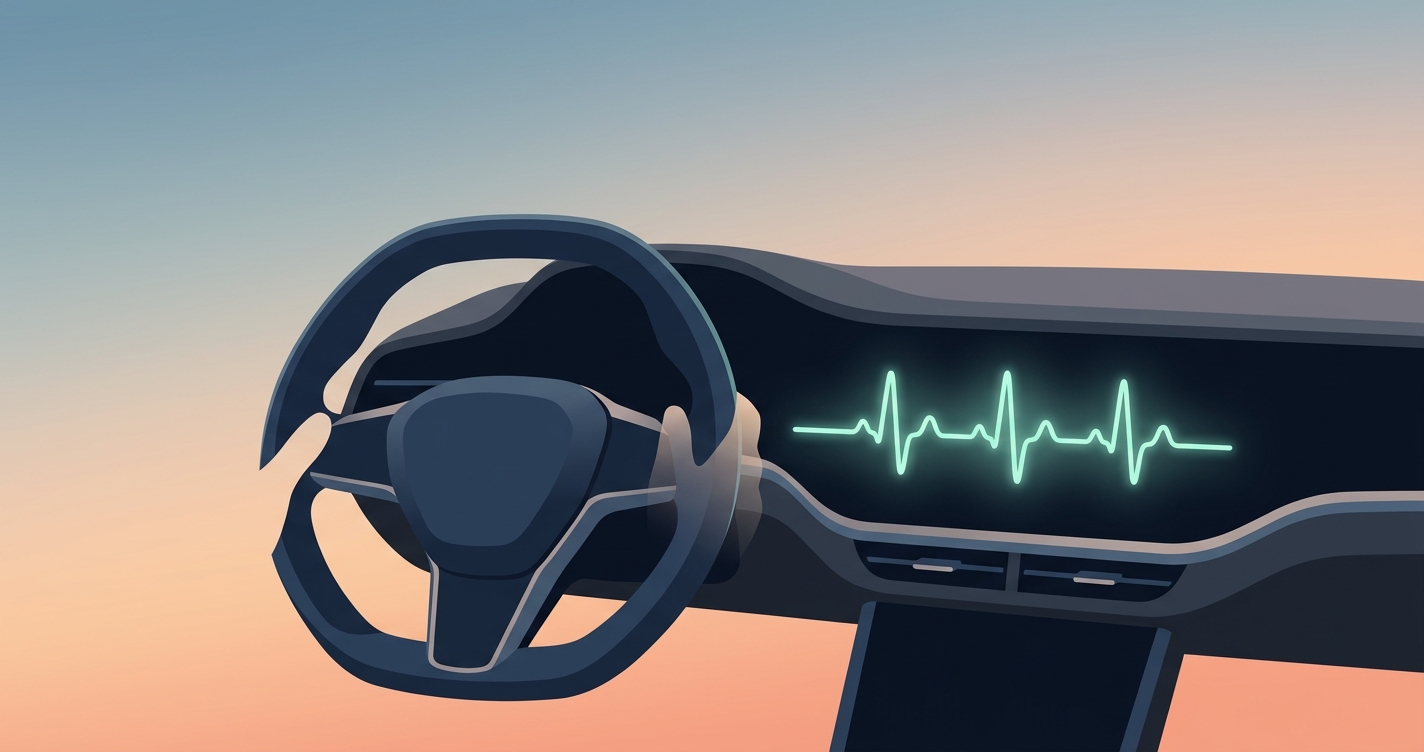
The scenario is easy to imagine: you are stuck in gridlock, the pressure of the day mounting, when you feel a sudden, sharp pain in your chest. Or perhaps it's more subtle-a wave of dizziness, or the creeping fog of a diabetic event. For thousands of drivers every year, this is not a hypothetical. It's a real medical emergency, happening in one of the worst possible places. The question is no longer if we can address this, but how. As vehicles become more connected and computationally powerful, they are gaining the ability to monitor the wellness of their occupants. The technology to turn a vehicle into a proactive health guardian is rapidly maturing, moving from research labs to the cars we drive every day.
"An estimated 20,000 drivers annually were involved in crashes precipitated by medical emergencies. These crashes represented about 1.3% of all drivers in NMVCCS crashes." - National Highway Traffic Safety Administration (NHTSA), 2007
How your car becomes a doctor in a traffic jam
The idea that your car become doctor traffic jam assistant is centered on a suite of passive, contactless sensors integrated into the cabin. The most promising of these is camera-based monitoring powered by remote photoplethysmography (rPPG). This technology uses a standard digital camera - often one already in place for driver monitoring (DMS) - to detect subtle, involuntary changes in the driver's skin reflection. These micro-level changes are caused by the pulsing of blood through the capillaries just beneath the surface.
Advanced algorithms analyze this video feed in real time to extract a surprising amount of physiological data. By measuring the frequency and consistency of these color changes, the system can calculate a driver's heart rate, heart rate variability (HRV), and respiration rate. Abrupt, significant changes in these baseline vitals can indicate a range of events, from acute stress and drowsiness to a potential cardiac or respiratory distress event. The "doctor" is not making a formal diagnosis but is acting as a first-line detection system, identifying statistical anomalies in the driver's physiological state that correlate with high-risk conditions.
| Monitoring Technology | How It Works | Data Points | Pros | Cons |
|---|---|---|---|---|
| Camera (rPPG) | Optical sensor detects micro-changes in skin color from blood flow. | Heart Rate, HRV, Respiration Rate, Stress Index, Blood Pressure (emerging) | Contactless, uses existing DMS hardware, provides continuous data. | Sensitive to lighting changes, motion artifacts, and skin tone variations. |
| Steering Wheel ECG | Embedded sensors in the steering wheel measure the heart's electrical activity. | ECG, Heart Rate, HRV | High-fidelity cardiac data. | Requires hands to be on the wheel, not continuous, higher cost. |
| Wearable Devices | Driver wears a watch, ring, or chest strap. | Heart Rate, SpO2, Skin Temp, Activity | High accuracy, multi-parameter data. | Requires driver compliance, potential for battery death, data privacy concerns. |
| In-Cabin Radar | Low-power radar waves detect chest movements. | Respiration Rate, Occupant Detection | Contactless, can detect passengers and children, works in low light. | Primarily for respiration, limited cardiac data, potential for interference. |
Industry Applications
The ability to passively monitor driver health has profound implications across the automotive industry, from consumer vehicles to commercial fleets.
### For Automotive OEMs and Tier-1 Suppliers
Integrating health monitoring is becoming a key differentiator for new vehicles. For luxury brands, it's a premium wellness feature. For mainstream brands, it's a critical safety system that goes beyond airbags and seatbelts. The ability to detect a medical emergency and have the car's advanced driver-assistance system (ADAS) potentially intervene - by slowing the vehicle, pulling over to the shoulder, and calling for emergency services - is a powerful safety proposition. This capability relies on robust sensor fusion, combining the outputs of the DMS camera, ADAS sensors, and vehicle telematics.
### for fleet management
For commercial trucking, delivery services, and public transit, the driver is the most critical asset. Driver health monitoring systems can provide fleet managers with unprecedented insight into the well-being of their workforce.
- Fatigue Management: By tracking HRV and eye-gaze, the system can detect drowsiness long before a driver dozes off, enabling proactive alerts.
- Stress Monitoring: Identifying high-stress routes or times of day can help operators optimize schedules and improve driver working conditions.
- Emergency Response: In the event of a detected health crisis, the system can automatically alert the fleet operator and emergency services, providing the vehicle's exact location. This is especially vital for long-haul truckers and drivers in remote areas.
### for insurance and telematics
Usage-based insurance programs already use telematics to reward safe driving behavior. Incorporating health metrics is the next logical step. A driver who consistently shows low-stress levels and no signs of excessive fatigue could be considered lower risk, potentially qualifying for lower premiums. This creates a powerful incentive for drivers to manage their health and for fleets to invest in wellness programs.
Current research and evidence
The foundational technology, rPPG, is well-established in clinical settings, but its application in a moving vehicle presents unique challenges. A significant body of recent research is focused on making these systems robust enough for automotive use. Researchers are tackling issues like variable lighting from tunnels and overhead trees, vibrations from road surfaces, and driver movements.
A 2023 study published by the IEEE, for example, focused on creating a robust "In-Vehicle Health Monitoring Dataset" to train and validate these algorithms. Researchers recorded data from 19 subjects in various driving scenarios, using an RGB camera alongside reference ECG and PPG signals. This type of academic work is critical for proving that camera-based systems can achieve the accuracy needed for safety-critical applications. The research, led by scientists like W. P. S. B. Weerakoon and Subhas Mukhopadhyay, aims to develop advanced signal processing and AI techniques, like the Wavelet Scattering Transform, to filter out the "noise" of the in-cabin environment and isolate the clean physiological signal.
The future of in-cabin health
Looking ahead, the car become doctor traffic jam concept will evolve. The next phase will involve integrating more data sources for a more holistic view of driver wellness. This could include analyzing the driver's voice for signs of stress or slurring, monitoring cabin CO2 levels, or even integrating with a driver's personal health records via their smartphone (with explicit consent).
The ultimate goal is a closed-loop system. The car detects an issue, assesses the driver's state and the surrounding environment, takes control of the vehicle if necessary to ensure safety, and communicates with the outside world - calling for help, notifying family members, and providing first responders with critical health data before they even arrive on the scene. This level of integration requires overcoming significant regulatory, data privacy, and cybersecurity hurdles, but the technological foundation is being built today.
Frequently asked questions
Is this technology available in cars now? Elements of it are. Many new cars have Driver Monitoring Systems (DMS) that use cameras to detect distraction and drowsiness by tracking eye-gaze and head position. The addition of vital signs monitoring via rPPG is the next step, and it is beginning to be deployed in select high-end models and commercial vehicle systems.
Can the car make a medical diagnosis? No. The system does not diagnose specific conditions like a heart attack. Instead, it detects statistical anomalies in vital signs compared to the driver's established baseline. It identifies that something is physiologically wrong and that the driver may be incapacitated, triggering an alert or intervention.
What about data privacy? This is a critical concern. For these systems to be trusted, the data must be handled securely. Most architectures process the video feed locally on a dedicated automotive-grade processor within the car. Only risk-event data (e.g., a detected emergency) is typically uploaded, and this is done with strong encryption and clear user consent protocols. The raw video feed of the driver's face does not leave the vehicle.
The technologies that allow a vehicle to monitor its driver are evolving faster than ever. As sensor and processing capabilities improve, the car is poised to become a guardian of occupant wellness, providing a new layer of safety that can react not just to external road hazards, but to the health of the person behind the wheel. For automotive OEMs, Tier-1 suppliers, and fleet operators exploring this space, Circadify is developing the custom camera-based software solutions needed to power this transition. To learn more about a potential collaboration for your automotive program, please begin your Automotive program inquiry.