
Should my car alert me if my breathing changes during a long trip?
How in-cabin vital signs monitoring tracks driver breathing on long trips, the sensing methods involved, and what OEMs and Tier-1 suppliers should weigh.
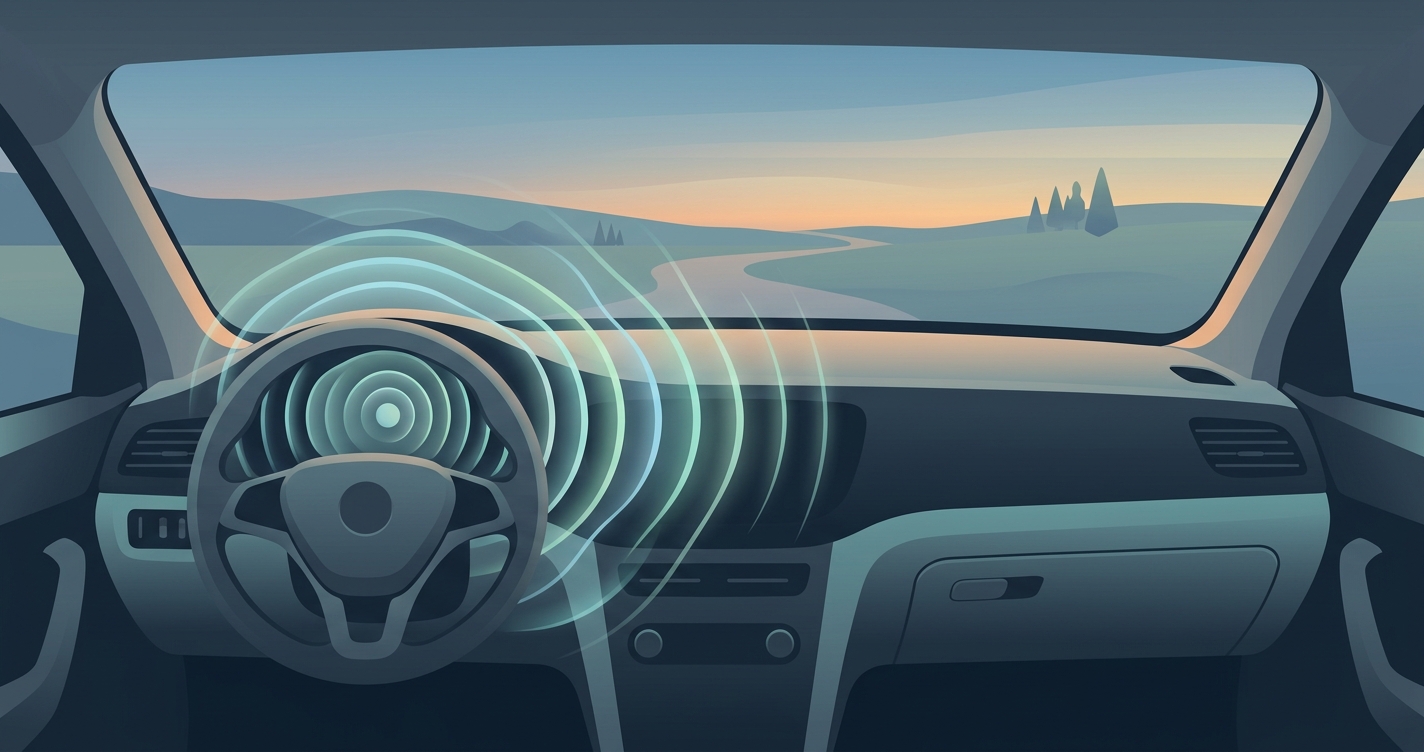
A driver three hours into a highway shift rarely notices the slow drift in their own breathing. Respiration is one of the first physiological signals to shift when fatigue, stress, or a developing medical event takes hold, yet it is the one channel most vehicles ignore entirely. As cabin cameras and radar modules become standard hardware to satisfy safety regulations, in-cabin vital signs monitoring is moving from a research curiosity toward a practical question for automotive OEMs and Tier-1 suppliers: if the breathing pattern of a driver changes mid-trip, should the vehicle say something? The answer depends less on whether the signal can be measured and more on how a measured change should translate into an alert that a driver trusts rather than tunes out.
"Respiratory rate is a strong early indicator of physiological deterioration, yet it remains the most poorly monitored vital sign in most non-clinical settings." This observation, echoed across remote-sensing reviews including work published in RSC Publishing (2023), frames why automotive teams are now treating breathing as a measurable safety channel rather than an afterthought.
Why in-cabin vital signs monitoring includes breathing
In-cabin vital signs monitoring covers heart rate, respiration, and increasingly blood oxygen and stress estimation, all captured without contact. Breathing earns particular attention on long trips because it correlates with several states that matter behind the wheel. Respiration slows and becomes more regular as drowsiness sets in, becomes shallow and rapid under acute stress, and can turn irregular or labored during a developing cardiac or respiratory event. A system that already runs a driver-facing camera or a cabin radar for occupant detection can extract respiration as a software layer rather than as new hardware, which is what makes the capability commercially interesting.
Two sensing families dominate current work. Camera-based remote photoplethysmography, or rPPG, reads subtle color and motion changes in skin and chest area to infer both pulse and breathing. Radar approaches, typically continuous-wave or millimeter-wave, measure the micromovements of the chest wall directly. Both can run unobtrusively, and both face the same core challenge: a moving vehicle is a hostile place to measure millimeter-scale chest displacement.
The table below compares the main approaches automotive teams evaluate for respiration sensing.
| Sensing method | How it reads breathing | Strength in a moving cabin | Main limitation |
|---|---|---|---|
| Camera rPPG (visible + NIR) | Skin color and chest motion analysis | Reuses existing DMS camera; works in darkness with NIR | Sensitive to occlusion, posture, and lighting shifts |
| mmWave / CW radar | Direct chest micromovement detection | Works through clothing; lighting independent | Motion artifacts from road vibration and body shifts |
| Seat pressure sensors | Pressure changes from chest expansion | Fully passive, no line of sight needed | Confounded by seat adjustments and road bumps |
| Multimodal fusion | Combines two or more of the above | Highest robustness under real driving | Higher integration cost and compute load |
Key reasons breathing has moved up the priority list for cabin programs:
- The sensor hardware is increasingly already present for regulatory drowsiness and child-presence functions.
- Respiration changes can precede the visible signs of fatigue that current systems rely on.
- Breathing patterns add a second physiological channel that improves confidence when fused with heart rate.
- A respiration baseline lets a system flag deviation rather than depend on absolute thresholds that vary by person.
Industry applications across the cabin
Passenger vehicle OEMs
For passenger car programs, breathing monitoring is framed mostly as comfort and wellness plus an emergency safety net. A vehicle that has learned a driver's resting respiration baseline over several trips can detect a sustained shift toward the slow, regular pattern associated with sleep onset and escalate a fatigue warning earlier than eyelid or head-pose cues alone. The same channel supports a sudden-illness response path, where an abrupt change in breathing combined with abnormal heart rate could trigger a graduated alert or, eventually, an assisted stop.
Commercial fleets and long-haul trucking
Fleet operators carry the clearest cost case. Long shifts, irregular schedules, and night driving make respiration-based fatigue detection valuable for both safety and duty-of-care documentation. A fleet system that logs respiration trends across a shift gives safety managers an objective signal to pair with hours-of-service data, without requiring drivers to wear anything.
Tier-1 sensing suppliers
For Tier-1 suppliers, respiration is a differentiator layered onto camera or radar modules already being sold for occupant monitoring. The engineering value sits in the signal-processing stack that survives road vibration, not in the raw sensor. Suppliers that can demonstrate stable respiration extraction during real driving hold a meaningful edge in cabin sensing bids.
Current research and evidence
The evidence base for in-cabin respiration sensing has grown quickly. On-road evaluations published in MDPI journals (2023 and 2024) have tested unobtrusive in-car respiration monitoring using both pressure-based seat sensors and optical methods, reporting usable agreement with reference belts during actual driving rather than parked conditions, which is the harder and more relevant test. Pressure-based work documented in PMC (2024) showed that a seat-integrated sensor could recover respiration through normal driving disturbances when paired with appropriate filtering.
On the radar side, research published in MDPI (2023) on contactless heart and respiration estimation using continuous-wave radar combined with temporal neural networks classified driver physiological states from chest micromovement, pointing toward systems that do more than report a number. A 2024 systematic review of AI innovations in rPPG for driver monitoring, published through IEEE Xplore, surveyed how deep-learning models are being applied to camera signals and flagged the recurring obstacles: motion robustness, performance across diverse skin tones and demographics, and the gap between lab datasets and real-road conditions. Multimodal fusion research, including the LeoPARD work from TU Braunschweig, has shown that combining radar, camera, and motion data produces more robust respiratory rate detection than any single sensor under continuous body movement.
The consistent message across this literature is that measuring breathing in a moving cabin is feasible but fragile. Accuracy holds in controlled conditions and degrades with posture changes, talking, and rough road surfaces. That fragility is precisely why the alerting logic matters as much as the sensing.
The Future of in-cabin breathing alerts
The near-term trajectory points away from raw vital-sign readouts and toward state classification. Drivers do not benefit from seeing a respiration number; they benefit from a system that quietly raises confidence in a fatigue or distress assessment by fusing breathing with heart rate, eye behavior, and steering data. The most credible designs treat respiration as one input to a layered decision, where a single channel rarely triggers an alert on its own. That approach reduces false alarms, which remain the fastest way to make drivers disable a feature.
Three developments will shape the next few years:
- Personalized baselines that learn an individual driver's normal respiration and flag deviation rather than population thresholds.
- Tiered response design, where a mild change prompts a comfort nudge and a severe, corroborated change escalates toward an emergency path.
- Edge processing of physiological signals to address privacy expectations, keeping raw biometric data inside the vehicle.
Regulation is the accelerant. With cabin cameras and occupant-sensing radar increasingly mandated for drowsiness, distraction, and child-presence functions, the marginal cost of adding respiration analysis is largely software. That economic reality, more than any single breakthrough, is what will decide how widely breathing-based alerts appear in production vehicles. Whether a car should alert you to a change in your breathing is becoming less a technical question and more a calibration question: how confident must the system be, and how should it speak, before it interrupts a driver who feels fine.
Frequently asked questions
Can a car actually measure breathing without any wearable device? Yes. Camera-based rPPG reads chest motion and skin signals, radar detects chest-wall micromovements through clothing, and seat sensors register pressure changes from breathing. On-road studies published in MDPI and PMC between 2023 and 2024 demonstrated usable respiration measurement during real driving, though accuracy is more variable than in clinical settings.
Why monitor breathing instead of just heart rate? Respiration shifts early during both drowsiness and stress, and it provides an independent channel that improves confidence when fused with heart rate and eye behavior. Relying on a single signal raises false-alarm rates, so most credible cabin designs combine breathing with other inputs rather than acting on it alone.
What is the biggest obstacle to reliable in-cabin respiration monitoring? Motion. Road vibration, posture changes, and talking all corrupt the millimeter-scale signals that respiration sensing depends on. Current research focuses on motion-robust algorithms and multimodal fusion to keep the measurement stable under real driving conditions.
Should every breathing change trigger an alert? No. Normal breathing varies with speech, conversation, and activity. Effective systems use personalized baselines and tiered logic so that only sustained, corroborated changes prompt escalation, which keeps drivers from disabling a feature that cries wolf.
Circadify is working with automotive teams on exactly this problem: turning camera and radar signals into respiration and vital-sign insight that survives the realities of a moving cabin. OEMs, Tier-1 suppliers, and fleet operators exploring comprehensive in-cabin health can start an automotive program inquiry at circadify.com/custom-builds/automotive-cabin.