Camera-Based vs Wearable Driver Monitoring: Which Is Better?
A research-based camera vs wearable driver monitoring comparison covering fatigue detection, in-cabin vitals, deployment tradeoffs, and fleet-scale automotive use cases.
Camera-Based vs Wearable Driver Monitoring: Which Is Better?
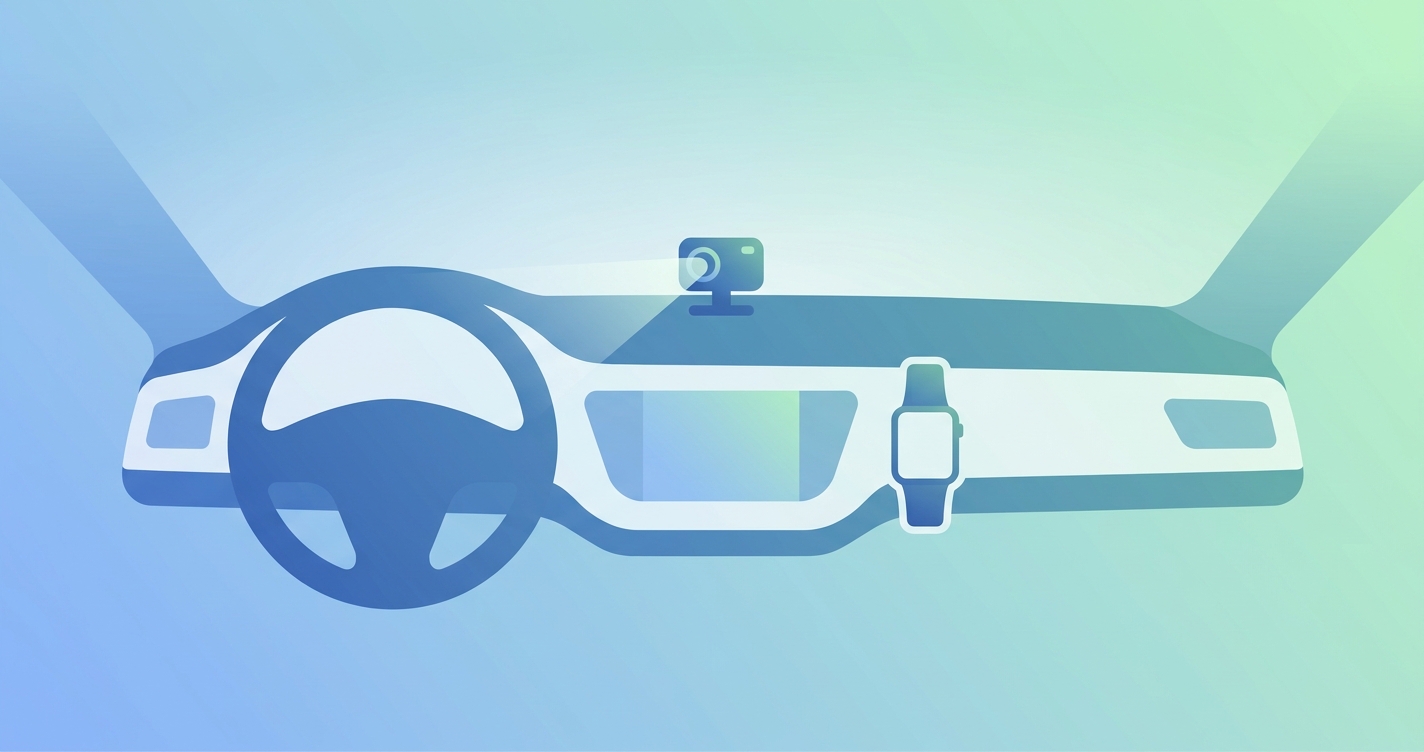
For automotive OEMs, Tier-1 suppliers, and fleet operators, the camera vs wearable driver monitoring comparison is no longer a theoretical product debate. It is a platform decision with direct consequences for compliance, retrofit cost, user acceptance, and the quality of fatigue or distraction data collected inside the cabin. Camera-based systems are gaining momentum because they fit naturally into the vehicle architecture and can observe the driver continuously without asking for behavior change. Wearables still matter, though, especially when teams want richer physiological data or monitoring that starts before a driver even touches the wheel.
“Fatigue is the single most underestimated risk factor in road transport. Unlike alcohol or speed, there is no roadside test — which makes in-vehicle detection the only scalable intervention.” — International Transport Forum, Road Safety Annual Report (2024)
Camera vs Wearable Driver Monitoring Comparison: The Core Tradeoff
At a high level, camera-based monitoring watches the driver from the outside, while wearable monitoring senses the driver from the body. That difference sounds simple, but it changes nearly everything about deployment.
A modern camera-based driver monitoring system uses near-infrared imaging, facial landmark tracking, gaze estimation, blink analysis, and head-pose modeling to infer whether a driver is attentive, drowsy, distracted, or under rising cognitive load. The strongest case for this approach is operational: the driver does not need to remember, charge, wear, or pair anything.
Wearable monitoring works from the opposite direction. Smartwatches, chest straps, earables, smart glasses, and wrist sensors can capture heart rate, heart rate variability, skin temperature, electrodermal activity, or motion. In a 2022 review in Bioengineering & Translational Medicine, Jingyang Zhang, Mengmeng Chen, Yuan Peng, and colleagues argued that wearable biosensors are attractive because they support continuous, noninvasive collection of fatigue-related biomarkers from the body rather than inferring them only from visible behavior.
That is the real dividing line. Cameras are usually better at observing immediate driving behavior. Wearables are often better at measuring internal physiology. Most buyers do not actually need “the best technology” in the abstract. They need the best fit for a production vehicle, a regulated safety program, or a large commercial fleet.
Comparison of Driver Monitoring Approaches
| Dimension | Camera-Based Monitoring | Wearable Monitoring |
|---|---|---|
| Primary signal source | Face, eyes, gaze, head pose, cabin video | Heart rate, HRV, motion, skin temperature, EDA, eye closure depending on device |
| Driver adoption burden | Low | Moderate to high |
| Works without active driver participation | Yes | Not always |
| Best for distraction detection | Strong | Limited unless paired with vision or steering data |
| Best for direct physiology | Moderate with rPPG | Strong |
| Vehicle integration path | Native in-cabin integration | Depends on BYOD, device provisioning, pairing, and uptime |
| Regulatory fit for automotive DMS | Strong | Weak as a stand-alone path |
| Privacy perception | Mixed due to camera | Often perceived as better, though data sensitivity is high |
| Maintenance burden | Mostly vehicle-side | Device charging, loss, replacement, compliance |
| Fleet scalability | High once installed | Variable and heavily behavior-dependent |
The reason this table matters is simple: procurement teams often compare sensor quality first and deployment friction second. In practice, the second factor can kill the program.
- Camera systems win when low-friction compliance and broad coverage matter most.
- Wearables win when the goal is physiological depth and individualized baselining.
- Hybrid models make sense when the safety case needs both observable behavior and biometric context.
Where Camera-Based Monitoring Pulls Ahead
Camera systems have become the default direction in automotive driver monitoring because they align with how vehicles are engineered and sold. A driver can sit down, start the vehicle, and the monitoring system is already running. That sounds obvious, but it removes one of the biggest failure modes in any real-world safety deployment: nonuse.
Shichen Fu, Zhenhua Yang, Yuan Ma, Zhenfeng Li, Le Xu, and Huixing Zhou wrote in their 2024 MDPI review on fatigue and distraction detection that image-based systems remain central because they can detect visible fatigue cues, distraction patterns, and driver-state changes with no body-worn hardware requirement. That matters for passenger vehicles, where even a small rise in setup friction can translate into low feature utilization.
The research base behind camera systems is also mature. Wierwille and Ellsworth at the Virginia Tech Transportation Institute helped establish PERCLOS as one of the most reliable visual markers of drowsiness. Thomas Dingus and colleagues, working through the SHRP 2 Naturalistic Driving Study, built one of the largest real-world driving datasets ever assembled: more than 35 million miles of driving data. That work gave the industry something it badly needed — evidence from actual roads, not just labs.
Camera systems usually outperform wearables in these scenarios:
- Detecting visual distraction and prolonged off-road glances
- Measuring eyelid closure, blink duration, and yawning in real time
- Supporting handoff monitoring in Level 2 and Level 3 automation contexts
- Delivering fleet-wide coverage without dependence on driver compliance
- Combining driver monitoring with broader occupant or in-cabin sensing
A related advantage is architectural convergence. The same cabin camera stack can support driver monitoring, occupant monitoring, child presence detection, and, increasingly, contactless vital-signs estimation.
Where Wearables Still Have a Real Edge
Wearables have one obvious strength: they can see inside the driver’s physiology in ways cameras still approximate.
A wrist or chest-worn system can collect heart rhythm, heart rate variability, motion, skin temperature, and in some cases stress-linked signals long before a driver begins to yawn or lose gaze stability. That makes wearables attractive in long-haul transport, mining, military mobility, and other operations where fatigue risk may build gradually before visible symptoms appear.
Agent-search results also surfaced a more direct comparison in a recent hands-on-wheel detection study: a camera-based vision model reached about 98% overall accuracy, while a wearable-plus-LSTM approach reached about 86% under controlled conditions. Even so, the study noted a point buyers should not ignore: wearables may offer better perceived privacy than always-on cameras.
That privacy argument is real, but it is not the whole story. Wearables shift the burden from optics to logistics. Someone has to issue the devices, make sure they stay charged, confirm they are actually worn, handle replacements, and manage driver resistance. For fleet programs, those operational headaches can erase the theoretical sensing advantage.
Wearables are strongest when teams need:
- Direct physiology rather than visible behavior alone
- Monitoring that extends beyond time in the vehicle
- Personalized baselines for the same individual over weeks or months
- Pilot programs with a small, controlled driver population
- Supplemental stress or recovery signals in specialized operations
Industry Applications by Buyer Type
Passenger Vehicle OEMs
For OEMs, camera-based monitoring is usually the better answer because it fits production realities. There is no need to distribute hardware to drivers, no pairing workflow, and no risk that the feature stops working because a watch battery died. Camera systems also map more cleanly to current safety-rating and in-cabin monitoring expectations.
Tier-1 Suppliers
Tier-1s tend to prioritize compute efficiency, sensor consolidation, and software reuse. That makes camera systems attractive because the same pipeline can support fatigue, distraction, occupant monitoring, and increasingly rPPG-based vital sign estimation. Wearables are harder to standardize across vehicle programs because they depend on external device ecosystems.
Commercial Fleets
Fleets have a more nuanced decision. If the goal is broad coverage across hundreds or thousands of vehicles, cameras scale better. If the goal is to understand stress load, circadian disruption, or readiness-to-drive in a narrow high-risk workforce, wearables may provide better depth. The catch is compliance: the more distributed the workforce, the harder it becomes to sustain wearable adherence.
Mining, Construction, and Safety-Critical Operations
These environments are where wearables make their strongest case, especially when drivers work long shifts, off-road, or in harsh environments where physiological strain matters before road-style distraction does. Even then, many operators end up favoring hybrid systems because supervisors want both direct body signals and visible driver-state verification.
Current Research and Evidence
The current evidence does not support a simplistic winner-take-all answer. Instead, it points to different strengths.
Wim Verkruysse, Lars O. Svaasand, and J. Stuart Nelson at the Beckman Laser Institute at the University of California, Irvine showed in 2008 that remote plethysmographic signals could be extracted from standard facial video using ambient light. That paper helped establish the basis for contactless heart-rate and respiration sensing from a camera — an important bridge between classic DMS and in-cabin vital-sign monitoring.
Jingyang Zhang and colleagues, in their wearable fatigue-biosensor review, emphasized that body-worn systems can gather quantitative biomarkers continuously and noninvasively. That supports a strong wearable argument for programs focused on early physiological fatigue detection rather than visible distraction.
The SHRP 2 Naturalistic Driving Study, led in part by Thomas Dingus and the Virginia Tech Transportation Institute, remains critical because it grounds driver-state research in real-world exposure at scale. Meanwhile, the 2024 review by Fu and colleagues shows how the field is shifting toward multimodal fusion rather than single-sensor thinking.
The research trend is pretty clear:
- Cameras dominate when deployment friction must stay close to zero.
- Wearables dominate when biomarker richness matters more than cabin simplicity.
- The most ambitious programs are moving toward fusion models.
The Future of Driver Monitoring
The future of the camera vs wearable driver monitoring comparison is probably not a single winner. It is a stack decision.
For mainstream automotive production, camera-based systems are likely to remain the primary layer. They are easier to standardize, easier to deploy, and easier to justify in a vehicle safety architecture. For high-risk or high-value operations, wearables will continue to add value by supplying context cameras cannot always see early enough.
What changes next is the boundary between the two. As camera-based rPPG improves, cabins will capture more physiological insight without touching the driver. As wearable analytics improve, fleets will get better at predicting fatigue before visible degradation begins. The most capable systems will merge those worlds instead of forcing buyers to choose one forever.
For teams building 2026 and 2027 roadmaps, the better question is not “camera or wearable?” It is “what is the minimum-friction system that still captures the signals our safety case depends on?” That usually leads mainstream vehicle programs toward cameras first, then physiology-enriched layers where justified.
Frequently Asked Questions
Is camera-based or wearable driver monitoring more accurate?
It depends on the task. Cameras are generally better for distraction, gaze, eyelid closure, and visible drowsiness behaviors. Wearables are generally better for direct physiological signals such as heart rate variability, skin temperature, and motion-linked fatigue markers.
Why do automotive OEMs usually prefer camera-based driver monitoring?
Because cameras are easier to integrate into the cabin, require no action from the driver, and support direct observation of attention and drowsiness. For production vehicles, that low-friction model is hard to beat.
Are wearables better for fleet fatigue programs?
They can be, especially when a fleet wants individualized physiological baselines or off-duty readiness insights. But fleets also have to manage charging, compliance, loss, and replacement, which can make wearable-only programs difficult to sustain.
Can camera systems collect vital signs too?
Yes. Remote photoplethysmography research going back to Verkruysse and colleagues in 2008 showed that heart and respiration signals can be estimated from facial video. In-cabin implementations are still an active development area, but the direction is clear.
Is a hybrid driver monitoring strategy becoming more common?
Yes. Many advanced programs are moving toward multimodal systems that combine camera observations with physiological or contextual data. That approach can improve confidence and reduce blind spots from any one modality.
For automotive teams weighing low-friction deployment against richer physiological sensing, solutions like Circadify are helping bring camera-based in-cabin vitals and driver-state monitoring into real vehicle programs. For custom automotive cabin builds, see Circadify’s automotive program page, and explore related Quick Scan Vitals coverage on camera-based driver monitoring systems and fleet driver health monitoring systems.