Camera vs Steering Sensors for Spotting Tired Drivers
A head-to-head comparison of driver fatigue detection methods: camera-based monitoring versus steering and lane sensors for catching drowsiness early.
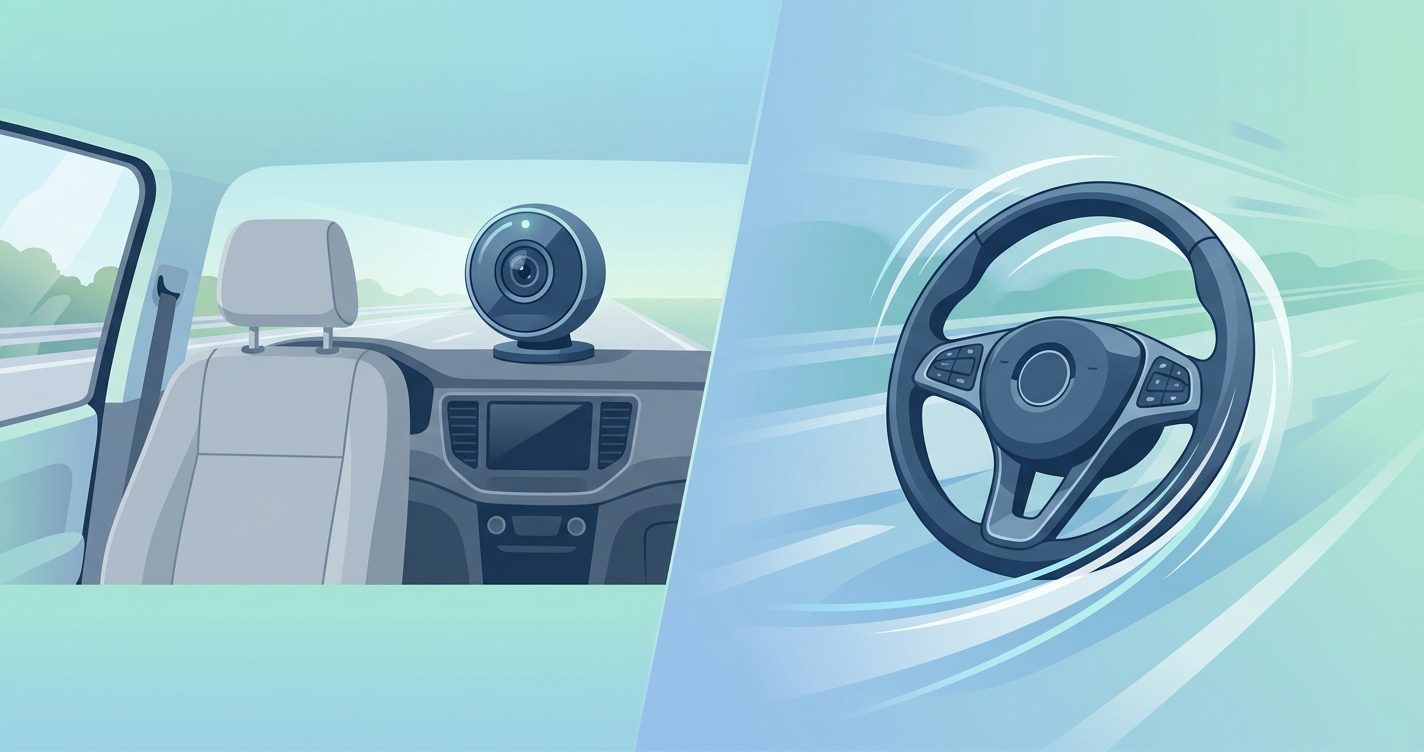
Every automotive program that takes drowsy driving seriously eventually arrives at the same fork in the road: should the system watch the driver, or watch the vehicle? The two dominant driver fatigue detection methods, inward-facing cameras and steering or lane behavior sensors, reach the same goal from opposite directions. One reads the body for the physiological signs of fatigue. The other infers fatigue from how the car is being driven. For OEMs, Tier-1 suppliers, and fleet operators deciding where to spend integration budget, the difference is not academic. It changes how early a warning fires, how many false alarms drivers tolerate, and whether the system holds up on a dark rural highway at 3 a.m.
"PERCLOS, the percentage of time the eyes are at least 80 percent closed over a minute, is among the most promising real-time measures of alertness for in-vehicle drowsiness-detection systems." - U.S. National Highway Traffic Safety Administration and Federal Highway Administration research program
Comparing driver fatigue detection methods head to head
The core distinction between these driver fatigue detection methods is what each one actually measures. Camera-based systems observe the driver directly. They track eyelid closure using the PERCLOS metric first validated in a 1994 driving simulator study, along with blink rate, yawning, head pose, and gaze direction. More advanced camera stacks add remote photoplethysmography (rPPG), pulling heart rate and heart-rate variability from subtle color changes in facial skin, which gives an earlier physiological read on fatigue before behavior degrades.
Steering and lane sensors take the indirect route. They watch steering wheel angle, steering reversal rate, micro-corrections, and lane position drift captured from an outward-facing camera or the electric power steering signal. A drowsy driver tends to make fewer small corrections followed by larger jerky ones, and to wander within the lane. The logic is sound, but the signal only appears after fatigue has already started affecting control of the vehicle.
That timing gap is the central trade-off. Direct measurement catches the onset; indirect measurement catches the consequence.
| Factor | Camera-Based Monitoring | Steering and Lane Sensors |
|---|---|---|
| What it measures | Eyelid closure, blink, yawn, head pose, gaze, rPPG vitals | Steering angle, reversal rate, micro-corrections, lane drift |
| Detection timing | Early, at physiological onset | Later, after vehicle control degrades |
| Reported detection performance | Eye-closure detection near 88 to 95 percent in recent studies | Roughly 78 to 92 percent depending on conditions |
| Performance at low speed or in traffic | Maintained, driver always visible | Degrades, little steering or lane input available |
| Sensitivity to road geometry | Low | High, curves and crosswinds confound signal |
| Lighting dependence | Needs NIR illumination at night | Lane camera needs clear markings |
| Driver-specific calibration | Minimal | Often required per driver and vehicle |
| Privacy considerations | Higher, captures the face | Lower, captures vehicle behavior |
| Hardware footprint | Dedicated cabin camera and processor | Often reuses existing steering and ADAS signals |
The performance figures above come from recent peer-reviewed work and should be read as directional rather than absolute, because test conditions vary widely between simulator and real-road studies.
Where each approach wins and struggles
No single method is flawless, and the failure modes matter more than headline numbers for a production program.
Camera-based strengths:
- Detects fatigue before the driver loses vehicle control, buying critical seconds.
- Works at any speed, including stop-and-go traffic where steering input is minimal.
- Distinguishes fatigue from distraction, since gaze and head pose are observed directly.
- Adds a path to vital-sign monitoring through rPPG, extending beyond drowsiness alone.
Camera-based challenges:
- Requires near-infrared illumination to function in darkness and through sunglasses.
- Raises privacy questions that demand on-edge processing and clear data governance.
- Needs robust handling of occlusion, such as a hand over the mouth or a turned head.
Steering and lane sensor strengths:
- Can reuse signals already present in electric power steering and lane-keeping systems.
- Lower per-unit cost when no new sensor hardware is added.
- Less intrusive, since nothing watches the driver's face.
Steering and lane sensor challenges:
- Late warning, because the signal only emerges once control quality drops.
- Confounded by road curvature, crosswind, and individual driving style.
- Weak or absent signal at low speed, in traffic, or with lane-keeping assist active.
- Frequently requires a baseline calibration period per driver before it is reliable.
Industry Applications
Passenger vehicle oems
For consumer vehicles, regulation is now the forcing function. The European Union General Safety Regulation requires driver drowsiness and attention warning systems, and Euro NCAP scoring rewards direct driver monitoring. Camera-based methods align cleanly with these requirements because they measure attention state directly rather than inferring it. Many production programs run a hybrid: the camera provides the primary fatigue read while steering data acts as a corroborating input to suppress false alarms.
Commercial and long-haul fleets
Fleets care about cost per incident avoided, not sensor elegance. Long-haul operations face sustained monotony where lane and steering drift can be subtle on straight interstates, and where a late warning is the difference between a rumble-strip correction and a rollover. Camera systems that combine PERCLOS with rPPG-derived heart-rate trends give safety managers an earlier, driver-specific signal, and they keep working during the low-speed yard and urban-delivery segments where steering signals thin out.
Tier-1 suppliers and platform integrators
For suppliers building a platform across multiple OEM customers, the camera approach offers a single sensing modality that scales from basic drowsiness alerts to distraction detection, occupant monitoring, and in-cabin vitals. Steering-based detection, by contrast, is tightly coupled to each vehicle's steering hardware and tuning, which raises per-platform validation effort.
Current research and evidence
The evidence base favors direct ocular measurement for early detection. NHTSA and FHWA research identified PERCLOS as the most reliable single index of driver alertness when validated against psychomotor vigilance task lapses, outperforming several behavioral and physiological alternatives. Recent computer-vision studies using facial landmarks and deep learning report eye-closure detection in the high 80s to mid 90s percent range, with one 2024 real-time driver monitoring study reporting eye-closure detection near 88.9 percent and yawning detection near 85.2 percent.
Steering-based research is also maturing. An online steering wheel angle study under real driving conditions reported average detection around 78 percent, while a 2024 machine-learning approach using micro-maneuvers on the steering wheel reported overall detection above 92 percent in its test setting. The recurring caveat across reviews, including comprehensive MDPI surveys of fatigue and distraction detection, is that steering signals are sensitive to road geometry and driver style, which is why multimodal fusion of camera, physiological, and vehicle data is repeatedly recommended for robustness.
The consensus is not that one method is useless. It is that camera-based sensing detects fatigue earlier and more directly, while vehicle-based sensing adds confirmatory value when fused, not as a standalone primary.
The future of driver fatigue detection
Three shifts are reshaping how these methods are deployed. First, sensor fusion is becoming the default architecture, with the camera as the primary fatigue sensor and steering, lane, and even seat or wheel grip data as corroborating inputs. Second, rPPG and other contactless vital-sign techniques are extending the camera's role from drowsiness alone toward continuous physiological monitoring, which opens earlier fatigue prediction based on heart-rate variability trends. Third, edge processing is resolving the privacy objection by keeping facial data on-device and transmitting only fatigue states rather than images. The trajectory points toward camera-led, fusion-supported systems where steering sensors enrich rather than replace the direct read on the driver.
Frequently asked questions
Which detection method catches fatigue earlier, camera or steering sensors? Camera-based monitoring generally catches fatigue earlier because it measures physiological onset signs such as slow eyelid closure and changes in heart-rate variability. Steering and lane sensors only register fatigue once it has begun to degrade vehicle control, which arrives later in the fatigue progression.
Are steering sensors more reliable than cameras for drowsiness detection? Not consistently. Steering signals are strong on straight roads at steady speed but degrade in traffic, on curves, in crosswind, and often need per-driver calibration. Cameras maintain a usable signal across speeds and conditions, provided night illumination and occlusion are handled. Most current research recommends fusing both rather than relying on steering alone.
Can both methods be combined in one system? Yes, and fusion is increasingly the production standard. A common design uses the camera as the primary fatigue sensor and steering or lane data as a confirming input to reduce false alarms. This combination improves robustness without making vehicle behavior the sole basis for a warning.
Do camera-based fatigue systems create privacy problems? They can if images leave the vehicle, but modern designs process facial data on the edge inside the vehicle and output only a fatigue state. This approach addresses most privacy concerns while preserving the early-detection advantage of direct monitoring.
Circadify is building camera-based driver fatigue, drowsiness, and stress detection designed for the cabin, pairing PERCLOS-style ocular metrics with rPPG vital signs so OEMs and fleets get an early, direct read on the driver rather than a delayed inference from vehicle behavior. Teams weighing a detection approach for an upcoming program can start an automotive program inquiry at circadify.com/custom-builds/automotive-cabin.