How to Build a Driver Monitoring Program for Your Fleet
A research-based framework for teams that need to build driver monitoring program fleet operations around fatigue detection, telematics, privacy, and measurable safety outcomes.
How to Build a Driver Monitoring Program for Your Fleet
To build driver monitoring program fleet leaders can actually operate, the hard part is not choosing a camera. It is deciding what the system is supposed to change. Fleets usually buy monitoring tools after a bad quarter: too many fatigue events, too many near misses, too much uncertainty about what drivers are dealing with in the cab. But a durable program starts earlier than procurement. It starts with a risk model, clear operating rules, and a realistic view of what supervisors will do when the system raises its hand.
"A 2018 study by the AAA Foundation for Traffic Safety found that drowsiness was a factor in 9.5% of all crashes in the SHRP 2 naturalistic driving dataset." — Brian C. Tefft, AAA Foundation for Traffic Safety (2018)
Build driver monitoring program fleet strategy around the actual failure modes
There is a reason many fleet driver monitoring rollouts disappoint. The software works, the alerts fire, and then the operation realizes it never agreed on which events matter most. Long-haul fatigue, phone distraction, microsleeps near the end of a shift, stress spikes in urban delivery routes, and medical events are not the same problem. They should not be handled by the same workflow.
David F. Dinges and Randolph C. Grace helped establish one of the field's most influential fatigue measures in their 1998 work on PERCLOS, showing that eyelid-closure metrics tracked psychomotor vigilance decline better than several competing indicators. That matters because many production driver monitoring systems still build on the same logic: look for the small facial changes that show alertness is fading before the vehicle makes the mistake obvious.
A fleet program usually needs five design decisions up front:
- Which risks are in scope: drowsiness, distraction, stress, or medical distress
- Which vehicles and routes create the highest exposure
- Which alerts stay in-cab and which escalate to dispatch or safety teams
- Which data is stored, for how long, and who can review it
- Which outcome metrics prove the program is worth keeping
If those decisions stay fuzzy, the technology turns into background noise.
Program design choices that shape deployment
| Program layer | What it should answer | Typical data inputs | Common mistake |
|---|---|---|---|
| Risk definition | What problem are we trying to reduce? | Crash history, near misses, hours-of-service patterns, route type | Buying a generic DMS before defining use cases |
| Detection model | What counts as an event? | Eye closure, gaze, head pose, cabin video, telematics, rPPG where available | Using the same thresholds for every route and driver population |
| Escalation policy | What happens after an alert? | In-cab warning, dispatch notification, coaching workflow | Sending too many low-confidence alerts to supervisors |
| Privacy and governance | Who can see what? | Raw video rules, retention windows, labor policy, consent language | Treating privacy as a legal footnote instead of an adoption issue |
| ROI measurement | Did the program improve safety or operations? | Event rates, preventable crashes, claims severity, coaching completion | Tracking alerts only and not business outcomes |
The table is simple on purpose. Most failed deployments do not fail on model architecture. They fail because one of these operating layers was skipped.
What a working fleet driver monitoring program usually includes
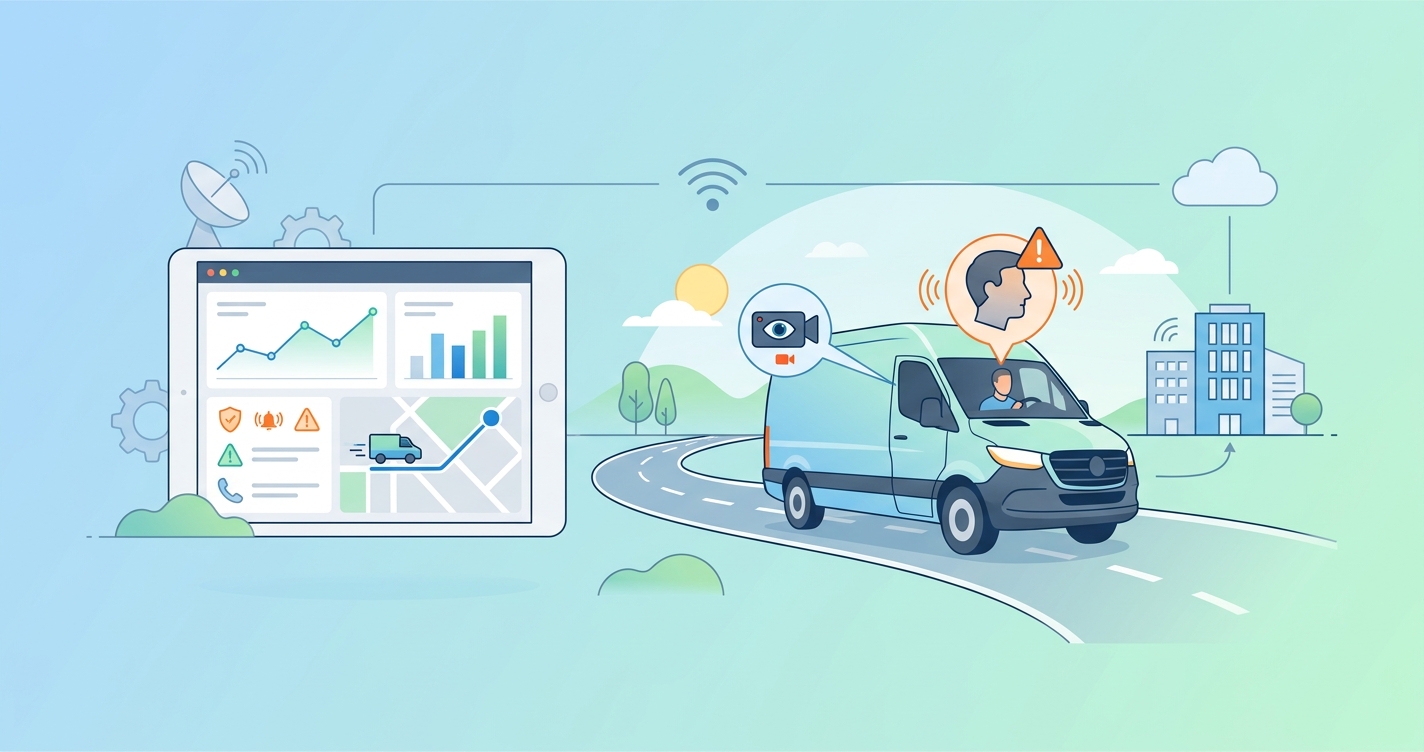
A production program is usually a stack, not a feature. The camera may be the most visible piece, but the fleet has to connect detection, operations, and policy.
The strongest programs usually include:
- A baseline period before coaching begins, so teams can understand normal event rates by route and shift type
- Driver-facing in-cab alerts for immediate correction
- Supervisor review queues that focus on severe or repeated events, not every blink or glance
- Telematics integration so fatigue events can be seen alongside speed, braking, route density, and trip duration
- A documented privacy policy that limits access to raw footage and avoids open-ended retention
- A coaching cadence with written thresholds for intervention
That telematics link matters more than vendors sometimes admit. A drowsiness event by itself is useful. A drowsiness event paired with overnight driving, repeated hard braking, and route delays is operationally actionable.
Industry applications and operating models
Long-haul trucking
Long-haul fleets usually need fatigue detection first. The exposure window is long, circadian disruption is common, and the cost of a severe crash is brutal. In this setting, the driver monitoring program is less about catching ordinary distraction and more about identifying the slow drift from alert to impaired.
Takashi Abe of the International Institute for Integrative Sleep Medicine at the University of Tsukuba argued in a 2023 review that PERCLOS remains one of the most studied drowsiness measures, even as researchers look at richer multimodal signals. That is useful guidance for fleets: start with robust eye and face signals, then add more data where the use case justifies it.
Last-mile and urban delivery
Urban fleets deal with a different pattern. They see shorter trips, higher stop density, more phone temptation, and more cognitive overload. A useful program here emphasizes distraction, repeated risky behaviors, and coaching at the route or depot level. The operational question is often not "Was the driver sleepy?" but "What cabin behaviors keep showing up in congested environments?"
Transit, mining, and heavy equipment
High-duty-cycle operations often want escalation logic that is tighter than consumer automotive DMS. The safety team may need near-real-time alerts, not just post-shift analytics. For those programs, driver monitoring becomes part of the operating control system. The false-positive tolerance is low, but the cost of missing a true event is higher.
Current Research and Evidence
The current evidence base gives fleets a pretty practical roadmap.
Brian C. Tefft's 2018 AAA Foundation analysis used face video from 3,593 drivers in the SHRP 2 Naturalistic Driving Study and concluded that drowsiness was involved in 9.5% of all crashes. That result still matters because it pushed the field away from the old assumption that fatigue was too rare to justify active monitoring.
Dinges and Grace, working with support from the Federal Highway Administration and NHTSA, found in 1998 that PERCLOS was a reliable psychophysiological measure of alertness when compared with lapses on the Psychomotor Vigilance Task. In other words, eyelid behavior was not just visually suggestive; it tracked measurable performance decline.
Abe's 2023 review in Sleep Advances adds a useful update. He notes that PERCLOS is still valuable, but newer systems increasingly combine eyelid closure with fixation patterns, pupil dynamics, heart-rate variability, and other signals when available. That points fleets toward a sensible build order: use mature camera-based fatigue markers first, then layer in multimodal sensing if the operation needs higher confidence or earlier prediction.
Regulation is moving the same way. Euro NCAP's 2026 protocols and its Driver Monitoring technical bulletin push manufacturers toward more rigorous distraction, drowsiness, and impairment detection. Those are passenger-vehicle rules, not fleet operating manuals, but they still matter. When consumer and commercial platforms standardize around better in-cabin monitoring, fleet buyers get stronger hardware and more mature software supply chains.
The Future of Fleet Driver Monitoring Programs
The next wave of fleet monitoring will probably look less like isolated video safety and more like risk scoring tied to dispatch, maintenance, and coaching. Fleets want fewer disconnected dashboards. They want one view that shows where fatigue risk is building and what to do next.
That does not mean every program needs biometric complexity on day one. Most fleets are better off getting three things right first: reliable event detection, clear escalation rules, and trust from drivers. After that, more advanced layers start to make sense. Remote photoplethysmography, for example, may give in-cabin systems another path to heart-rate or stress-related context without asking drivers to wear extra hardware.
The future question is not whether fleets will monitor drivers. Many already do. The real question is whether they will build programs that drivers understand, supervisors can manage, and executives can measure.
Frequently Asked Questions
What is the first step when you build a driver monitoring program for your fleet?
Start by defining the risk you want to reduce. A fatigue-focused long-haul program should be designed differently from an urban distraction-reduction program.
Should fleets connect driver monitoring to telematics?
Usually yes. Driver-state events become much more useful when they are reviewed alongside route, speed, braking, trip duration, and time-of-day data.
How much video should a fleet keep?
Most fleets should keep as little raw footage as possible. Short retention windows, event-based access, and limited reviewer permissions are easier to defend and easier for drivers to accept.
Are camera-only systems enough for fleet safety?
For many fleets, yes. Camera systems already support fatigue and distraction detection well enough to drive meaningful safety workflows. More advanced physiological sensing can help in higher-risk operations, but it is not always the right starting point.
Do regulations matter for fleet programs if the fleet is not an OEM?
Yes. Regulations and rating protocols influence the hardware and software that reach production scale. That shapes what fleets can buy, integrate, and maintain over time.
For fleet teams planning camera-based fatigue and wellness programs, solutions like Circadify are helping bring in-cabin vital-signs sensing and driver-state monitoring into custom automotive builds. For automotive program discussions, see Circadify's automotive cabin page, and explore related Quick Scan Vitals coverage on fleet driver health monitoring systems and driver health analytics.