Best In-Cabin Health Monitoring Systems for Fleets in 2026
A buyer's roundup comparing in-cabin health monitoring systems for fleets in 2026 on accuracy, install effort, and total cost of ownership.
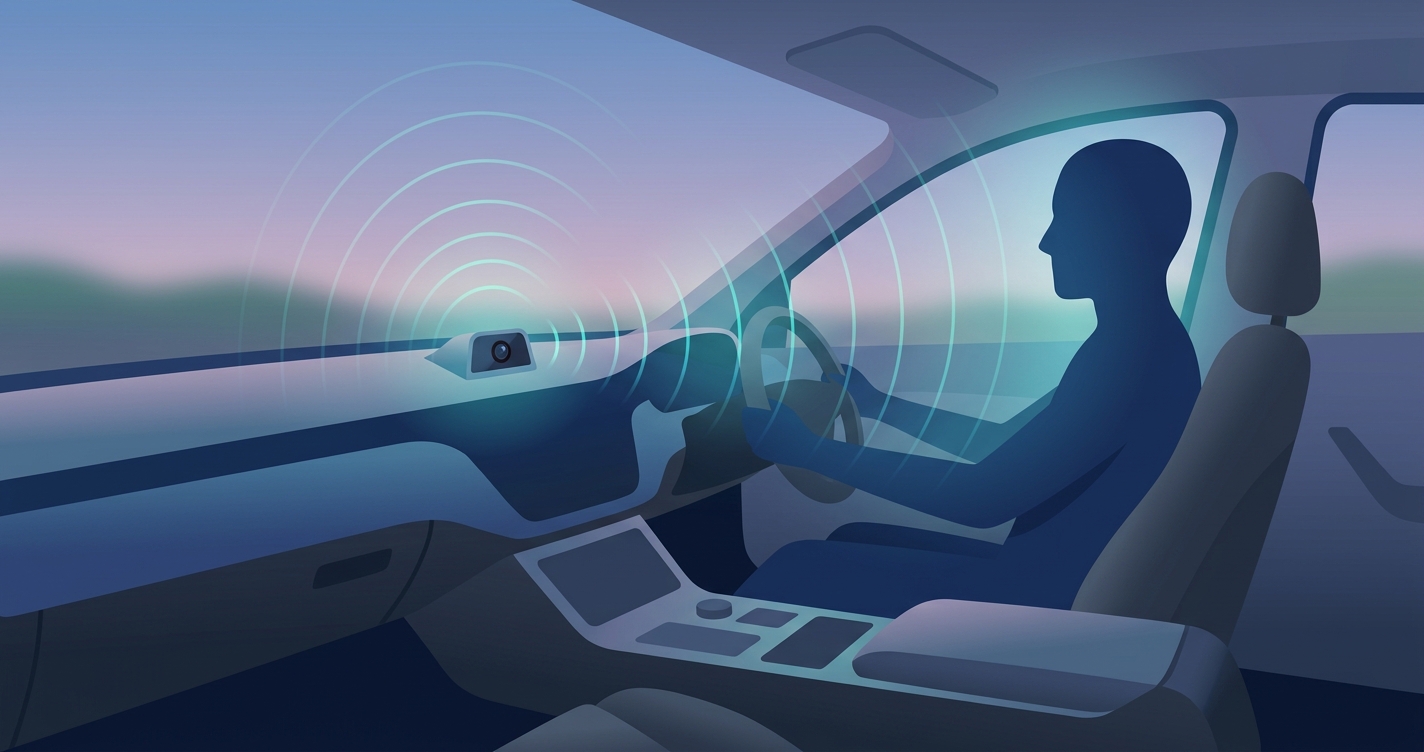
Fleet procurement teams entering 2026 face a buying decision that did not exist three years ago: choosing an in-cabin health monitoring system that reads driver vital signs, not just eyelids. The shift is being pulled forward by regulation and pushed by economics. The European Union's General Safety Regulation makes Advanced Driver Distraction Warning systems mandatory on all new vehicles from July 7, 2026, building on the Driver Drowsiness and Attention Warning requirement that took effect in July 2024. For fleet operators and the OEMs and Tier-1 suppliers who serve them, the question has moved from whether to deploy cabin sensing to which architecture delivers reliable physiological signals at a defensible cost.
The automotive in-cabin monitoring solution market is projected to grow from $4.8 billion in 2025 to an estimated $14.6 billion by 2034, with the commercial vehicle segment among the fastest-moving categories as fleets respond to fatigue-related crash exposure., IDTechEx and industry market analyses, 2025
What "in-cabin health monitoring" actually covers in 2026
The term in-cabin health monitoring describes systems that go beyond classic driver monitoring. A conventional driver monitoring system tracks gaze, head pose, blink rate, and eyelid closure to infer distraction and drowsiness. A health monitoring layer adds physiological measurement: heart rate, respiration rate, heart rate variability as a stress and fatigue proxy, and in some architectures blood oxygen estimation. The best driver monitoring system for a given fleet depends on how many of those signals it can extract reliably from a moving cabin, and at what installed cost per vehicle.
Three sensing approaches dominate the 2026 market for fleet vital sign monitors:
- Camera-based remote photoplethysmography (rPPG), which reads micro color changes in facial skin caused by blood flow, typically reusing the near-infrared camera already required for distraction monitoring.
- Radar-based sensing, including ultra-wideband (UWB) and millimeter-wave units that detect chest-wall motion for respiration and heart rate without imaging the occupant.
- Contact and wearable hybrids, where steering-wheel electrodes or driver-worn bands feed physiological data into the cabin platform.
Each approach trades accuracy against install effort and unit economics differently. The comparison below frames those trade-offs for a fleet buyer rather than a research lab.
Comparison: leading in-cabin sensing approaches for fleets
| Approach | Vital signs captured | Relative accuracy in motion | Install effort | Indicative per-vehicle cost | Best fit |
|---|---|---|---|---|---|
| Camera rPPG (reuses DMS camera) | Heart rate, respiration, HRV/stress, SpO2 estimation | Good for resting and moderate ranges; degrades at elevated heart rates | Low when bundled with required DMS camera | Lowest incremental cost | Mixed fleets already installing DMS for compliance |
| Dedicated camera rPPG (added sensor) | Heart rate, respiration, HRV | Good, with better placement control | Medium; new camera and harnessing | Moderate | Premium passenger and long-haul cabins |
| UWB / mmWave radar | Heart rate, respiration, occupant presence | Robust to lighting; strong for respiration | Medium to high; new module and integration | Moderate to high | Privacy-sensitive deployments, child-presence dual use |
| Contact / wearable hybrid | Heart rate, HRV, sometimes ECG-grade signals | High when worn correctly | High; depends on driver compliance | Variable; recurring device cost | Specialist safety pilots, regulated high-risk routes |
The headline pattern for most commercial fleets is straightforward. If a vehicle is already getting a camera to satisfy distraction and drowsiness rules, layering rPPG analytics onto that same camera is the lowest-incremental-cost path to in-cabin health monitoring. Radar adds robustness and privacy benefits but carries a separate hardware line item. Wearables produce the cleanest data but reintroduce the driver-compliance problem that camera systems were designed to solve.
Industry applications across fleet types
Long-haul trucking
Fatigue accumulates across multi-hour shifts in ways drivers rarely self-report accurately. Continuous heart rate variability trends and respiration patterns give safety managers a leading indicator rather than a lagging incident report. For long-haul operators, camera rPPG bundled with the mandated DMS camera offers the most direct route to vital sign coverage without adding hardware the maintenance shop has to support.
Last-mile and delivery fleets
High vehicle counts make per-unit cost the deciding variable. A delivery operation running thousands of vans cannot easily absorb a separate radar module on every vehicle. Software-defined rPPG that activates analytics on existing cameras lets these fleets scale health monitoring with minimal bill-of-materials change.
Passenger transport and OEM programs
Buses, coaches, and OEM passenger programs increasingly treat in-cabin wellness systems 2026 as a differentiator and a Euro NCAP scoring lever. Here, dual-use radar earns its place because the same module can support child-presence detection and occupant classification alongside vital sign sensing.
Current research and evidence
The reliability question is the one fleet buyers should press hardest. Peer-reviewed work has shown that remote photoplethysmography is viable in real vehicles but bounded by conditions. A study published as "A Heart Rate Monitoring Framework for Real-World Drivers Using Remote Photoplethysmography" (PubMed, 2023) demonstrated that camera-based heart rate estimation can work outside the lab, while also documenting the disturbances that erode accuracy: motion artifacts, variable cabin lighting, and driver movement.
Independent analysis reported by news-medical.net in 2024 found that rPPG accuracy drops sharply at elevated heart rates, which matters precisely in the high-stress and emergency moments a health system most needs to catch. This is the central engineering reality of camera-based vital signs: performance is strong in resting and moderate ranges and weaker at the extremes.
Radar offers a complementary evidence base. Vendor and silicon research, including UWB work summarized by Ceva in 2025, points to robust respiration detection that is indifferent to lighting and does not capture an identifiable image, which addresses privacy concerns that some fleets and works councils raise about cabin cameras.
Regulation is the other body of evidence shaping purchasing. Euro NCAP's 2026 protocols allocate up to 25 points to driver monitoring within a new driver engagement category, and require detection of drowsiness at speeds of 50 km/h and above and impairment within the first ten minutes of a trip, according to summaries from ETSC and Smart Eye published in 2025. The EU estimates the broader General Safety Regulation package will save more than 25,000 lives and prevent at least 140,000 serious injuries by 2038, with fatigue and distraction implicated in up to half of crashes. Those figures are the underwriting case fleets are increasingly using to justify spend.
The future of in-cabin health monitoring
Three directions are visible for 2026 and beyond. First, sensor fusion will become the default rather than a premium feature. Combining rPPG with radar covers each method's weak spots, with the camera handling stress and fatigue inference and radar stabilizing respiration in poor lighting. Second, processing is moving to the edge. As covered in adjacent QuickScanVitals analysis, on-device computation reduces latency, contains privacy exposure, and lowers recurring cloud cost, which matters when a fleet multiplies any per-vehicle data charge by tens of thousands of units. Third, health monitoring will be priced as software. Because much of the value can ride on cameras installed for regulatory compliance, the competitive battleground shifts from hardware to the quality of the analytics and the false-alarm rate that determines whether drivers trust and keep the system on.
For buyers, the practical implication is to evaluate vendors on three axes that the comparison table above isolates: measured accuracy under real driving conditions, install effort relative to hardware already being deployed for compliance, and total cost including any recurring data fees. The lowest-friction path for most fleets in 2026 is to treat the mandated DMS camera as the platform and add vital sign analytics on top.
Frequently asked questions
Is camera-based in-cabin health monitoring accurate enough for fleet use? For resting and moderate physiological ranges, peer-reviewed studies show camera rPPG produces usable heart rate and respiration estimates in real vehicles. Accuracy degrades with motion and at elevated heart rates, so fleets should ask vendors for performance data captured in moving cabins, not bench tests, and consider radar fusion where extreme-range reliability is critical.
Do these systems require new hardware on every vehicle? Not necessarily. Because the EU mandates a distraction-monitoring camera on new vehicles from July 2026, camera rPPG analytics can often run on hardware the fleet is already installing for compliance, making it the lowest incremental-cost option. Radar and wearable approaches add separate hardware and cost.
How does in-cabin health monitoring relate to Euro NCAP and EU rules? The EU General Safety Regulation mandates drowsiness and distraction warning systems, and Euro NCAP's 2026 protocols award up to 25 points for driver monitoring. Health monitoring extends those compliant camera platforms with physiological signals, supporting both safety scoring and fleet duty-of-care programs.
What should a fleet prioritize when comparing vendors? Weigh three factors together: demonstrated accuracy under real driving motion and lighting, install effort relative to hardware already required for compliance, and total cost of ownership including any recurring cloud or data fees. A low false-alarm rate is decisive, since drivers disable systems they do not trust.
Circadify is building toward this exact space, developing camera-based cabin sensing for driver fatigue, drowsiness, and stress that fits the software-on-existing-hardware model fleets and OEMs are converging on for 2026. Fleet companies and OEM program teams evaluating in-cabin health monitoring can request a technical walkthrough and program inquiry at circadify.com/custom-builds/automotive-cabin.