What if my car could warn me about a sudden health issue before I feel it?
How automotive health monitoring uses continuous, non-invasive vital sign sensing to detect emergent driver health conditions before symptoms surface.
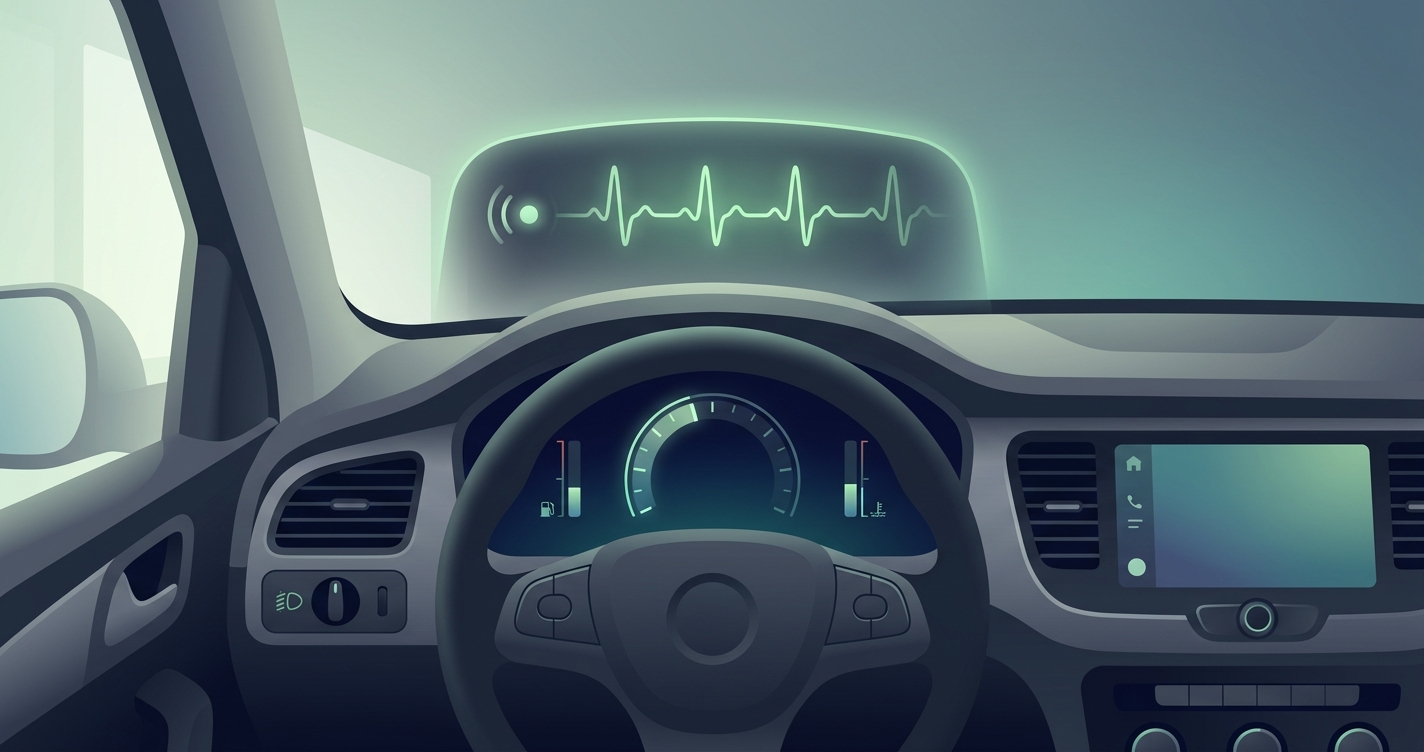
A driver rarely feels a medical emergency arriving. A cardiac arrhythmia, a hypoglycemic slide, or the early minutes of a stroke often unfold in the body well before conscious awareness catches up. For automotive OEMs and Tier-1 suppliers, this gap between physiological change and felt symptom is the most interesting frontier in cabin safety. Automotive health monitoring reframes the vehicle as a continuous, non-invasive observation point that can notice what the driver cannot, and potentially intervene during the seconds that matter. The question is no longer whether the cabin can read vital signs, but how reliably it can separate a genuine emergent condition from the ordinary noise of driving.
"The global automotive active health monitoring systems market was valued at roughly US$807 million in 2025, with in-vehicle sensors dominating the segment as OEMs move health sensing from concept reels into platform roadmaps.", Strategic Market Research, 2025
Why automotive health monitoring is shifting from reactive to predictive
Traditional driver monitoring systems were built to answer one narrow question: is the driver paying attention? The next generation widens that scope to a second question that is harder and more valuable: is the driver physiologically safe? Automotive health monitoring sits at this junction, using cameras, radar, and contact electrodes to track heart rate, heart rate variability, respiration, and blood oxygenation without asking the driver to wear or touch anything.
The predictive premise rests on a well-documented clinical reality. Many acute events announce themselves through measurable changes in vital signs before the person reports feeling unwell. Resting heart rate creeps up, heart rate variability collapses, breathing becomes shallow or irregular, or skin perfusion shifts. A system sampling these signals continuously across a commute has a chance to flag the trend long before the driver would think to pull over.
Soha G. Ahmed and colleagues at United Arab Emirates University, together with Katrien Verbert at KU Leuven, published a comprehensive systematic review of AI innovations in remote photoplethysmography (rPPG) for driver monitoring in 2024, with a literature search running through April of that year. Their work catalogues how camera-based pulse extraction has matured from lab demonstrations toward in-cabin viability, while also documenting the open problems that still keep most systems short of clinical-grade reliability.
How the sensing approaches compare
No single sensor solves automotive health monitoring on its own. Each modality trades coverage, comfort, and robustness differently, which is why sensor fusion has become the default design assumption for serious programs.
| Sensing modality | Vital signs captured | Driver contact required | Strengths | Key limitations |
|---|---|---|---|---|
| Camera-based rPPG | Heart rate, HRV, respiration, SpO2 estimate | None | Reuses existing DMS camera, fully passive | Sensitive to motion, lighting, skin tone variation |
| Near-infrared / ToF camera | Heart rate, respiration | None | Works in low light and at night | Higher hardware cost, narrower field |
| Radar (mmWave) | Heart rate, respiration | None | Robust to lighting, sees through clothing | Coarser signal, occupant separation is hard |
| Contact electrodes (steering, seat) | ECG, heart rate | Yes (grip or seated contact) | Cleaner cardiac signal, arrhythmia detection | Intermittent contact, grip-dependent |
| Wearable integration | Heart rate, HRV, SpO2 | Yes (driver-owned device) | Continuous off-vehicle data | Relies on driver adoption and pairing |
The practical takeaway for design teams is that camera-based rPPG offers the lowest friction because it can run on hardware many cabins already carry for drowsiness detection, while contact electrodes still provide the cleanest cardiac trace when grip conditions allow. Most credible architectures blend at least two of these to cross-validate a signal before raising an alert.
Key design considerations that recur across programs:
- Signal quality assessment must run before any health inference, since a noisy rPPG trace is worse than no trace at all.
- Occupant separation matters in shared cabins, so the system must attribute every reading to the correct person.
- Baseline personalization improves specificity, because what counts as abnormal depends on the individual driver's normal range.
- Edge processing protects privacy and latency, keeping raw biometric video inside the vehicle.
- Graceful degradation is essential, so the system communicates uncertainty rather than guessing.
Industry applications across the vehicle ecosystem
Passenger vehicle OEMs
For OEMs, automotive health monitoring is becoming a differentiator tied to safety ratings and brand trust. A vehicle that can detect a probable cardiac event and trigger a controlled stop, hazard signaling, and an emergency call adds a safety layer that complements ADAS rather than competing with it. The same inward-facing camera already used for attention monitoring becomes a dual-purpose health sensor, which improves the cost case for integration.
Commercial and long-haul fleets
Fleet operators carry direct financial and duty-of-care exposure when a driver suffers a medical emergency at speed. Continuous vital sign trends across a shift can surface fatigue, acute illness, or cardiovascular strain earlier than a self-report ever would. For fleets, the value is less about a single dramatic rescue and more about pattern detection across thousands of driver-hours.
Tier-1 suppliers and platform integrators
Tier-1 suppliers are positioned to package sensing, signal processing, and alerting into modules that drop into multiple OEM platforms. The integration challenge is standardization: aligning health monitoring outputs with existing DMS, ADAS, and telematics stacks so an alert can actually trigger a vehicle response. Suppliers such as Bosch and Continental have signaled active work on sensor fusion and AI-driven health algorithms, indicating the supply base is treating this as a near-term product category rather than research.
Current research and evidence
The research base is moving quickly but remains honest about its limits. The 2024 systematic review by Ahmed, Verbert, and collaborators found that rPPG heart rate estimation has reached promising accuracy in controlled conditions, while real driving introduces motion artifacts, variable illumination, and vibration that still degrade performance. The same review highlighted work by Nowara and colleagues on reliable heart rate estimates from near-infrared video, an important step because night driving and tunnels defeat ordinary RGB cameras.
A separate MDPI study described a contactless vital sign monitoring system for in-vehicle use built on a near-infrared time-of-flight camera, demonstrating that depth-aware sensing can stabilize respiration and pulse extraction under cabin conditions. Machine learning approaches to rPPG signal quality assessment, reported on ResearchGate, address a quieter but critical problem: knowing when to trust a reading. Feasibility research presented through SciTePress on driver monitoring for sudden cardiac illness detection points to the central engineering tension the field still faces, namely achieving high detection accuracy despite individual physiological variation and environmental disturbance.
The market data frames the urgency. Beyond the 2025 valuation cited above, the broader vehicle health monitoring market was estimated at around US$27 billion in 2024 with a projected compound annual growth rate near 7.6 percent through 2034, and analysts have forecast the active health monitoring segment reaching several billion dollars by 2030. Capital is following the capability.
The future of automotive health monitoring
The trajectory points toward layered systems that treat health as a continuous state estimate rather than a single threshold alarm. Three shifts look likely.
- Sensor fusion becomes standard, with camera, radar, and contact signals combined so no single failure mode triggers a false alert or misses a real event.
- Personalized baselines replace population averages, since predictive value depends on knowing each driver's normal rhythm, respiration, and variability.
- Graded vehicle responses emerge, ranging from a gentle prompt to pull over, through escalating alerts, up to automated minimal-risk maneuvers when a driver becomes unresponsive.
The hardest remaining work is not detection in isolation but trustworthy detection at fleet scale, across skin tones, ages, lighting, and road conditions, with privacy preserved through on-device processing. The teams that solve specificity, keeping false alarms rare enough that drivers and regulators trust the system, will define the category.
Frequently asked questions
Can a car really detect a health issue before the driver feels it?
In principle, yes, because many acute events change measurable vital signs before they produce conscious symptoms. Continuous monitoring of heart rate, variability, respiration, and perfusion can flag abnormal trends earlier than self-perception. The practical constraint is reliability under real driving conditions, which current research is still improving.
Does automotive health monitoring require the driver to wear anything?
Not necessarily. Camera-based rPPG and radar are fully contactless and can reuse cabin hardware already present for driver monitoring. Contact electrodes in the steering wheel or seat add a cleaner cardiac signal but depend on consistent driver contact, and many systems blend contactless and contact methods.
What is the biggest technical barrier for OEMs adopting this?
Specificity under noise. Motion, vibration, lighting changes, and individual physiological variation make it hard to separate a true emergent condition from ordinary fluctuation. Reducing false alarms while preserving sensitivity is the central engineering challenge, which is why signal quality assessment and personalized baselines are active research priorities.
How does health monitoring relate to existing driver monitoring systems?
It extends them. Existing systems answer whether the driver is attentive, while health monitoring adds whether the driver is physiologically safe, often using the same camera. The two run as complementary layers feeding a shared alerting and vehicle-response stack.
For OEMs, Tier-1 suppliers, and fleet operators evaluating where cabin sensing goes next, automotive health monitoring is moving from feasibility study to platform roadmap. Circadify is actively addressing this space, building camera-based in-cabin vital sign capabilities for next-generation safety integration. Teams exploring a program can start a conversation at circadify.com/custom-builds/automotive-cabin.