How Carmakers Add Driver Vital Sign Monitoring to New Models
How automakers integrate camera-based automotive driver vital sign monitoring into vehicle design, safety architecture, and OEM program timelines.
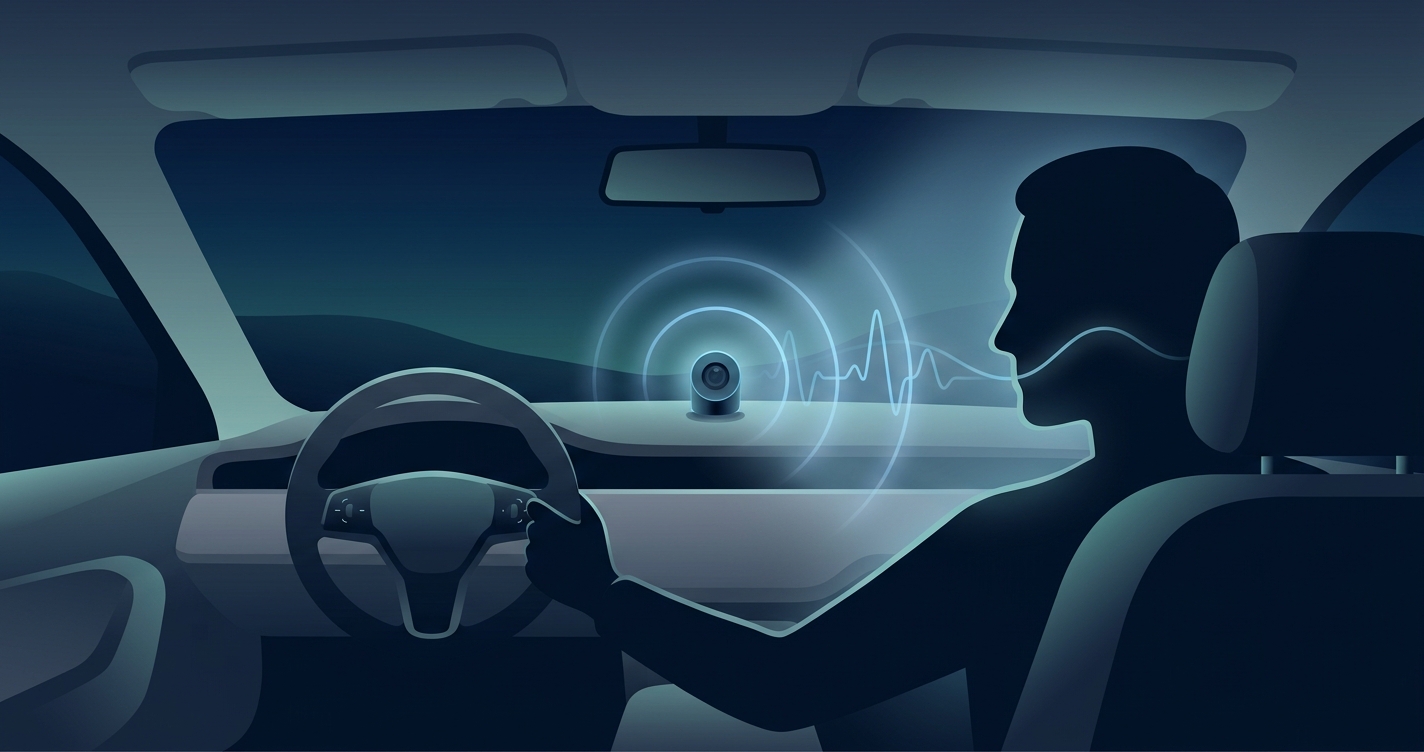
The inward-facing camera that started life watching a driver's eyelids is quietly becoming a physiological sensor. As regulators in Europe push driver attention monitoring from option to requirement, automakers are discovering that the same hardware already specified for distraction detection can also read heart rate, breathing, and signs of acute stress. That overlap is reshaping how engineering teams plan new vehicle programs, and automotive driver vital sign monitoring is moving from research curiosity to a line item in cabin architecture reviews. For OEMs and Tier-1 suppliers, the question is no longer whether the camera can see physiology, but how to fold that capability into a platform without adding cost, weight, or a separate certification headache.
Driver Monitoring Systems are being made mandatory across roughly 18 million European cars as the EU General Safety Regulation takes full effect, with Advanced Driver Distraction Warning required for all new vehicle registrations by July 7, 2026., Smart Eye, 2025
What automotive driver vital sign monitoring actually adds
A conventional driver monitoring system (DMS) tracks gaze direction, head pose, and eyelid closure to infer distraction and drowsiness. Automotive driver vital sign monitoring extends that pipeline by extracting physiological signals from the same video stream. The dominant method is remote photoplethysmography (rPPG), which detects the tiny color changes in facial skin caused by blood flow with each heartbeat. From that waveform, software can estimate heart rate, heart rate variability, and respiration rate without any contact or wearable.
The appeal for an OEM is architectural. The expensive parts, the near-infrared camera, the lens, the in-cabin compute, and the wiring harness, are already being added to meet regulation. Vital sign extraction is largely a software layer running on the same image data. A 2024 systematic review by researchers publishing in the IEEE and ResearchGate community on AI innovations in rPPG for driver monitoring noted that automotive-grade in-cabin cameras now provide a hardware foundation that reduces integration cost and accelerates market entry for software suppliers. In other words, the marginal cost of physiology is mostly engineering effort, not bill of materials.
What that buys a vehicle program:
- A richer drowsiness signal that does not depend solely on eyes, useful when sunglasses or head-down posture defeat gaze tracking.
- Early stress and cognitive load estimation that can modulate how aggressively other systems intervene.
- A pathway toward acute medical event detection, where a sudden cardiac or respiratory anomaly could trigger a safe-stop or emergency call.
- Continuity of monitoring during the handoff between manual and assisted driving modes.
Integration paths: where the sensing lives
Carmakers generally choose one of three integration models, and the choice shapes cost, validation effort, and how much physiological capability the platform can carry.
| Integration Approach | Where Vitals Run | OEM Cost Profile | Validation Burden | Best Fit |
|---|---|---|---|---|
| Shared DMS camera, edge software | On existing DMS ECU or SoC | Lowest, reuses mandated hardware | Moderate, added software validation | Mass-market models meeting GSR/NCAP |
| Dedicated in-cabin sensing module | Separate camera plus compute | Higher, new part numbers | Higher, new hardware homologation | Premium models, wellness positioning |
| Domain controller / central compute | Centralized vehicle computer | Variable, depends on platform | Complex, software partitioning | New EV and software-defined platforms |
The shared-camera path is where most volume programs are heading, because it leans on hardware the regulation already forces into the cabin. The dedicated module appeals to premium brands that want headroom for advanced features such as multi-occupant sensing or higher-fidelity respiration tracking. The domain-controller route fits software-defined vehicles where in-cabin sensing becomes one workload among many on a central compute platform, updatable over the air.
Across all three, several engineering constraints recur:
- Camera placement. The lens must hold a clear view of facial skin across driver heights, seating positions, and steering wheel occlusion. Steering-column and rearview-mirror mounts dominate.
- Lighting. Near-infrared illumination keeps gaze tracking alive at night, but rPPG benefits from stable skin-region exposure, so illumination design and auto-exposure tuning matter.
- Compute budget. Physiology algorithms share silicon with distraction detection, so latency and thermal headroom must be allocated early in the program.
- Privacy by design. EU rules require that camera data is processed in-vehicle and not recorded or transmitted, which pushes vital sign computation to the edge.
Industry Applications
Passenger vehicle OEM programs
For mass-market automakers, the immediate driver of in-cabin sensing in new cars is compliance. The EU General Safety Regulation mandates Advanced Driver Distraction Warning, and Euro NCAP's 2026 protocols increase the scoring weight for direct driver monitoring, rewarding systems that detect distraction, drowsiness, and impairment. Because vital signs sharpen drowsiness and impairment estimates, physiological sensing becomes a way to chase NCAP points using hardware already on the car. OEM driver monitoring integration teams increasingly treat rPPG as an enhancement module layered onto the compliance baseline rather than a standalone feature.
Tier-1 supplier platforms
Tier-1 suppliers are packaging vital sign extraction into the DMS software stacks they already sell. Their value proposition to automakers is a single validated module that covers gaze, drowsiness, and physiology, reducing the number of suppliers an OEM must coordinate. The competitive pressure is real: a supplier whose automotive health camera stack can also output heart rate and respiration offers more feature density per silicon dollar.
Commercial fleets and heavy vehicles
Fleet and heavy-vehicle operators have the clearest safety case. Long shifts, irregular schedules, and night driving make fatigue and acute health events disproportionately costly. Physiological monitoring layered onto a fleet DMS gives safety managers a continuous record that goes beyond eye closure, supporting earlier intervention and post-event analysis.
Current research and evidence
The technical question every OEM raises is whether rPPG holds up in a moving car, where vibration, changing light, and head motion all corrupt the signal. The research trend is toward motion-robust methods. A study on a motion-robust remote-PPG approach to driver health state monitoring focused specifically on extracting stable heart rate under driving motion, while a real-world heart rate monitoring framework indexed in PubMed evaluated rPPG on actual drivers rather than lab volunteers. The recurring conclusion is that deep learning signal extraction has narrowed the gap between controlled and on-road conditions, though accuracy still degrades with extreme motion and is sensitive to skin-tone diversity in training data.
That last point is a known limitation. The 2024 AI rPPG review flagged the lack of diverse population representation in datasets as a barrier to consistent performance across drivers. For OEMs, this translates into a validation requirement: data collection campaigns must span demographics, lighting, and vehicle conditions before a feature is production-ready. Researchers have also reported that rPPG-derived heart rate variability can surface pre-symptomatic cardiovascular stress states, which is what makes the safety-system tie-in compelling, though such claims demand careful, conservative deployment.
The future of automotive driver vital sign monitoring
Three trajectories look likely. First, consolidation onto shared hardware will continue, with physiology riding the regulatory wave that puts cameras in nearly every new European car. Second, the feature will migrate from passive logging toward active safety, where a validated physiological anomaly can inform minimal-risk maneuvers and automatic emergency calls. Third, software-defined vehicle architectures will let automakers ship a baseline at launch and improve algorithms over the air, decoupling sensing capability from the production date of the car.
The constraints that decide the pace are not exotic. They are dataset breadth, motion robustness, privacy-preserving edge compute, and the discipline to make conservative claims. The automakers that win will be those that plan camera placement, illumination, and compute headroom for physiology at the start of a program rather than retrofitting it after the DMS spec is frozen.
Frequently asked questions
Does adding vital sign monitoring require a new camera? Usually not. The near-infrared DMS camera mandated for distraction warning can supply the video that rPPG algorithms use. In most volume programs vital sign monitoring is a software layer on existing hardware, though premium models sometimes add a dedicated module for higher fidelity.
How accurate is camera-based heart rate detection in a moving vehicle? Recent motion-robust rPPG methods perform well for resting and moderate-motion conditions, with accuracy degrading under heavy vibration or large head movement. On-road studies show meaningful progress, but production deployment depends on validation across diverse drivers and lighting, and on conservative thresholds for any safety action.
Where in the vehicle program should OEMs plan for this? Early. Camera placement, illumination design, and compute budget all affect physiological signal quality, and they are hard to change once the DMS architecture is locked. Treating vitals as a day-one requirement avoids costly retrofits.
Does in-cabin vital sign monitoring create privacy problems? EU rules require that camera data is processed inside the vehicle and not recorded or transmitted externally. Edge computation of vital signs keeps raw imagery in the car and aligns the feature with privacy-by-design expectations.
For OEM and Tier-1 teams scoping how physiological sensing fits an upcoming platform, Circadify is building camera-based driver fatigue, drowsiness, and stress detection designed to ride the in-cabin hardware automakers are already specifying. To discuss integration into a specific program, reach Circadify's automotive integration team at circadify.com/custom-builds/automotive-cabin.