
What Is ADAS + DMS Integration? How They Work Together
A research-based look at ADAS DMS integration how work together, and why OEMs now connect road-scene sensing with driver-state monitoring for safer assisted driving.
What Is ADAS + DMS Integration? How They Work Together
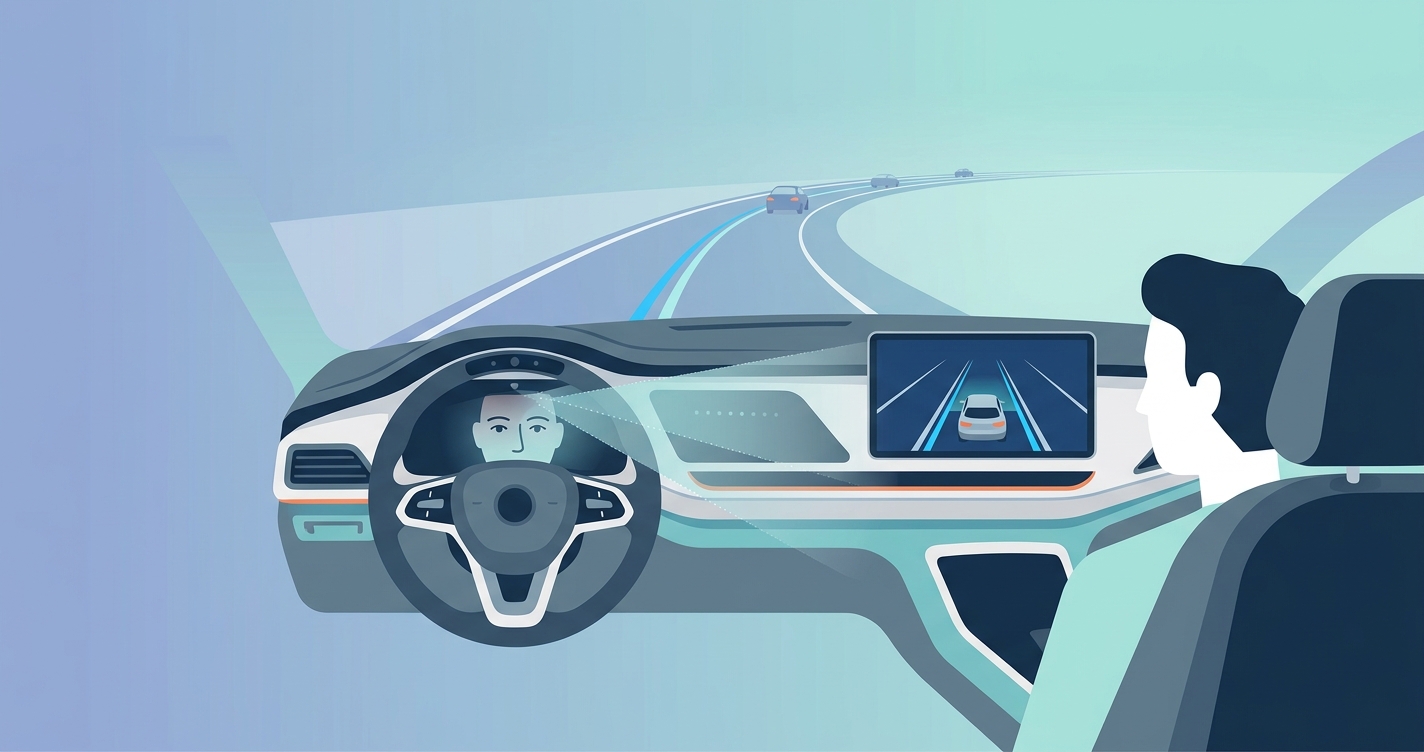
For OEMs and Tier-1 teams, ADAS DMS integration how work together is no longer a side question for premium trims. It sits right in the middle of assisted-driving architecture. ADAS watches the road, lanes, vehicles, and collision risk. DMS watches the human who is supposed to stay engaged when the vehicle is doing part of the driving task. Put together, they answer a harder safety question than either system can answer alone: not just "is there a hazard?" but also "is the driver ready to respond to it?"
"To achieve a 5-star rating, vehicles will need advanced Driver State Monitoring systems that continuously track eye and head movements to detect distraction, impairment, and unresponsiveness." — European Transport Safety Council summary of Euro NCAP's 2026 protocol update
ADAS + DMS integration starts with two different safety jobs
It helps to separate the roles before talking about integration. ADAS is outward-facing. It uses sensors and software to estimate what is happening around the car and when intervention may be needed. DMS is inward-facing. It estimates whether the driver is attentive, drowsy, distracted, or unavailable for a takeover.
Muhammad Qasim Khan and Sukhan Lee of Sungkyunkwan University wrote in their 2019 Sensors survey that driving monitoring and assistance systems work best when driver state, vehicle state, and environmental context are treated as connected parts of one decision loop. That point has aged well. In a Level 2 environment, the car may maintain lane position and speed, but the system still depends on a human fallback. If the external stack sees a problem and the cabin stack sees an inattentive driver, the response logic has to change.
That is the real value of integration.
- ADAS detects what is happening outside the vehicle.
- DMS estimates whether the driver can supervise or retake control.
- The fusion layer decides how aggressively to warn, slow, or escalate.
- HMI logic turns that decision into alerts the driver can actually understand.
Without integration, the car may know there is a hazard but not whether the person behind the wheel is ready. Or it may know the driver is looking away without knowing whether the road scene has become critical.
Where the two systems meet
| System layer | ADAS contribution | DMS contribution | Why integration matters |
|---|---|---|---|
| Perception | Lane, object, speed, path, collision risk | Eye gaze, head pose, eyelid closure, attention state | Combines roadway risk with driver readiness |
| Decision logic | Determines intervention need | Determines alert urgency and takeover confidence | Changes warning strategy in real time |
| HMI | Visual, audio, haptic alerts | Attention verification and acknowledgement checks | Helps prevent missed warnings |
| Safety fallback | Braking, lane support, risk mitigation | Confirms engagement or unresponsiveness | Supports safer handoff or minimum-risk response |
| Validation | Proves scene-detection performance | Proves attentiveness detection performance | Needed for NCAP scoring and assisted-driving assurance |
Why ADAS + DMS integration matters more in assisted driving than in basic safety features
A basic forward-collision warning system can operate reasonably well without deep knowledge of the driver's state. Assisted driving is different. Once the car takes on more longitudinal and lateral control, the old assumption breaks down. The human is still responsible, but may not be continuously engaged in the same way as in manual driving.
That is why takeover quality has become such a big research topic. Dongyeon Yu, Chanho Park, Hoseung Choi, Donggyu Kim, and Sung-Ho Hwang reported in a 2021 Applied Sciences study that driver monitoring systems can reduce takeover risk by helping prevent drivers from becoming fully immersed in non-driving tasks before a system failure or handoff event. Their team also found that combined visual, auditory, and haptic alerts worked better than relying on a single warning channel.
You can see the design logic pretty clearly:
- If ADAS confidence drops, the system may need an earlier warning.
- If DMS sees gaze off-road, the warning may need to become stronger and multimodal.
- If the driver stays unresponsive, fallback behavior may need to shift toward a minimum-risk maneuver instead of a simple handoff.
In other words, ADAS and DMS are not just two features in the same vehicle. In a mature architecture, one changes how the other behaves.
Industry applications for ADAS + DMS integration
Passenger vehicles with Level 2 assisted driving
This is the most obvious application. Passenger cars with lane centering, adaptive cruise, and traffic-jam assistance need a way to confirm that the driver is still supervising. DMS fills that gap. ADAS can manage routine control for stretches of a trip, but DMS checks whether the driver is still mentally in the loop.
The National Highway Traffic Safety Administration has moved in the same direction. In its 2026 NCAP update, NHTSA finalized new 5-Star Safety Ratings criteria that add more advanced crash-avoidance technologies and strengthen the broader case for systems that help drivers stay within safe operating limits. It is not a direct DMS mandate for every scenario, but it reflects the same policy reality: automation support without driver oversight is not a stable safety strategy.
Fleets and commercial vehicles
Commercial programs care about a different mix of outcomes. They usually want fewer fatigue events, fewer severe incidents, and cleaner operational data. In that setting, ADAS and DMS integration can connect external events like hard braking, lane departures, or close following with inside-the-cab evidence of distraction or drowsiness.
That matters because a fleet manager does not just want to know that automatic emergency braking triggered. They want to know whether the trigger happened during a genuine road surprise or during a moment when the driver had already checked out.
Future in-cabin health monitoring stacks
The next step is broader cabin sensing. Some programs are moving beyond gaze and eyelid closure toward heart-rate, respiratory, or stress-related context when the hardware supports it. A 2024 agent-search result summarizing work cited by NHTSA and Battelle notes that current DMS development is starting to overlap with impaired-driving detection and Level 2 automation assessment. That overlap is exactly why cabin monitoring is expanding. Once a camera is already installed for attention tracking, teams start asking whether it can support a richer view of driver condition.
Current research and evidence
The evidence base behind integrated ADAS and DMS is stronger than a lot of product marketing makes it sound.
Khan and Lee's 2019 survey in Sensors framed the field as a connected monitoring-and-assistance problem rather than a collection of isolated features. That matters because many real production tradeoffs happen at the boundary between perception, warning design, and driver behavior.
Yu and colleagues' 2021 takeover-safety paper pushed the same point from a different angle. Their simulator work showed that DMS is not just useful for scoring distraction after the fact. It can actively reduce risk in automated-driving failure scenarios by informing how and when the vehicle calls the driver back into the loop.
Euro NCAP's Occupant Status Monitoring protocol then translated that research pressure into market pressure. From 2023 onward, driver status monitoring became necessary for a full score in that part of the safety-assist protocol, and the 2026 updates go further by putting more weight on distraction, impairment, and unresponsiveness detection. That is a strong signal to OEM programs: the industry no longer treats driver monitoring as optional polish.
The U.S. regulatory picture is not identical, but it is moving. NHTSA's 2026 NCAP update adds pedestrian automatic emergency braking, lane-keeping assist, blind-spot warning, and blind-spot intervention to the rating program. Even when DMS is not the named headline, the structure of modern safety ratings keeps rewarding systems that work as coordinated stacks rather than isolated modules.
Selected sources shaping ADAS + DMS architecture
| Source | Institution | Practical takeaway |
|---|---|---|
| Khan and Lee (2019) | Sungkyunkwan University / Sensors | Driver, vehicle, and environment should be treated as one monitoring loop |
| Yu, Park, Choi, Kim, and Hwang (2021) | Applied Sciences | DMS-informed multimodal takeover alerts improve handoff safety |
| Euro NCAP Occupant Status Monitoring protocol | Euro NCAP | Driver status monitoring is now tied to safety scoring, not just feature design |
| NHTSA 5-Star update (2026 model year roadmap) | U.S. DOT / NHTSA | Safety programs are moving toward more integrated crash-avoidance architectures |
The future of ADAS + DMS integration
The next phase will probably be less about adding another warning icon and more about confidence management across the whole stack. Vehicles will need to know when the road scene is ambiguous, when the driver's attention is drifting, and when those two things happen at the same time.
That sounds obvious, but it changes design priorities.
- Validation shifts from component tests to system behavior under mixed-risk conditions.
- HMI teams have to tune alerts around both urgency and driver state.
- Cabin sensing becomes more important as assisted-driving features expand.
- Sensor fusion starts to include not just road inputs, but human readiness signals.
I think this is where a lot of current discussion gets simplified too much. People talk as if ADAS and DMS are two checkboxes. In practice, they are becoming one safety conversation. The whole point is to stop treating the driver as a black box at the exact moment when the vehicle is asking that driver to supervise automation.
Frequently Asked Questions
What is ADAS + DMS integration?
It is the combination of outward-facing advanced driver-assistance sensing with inward-facing driver monitoring. ADAS watches the road and the vehicle path. DMS watches attention, drowsiness, distraction, and readiness to take control.
Why do ADAS and DMS need to work together?
Because assisted driving creates situations where road risk and driver readiness have to be judged at the same time. A warning that works for an attentive driver may be too weak for a distracted one.
Is DMS only for fatigue detection?
No. Fatigue is one major use case, but current systems also focus on distraction, gaze behavior, unresponsiveness, and in some programs broader impairment-related indicators.
Does Euro NCAP affect ADAS + DMS integration decisions?
Yes. Euro NCAP's protocols increase the value of direct driver monitoring for top safety scores, which pushes OEMs to connect cabin monitoring with assisted-driving behavior earlier in platform design.
For teams exploring integrated cabin-sensing architectures, solutions like Circadify are being developed for custom automotive programs that connect in-cabin vital signs with broader driver-state monitoring workflows. For more on that direction, see Circadify's automotive cabin page, plus related Quick Scan Vitals analysis on driver monitoring system regulations and camera-based driver monitoring.