7 Warning Signs of Driver Fatigue a Camera Catches First
The 7 signs of driver fatigue a camera detects before a driver feels sleepy, from blink rate to micro-yawns and head drift, explained for fleet safety teams.
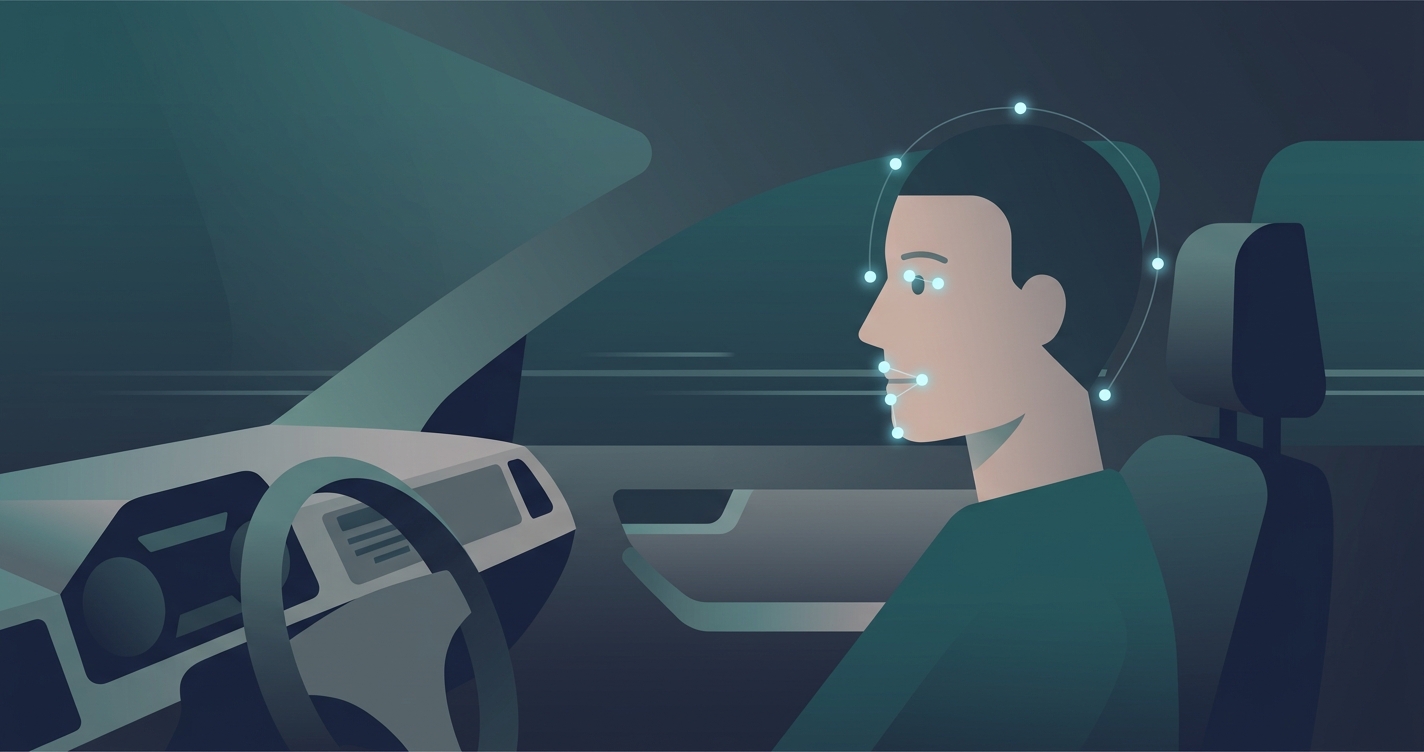
By the time a driver consciously registers that they are tired, the body has already been broadcasting the message for several minutes. This lag between physiological onset and subjective awareness is the central problem in drowsy driving, and it is exactly the gap a camera is built to close. The most reliable signs of driver fatigue are not the heavy eyelids a driver eventually feels, but the small, measurable shifts in blinking, gaze, posture, and facial movement that begin well before that point. A driver monitoring camera samples these cues many times per second, which means it can flag the slide into impairment while the driver still believes they are alert.
"Fatigue-induced driving contributes to roughly 20% of all annual traffic accidents, and PERCLOS, the percentage of time the eyes are more than 80% closed, remains one of the most validated passive indicators of that decline.", Driver drowsiness detection literature review, 2023
Why the earliest signs of driver fatigue show up on camera first
Self-report is a poor fatigue sensor. Drivers routinely underestimate their own impairment, and stimulants like coffee mask the feeling of sleepiness without restoring vigilance. A driver fatigue detection camera does not rely on how a driver feels. It tracks objective ocular and facial metrics that change in a predictable sequence as alertness drops.
Researchers have repeatedly shown that eyelid behavior degrades earlier and more consistently than steering or lane-keeping inputs. A normal blink lasts roughly 0.1 to 0.4 seconds. As fatigue builds, blinks lengthen, blink frequency rises, and eye closures begin to cluster. One frequently cited PERCLOS guideline treats a 10% threshold as a critical point for detecting one-second microsleeps in real driving conditions. These are changes a human passenger would rarely notice but a frame-by-frame vision system captures with ease.
The seven cues below are ordered roughly by how early they tend to appear. Most cameras combine several of them rather than relying on any single signal, because fusion improves reliability across lighting, head angle, and individual variation.
The seven early cues
- Increased blink duration and frequency. The single most studied of the early fatigue warning signs. Blinks grow longer and more frequent before a driver feels drowsy.
- Rising PERCLOS. Sustained partial eyelid closure across a rolling time window, the workhorse metric of camera-based fatigue scoring.
- Micro-yawns and full yawns. Yawning frequency increases with sleep pressure, and mouth-aspect-ratio tracking flags it without audio.
- Slowed saccades and fixed gaze. Eye movements become sluggish and the driver stares straight ahead, scanning mirrors and instruments less often.
- Head nodding and postural drift. Small forward nods and slow lateral lean appear as neck muscle tone fades.
- Reduced facial expressiveness. The face flattens and slackens as cognitive engagement drops.
- Microsleeps. Brief two-to-several-second lapses where the eyes close and gaze disengages entirely, the last and most dangerous cue.
How these cues compare as fatigue indicators
Not every sign carries equal weight. Some appear early but are noisy, others are unambiguous but arrive late. The table below summarizes how a camera-based system tends to treat each cue.
| Warning sign | How early it appears | Camera method | Reliability as a standalone cue |
|---|---|---|---|
| Blink duration and frequency | Very early | Eye landmark tracking, eye aspect ratio | Moderate to high |
| PERCLOS (eyelid closure %) | Early | Rolling eyelid-closure window | High |
| Yawning and micro-yawns | Early to mid | Mouth aspect ratio, facial landmarks | Moderate |
| Slowed saccades / fixed gaze | Early to mid | Gaze vector and scan-pattern analysis | Moderate |
| Head nodding / postural drift | Mid | Head-pose estimation (pitch, roll, yaw) | Moderate to high |
| Reduced facial expressiveness | Mid | Expression and micro-movement analysis | Low to moderate |
| Microsleeps | Late | Combined eye closure + gaze disengagement | Very high |
The pattern is consistent across the literature: the earliest cues are the least definitive on their own, which is why modern systems fuse them. A study examining blinking and yawning rates together reported current detection at 92%, while a separate algorithm using eye-blink and yawning analysis reported a detection rate of 85.7%. Systems combining eye closure with head posture have been documented around the 80% mark. The takeaway is that combining cues consistently outperforms any single tired-driver symptom read in isolation.
Industry Applications
Fleet and commercial vehicles
For fleet operators, the value of catching early signs of driver fatigue is operational, not just clinical. Long-haul and shift-based driving produces predictable fatigue windows, and a camera that scores PERCLOS and yawning continuously gives safety managers a data stream tied to specific routes, hours, and individuals. That supports coaching, dispatch decisions, and break scheduling rather than after-the-fact incident review. Naturalistic driving studies of commercial motor vehicles have used exactly these ocular and head-pose measures to quantify distraction and drowsiness at scale.
Automotive oems and tier-1 suppliers
For OEMs and Tier-1 suppliers, fatigue cues are increasingly a regulatory and design requirement. The inward-facing camera that began as an attention monitor is being asked to deliver graded drowsiness warnings. The engineering challenge is sustaining cue detection across night driving, sunglasses, varied seating positions, and a wide range of face shapes, which is why cue fusion and robust head-pose estimation have become differentiators on the spec sheet.
Insurance and risk analytics
Telematics and insurance teams treat aggregated fatigue cues as a behavioral risk signal. A rising PERCLOS trend across a driver population is a leading indicator that can be priced and acted on, shifting risk modeling from crash history toward measurable physiological precursors.
Current research and evidence
The research base behind camera fatigue detection is mature for ocular metrics and still developing for cognitive fatigue. PERCLOS continues to be the most validated index, correlating strongly with sleep deprivation, restricted sleep, and nighttime hours, and it is frequently used as the ground-truth measure against which other methods are judged. Reviews from 2023 note an important caveat: PERCLOS alone can be insufficiently sensitive to moderate drowsiness, and definitions of the metric still vary between devices, which complicates direct cross-study comparison.
That limitation is driving the field toward multi-cue models. Recent work integrating lightweight object-detection networks with facial 3D keypoints combines eyelid, mouth, and head-pose signals in a single pipeline. Convolutional neural network approaches using eye and mouth regions of interest have reported very high performance on specific test datasets, though such figures reflect controlled conditions rather than guaranteed road behavior. The honest summary from the literature is that eyelid-based indicators are robust, behavioral fusion improves results, and cognitive or visual fatigue remains comparatively under-explored in computer vision.
The future of driver fatigue detection
The clear direction is from behavioral cues toward physiological measurement. Camera-based methods such as remote photoplethysmography (rPPG) can estimate heart rate and heart rate variability from subtle skin-color changes, adding an internal-state signal to the external cues of blink and yawn. Pairing physiology with eyelid and head-pose data promises earlier and more individualized fatigue scoring, because it begins to capture the autonomic shifts that precede visible drowsiness.
Three developments are likely to define the next several years:
- Standardization of PERCLOS and related metrics so results are comparable across vehicles and suppliers.
- Personalization, where the system learns an individual driver's baseline blink and gaze behavior rather than applying a population threshold.
- Sensor fusion that blends camera cues with vehicle dynamics and contactless vital signs for a graded, explainable fatigue score.
For teams building or buying these systems, the practical lesson is that no single warning sign is enough. The earliest signs of driver fatigue are real and detectable, but reliability comes from combining them and validating against the specific conditions a fleet actually drives in.
Frequently asked questions
What is the earliest sign of driver fatigue a camera can detect?
Changes in blinking are typically the earliest. Blinks lengthen and grow more frequent before a driver feels sleepy, and a camera tracking eye landmarks can quantify this through PERCLOS and blink-rate metrics well before subjective drowsiness sets in.
Can a camera detect fatigue if the driver has had coffee?
Yes. Caffeine can reduce the feeling of sleepiness without restoring vigilance, so a driver may feel alert while their eyelid and head-pose behavior still shows fatigue. Because a camera measures objective cues rather than how the driver feels, it can flag impairment that coffee masks.
How reliable is yawning as a fatigue signal?
Yawning frequency does increase with sleep pressure and is useful as an early-to-mid cue, but it is moderately reliable on its own. Studies pairing yawning with blink-rate analysis report meaningfully stronger detection than either signal alone, which is why cameras rarely depend on yawning by itself.
What is PERCLOS and why does it matter?
PERCLOS is the percentage of time the eyes are more than 80% closed over a rolling window. It is one of the most validated camera-based fatigue indicators, correlating strongly with sleep loss and microsleeps, and is often used as a benchmark for evaluating other detection methods.
Circadify is actively developing camera-based fatigue, drowsiness, and stress detection for in-cabin monitoring, combining ocular cues with contactless vital signs. Fleet and automotive teams evaluating these capabilities can review the approach through an automotive program inquiry.